
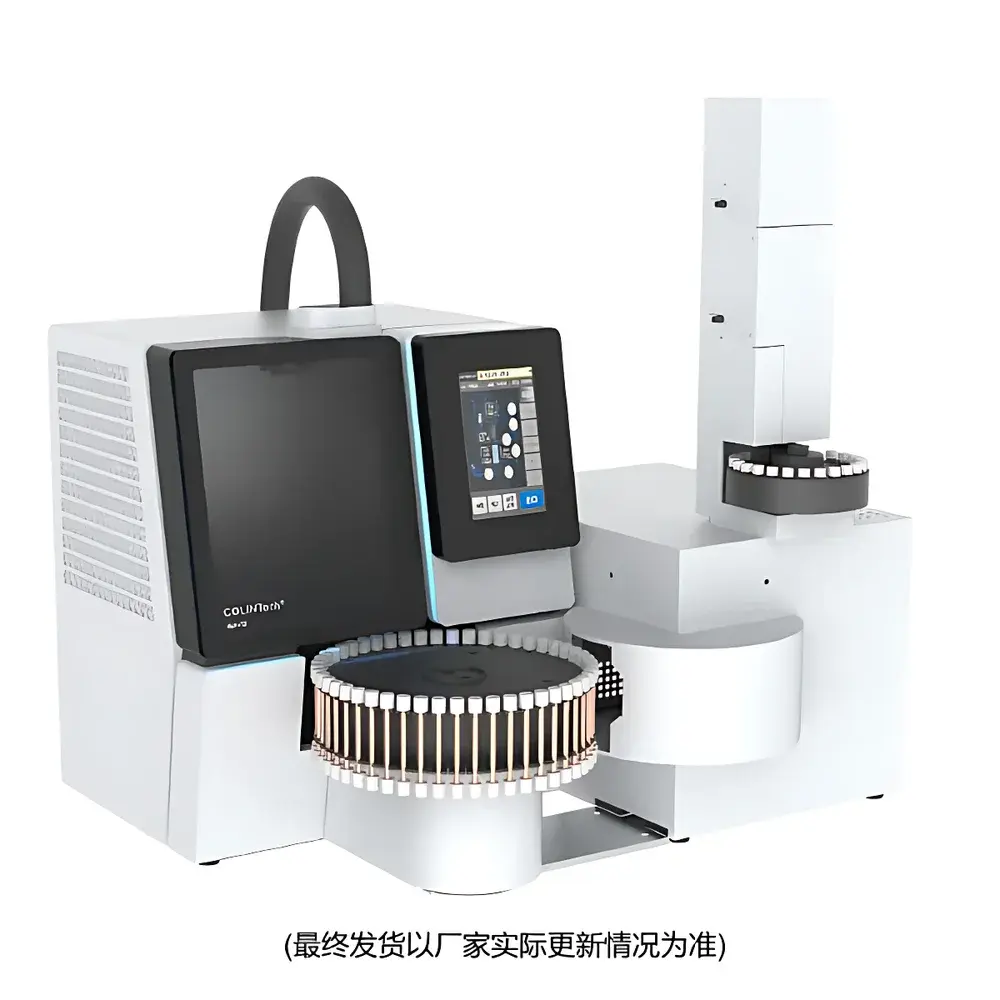
Colintech AutoS 50A Automated Thermal Desorption Standard Spiking Platform
| Brand | Colintech |
|---|---|
| Origin | Sichuan, China |
| Manufacturer Type | Direct Manufacturer |
| Model | AutoS 50A |
| Instrument Type | Dual-Stage Thermal Desorber / Thermal Desorption Unit |
| Automation Level | Fully Automatic |
| Primary Desorption Temp Range | 50–400 °C |
| Secondary Desorption (Cold Trap) Temp Range | −40 to 400 °C |
| Valve & Transfer Line Temp Range | 50–300 °C |
| Cold Trap Temp Control Accuracy | < ±0.1 °C |
| Spike Recovery Rate | 99.5% |
| Sample Tube Capacity | 50 positions |
| Liquid Standard Positions | 16 |
| Mass Flow Controller Range | 0–500 mL/min |
| Flow Control Accuracy | ≤ 0.1 mL/min |
| Max Operating Pressure | ≥ 1.0 MPa |
| Applicable Concentration Range | ppt to ppm |
| Liquid Heating Zone Temp Range | Ambient to 300 °C |
| Temp Stability | ≤ ±1.0 °C |
Overview
The Colintech AutoS 50A Automated Thermal Desorption Standard Spiking Platform is a precision-engineered, fully integrated sample preparation system designed for the reproducible and traceable preparation of calibrated thermal desorption tubes used in gas chromatography–mass spectrometry (GC–MS) and GC–flame ionization detection (GC–FID) workflows. It operates on the principle of controlled liquid or gaseous standard introduction into inert sorbent-packed sampling tubes—enabling quantitative spiking of volatile organic compounds (VOCs), semi-volatiles, and target analytes such as BTEX, aldehydes, and halogenated hydrocarbons. Unlike manual spiking methods, the AutoS 50A eliminates operator-induced variability by automating syringe handling, bubble elimination, needle washing, vapor-phase equilibration, and timed purge cycles—ensuring metrological traceability across calibration series. Its architecture supports both single-point and multi-point calibration curve generation in compliance with environmental and indoor air quality standards including HJ 644–2013, HJ 734–2014, HJ 583–2010, GB 50325–2020, and GB/T 18883–2022.
Key Features
- Fully automated spiking of 50 thermal desorption tubes per run—compatible with industry-standard 6 mm OD × 89 mm length stainless steel or glass tubes;
- Dual-mode standard delivery: programmable liquid-phase injection (via heated syringe pump and vaporization chamber) and gas-phase spiking (via high-accuracy mass flow controller with vacuum-assisted pressure stabilization);
- Integrated temperature-controlled zones: valve manifold (50–300 °C), transfer lines (50–300 °C), cold trap (−40 to 400 °C), and liquid heating module (ambient to 300 °C), all maintained at ≤ ±1.0 °C stability;
- Onboard 16-position liquid standard carousel with automatic needle wash, air purge, and bubble detection prior to aspiration;
- Mass flow control with dynamic range 0–500 mL/min and resolution ≤ 0.1 mL/min—calibrated per ISO 6145–2 and traceable to NIST-certified gases;
- Optional internal standard co-spiking capability—applied simultaneously to both calibration and unknown sample tubes within the same sequence to ensure consistent response factor normalization;
- Modular integration design: shares the same sample tube carousel with compatible thermal desorbers (e.g., Colintech TD series), eliminating inter-system tube handling and reducing carryover risk;
- Embedded tube-handling robot with positional repeatability < ±0.2 mm, enabling precise alignment with spiking nozzles and minimizing cross-contamination.
Sample Compatibility & Compliance
The AutoS 50A accommodates a broad spectrum of sorbent media—including Tenax TA, Carbopack B/C, Carboxen, and multibed configurations—as specified in EPA TO-17 and ISO 16017–1. It supports spiking of aqueous and organic solvent-based standards (e.g., methanol, CS2, acetone), as well as certified gas mixtures (N2– or He-diluted VOC blends). All thermal zones are validated per ASTM E29–23 for instrument calibration verification. The system meets GLP documentation requirements through audit-trail-enabled operation logs, including timestamped spiking parameters (volume, flow rate, temperature setpoints, dwell times), user ID, and tube barcode association. While not FDA 21 CFR Part 11–certified out-of-the-box, its data export structure (CSV/Excel-compatible) supports integration into validated LIMS environments requiring electronic signature and change control.
Software & Data Management
Controlled via Colintech’s TD-Studio v3.x software suite, the platform provides sequence-based method programming with nested loops, conditional branching, and real-time monitoring of temperature profiles, flow rates, and actuator status. Each spiking event generates a metadata-rich .tds file containing raw sensor readings, error flags (e.g., pressure deviation >5%, syringe stall detection), and QC metrics (e.g., calculated spike mass vs. theoretical). Data export complies with ASTM E1461–22 for analytical instrument data interchange. Audit trails are stored locally with SHA-256 hashing; optional network backup to secure NAS or cloud repositories is supported via TLS 1.2–encrypted SMB protocol.
Applications
- Preparation of certified reference material (CRM) tubes for laboratory accreditation (ISO/IEC 17025) and proficiency testing;
- Multi-level calibration curve generation for ambient air, stack emission, and indoor air VOC monitoring programs;
- Method validation studies requiring recovery assessment, linearity evaluation (R2 ≥ 0.999 over 3 orders of magnitude), and matrix-matched spiking;
- High-throughput QA/QC tube reconditioning and re-spiking in contract environmental laboratories;
- Development of custom spiking protocols for emerging contaminants (e.g., fluorotelomer alcohols, siloxanes) where conventional permeation tubes are unavailable.
FAQ
Can the AutoS 50A be used with third-party thermal desorbers?
Yes—it supports mechanical and electrical interoperability with major OEM platforms via customizable tube-handling interface plates and RS-232/Modbus TCP communication protocols.
Does it support isotopically labeled internal standards?
Yes—both liquid and gaseous internal standards can be introduced independently or co-injected with primary analytes, with programmable stoichiometric ratios.
How is carryover prevented between spiking cycles?
The system performs post-injection needle bake-out (up to 300 °C), high-purity nitrogen purging (>99.999%), and cold trap regeneration before each new tube loading cycle.
Is remote monitoring supported?
Yes—TD-Studio includes web-based dashboard access (HTTPS) for real-time status viewing and alarm notification via SMTP/SNMP.
What maintenance intervals are recommended?
Syringe pump calibration every 6 months; mass flow controller recalibration annually; cold trap sorbent replacement per 2000 cycles or as indicated by breakthrough testing per ISO 16017–2 Annex C.




