
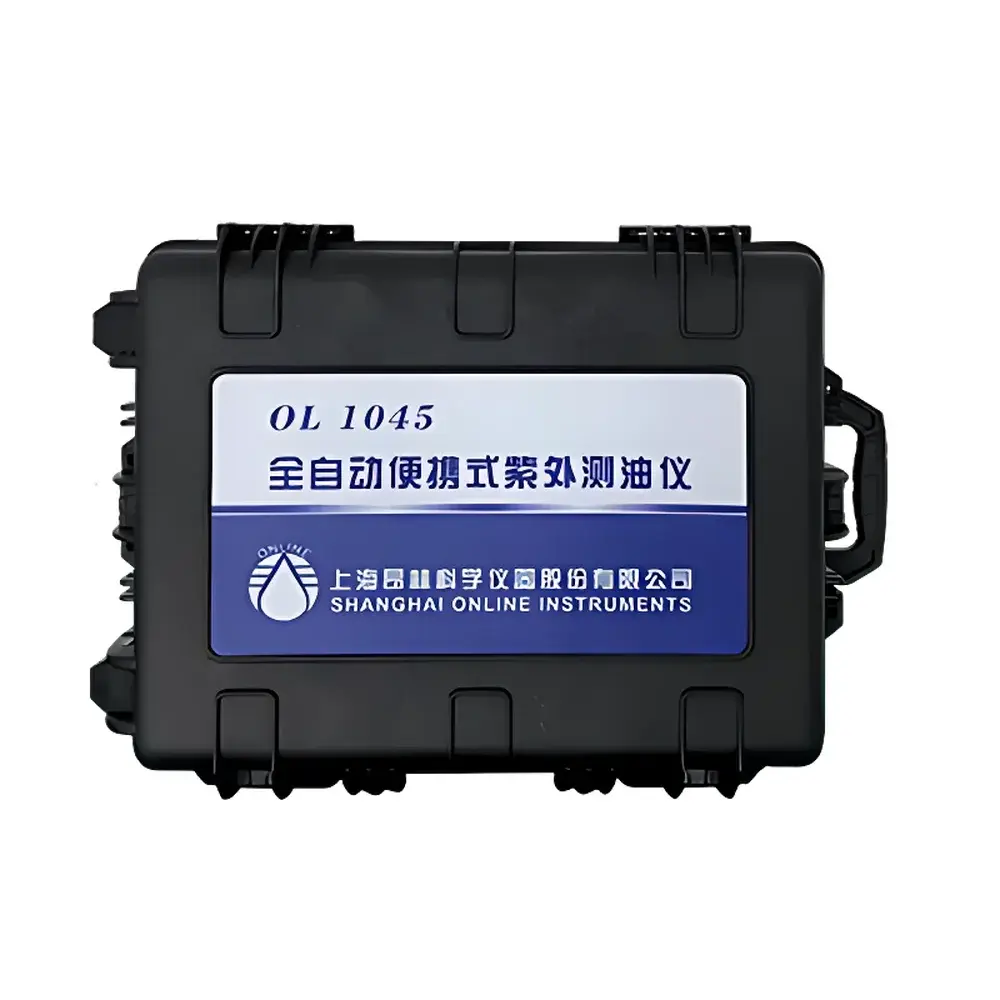
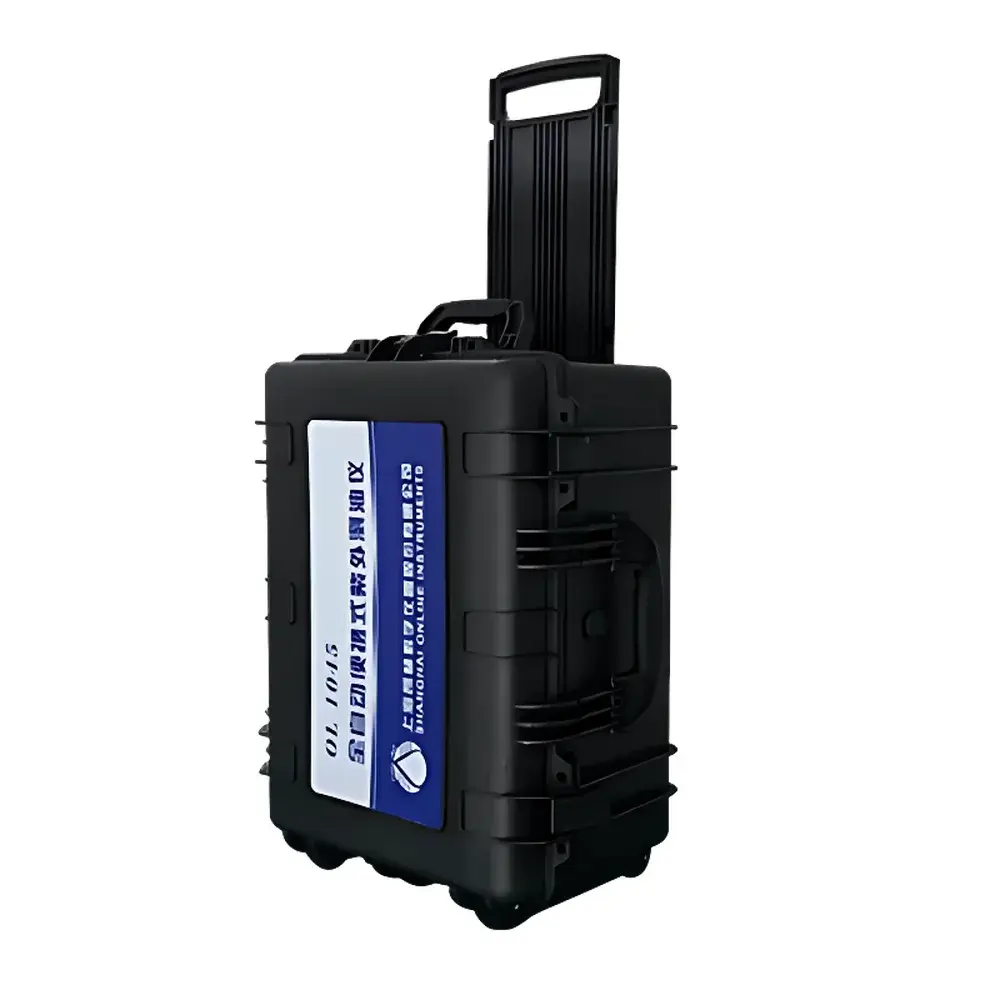
Online Instrument OL1045 Portable UV Spectrophotometric Oil Content Analyzer
| Brand | Online Instrument |
|---|---|
| Origin | Shanghai, China |
| Manufacturer Type | Direct Manufacturer |
| Product Category | Domestic |
| Model | OL1045 |
| Instrument Type | Portable |
| Measurement Principle | UV Spectrophotometry |
| Measurement Range | 0–60 mg/L (auto-dilution for over-range samples) |
| Detection Limit | 0.005 mg/L |
| Accuracy | ±2% |
| Resolution | 0.001 mg/L |
| Analysis Time | <8 min per water sample |
Overview
The Online Instrument OL1045 is a fully integrated, portable UV spectrophotometric oil content analyzer engineered for field-deployable, regulatory-compliant petroleum hydrocarbon quantification in aqueous matrices. It operates on the principle of ultraviolet absorption spectroscopy at 225 nm, where aliphatic and aromatic hydrocarbons—particularly those defined as “petroleum hydrocarbons” under U.S. EPA Method 1664A and China’s HJ 970–2018—exhibit characteristic absorbance. Unlike benchtop alternatives requiring laboratory infrastructure, the OL1045 embeds solvent extraction, phase separation, optical measurement, and data processing into a single ruggedized chassis. Its design conforms to the operational constraints of mobile environmental monitoring: vibration-resistant optical alignment, inertial damping of cuvette positioning, and stable photometric baseline maintenance during vehicle transit. The system is calibrated against certified mineral oil standards traceable to NIST SRM 2781, ensuring metrological continuity across field and lab environments.
Key Features
- Fully automated workflow: From non-contact water sample volume recognition (±2% error) to reagent addition, liquid–liquid extraction with n-hexane, triple-phase membrane-assisted separation (extraction tube + hydrophobic membrane + back-pressure rinse), organic phase transfer, and UV absorbance measurement—all executed without manual intervention.
- Integrated portable architecture: All functional modules—including sampling interface, extraction chamber, separation unit, spectrophotometer, and embedded 10.5-inch industrial touchscreen tablet—are housed within a reinforced engineering plastic roll-cage case (30 kg net weight), compliant with IP65 ingress protection and MIL-STD-810G shock/vibration specifications.
- Field-validated performance: Achieves detection limit of 0.005 mg/L, resolution of 0.001 mg/L, and repeatability (RSD) <2% across 10–1000 mL sample volumes. Linear correlation coefficient (R²) exceeds 0.9999 over the 0–60 mg/L range, validated per ISO/IEC 17025 calibration protocols.
- Battery-powered autonomy: Equipped with a sealed lead-acid battery supporting ≥3 hours of continuous operation—sufficient for ≥20 sequential analyses—enabling deployment in remote coastal zones, riverbanks, or emergency spill sites without external power.
- Regulatory alignment: Supports method validation documentation per HJ/T 91–2002 (China), ASTM D7066–22 (Standard Test Method for Oil and Grease in Water by Infrared Spectrophotometry—used here with UV adaptation per internal validation), and EU WFD Annex V requirements for hydrocarbon screening.
Sample Compatibility & Compliance
The OL1045 accepts direct analysis of water samples collected in standard wide-mouth HDPE or glass bottles (500 mL–2 L), eliminating transfer-related hydrocarbon loss—a critical requirement specified in HJ/T 91–2002 Section 5.3.2. It accommodates heterogeneous matrices including turbid surface water, saline estuarine samples (up to 35 ppt salinity), and groundwater with suspended solids ≤50 mg/L. Phase separation employs hydrophobic polytetrafluoroethylene (PTFE) membranes and reverse-pressure n-hexane flush to prevent clogging and cross-contamination between runs. Waste streams are segregated into aqueous and organic fractions via gravity-driven dual-channel collection, minimizing operator exposure and facilitating hazardous waste tracking per GB 8978–1996 discharge standards.
Software & Data Management
Control and data acquisition are managed through an embedded Linux-based OS running proprietary analytical software (v3.2+). The interface supports ASTM E2500-17–aligned instrument qualification records, automatic generation of audit trails compliant with FDA 21 CFR Part 11 (electronic signatures, user-level access control, immutable raw data logs), and GLP/GMP-ready reporting templates. Data export formats include CSV, PDF analytical reports, and XML metadata bundles compatible with LIMS integration. Remote monitoring and real-time command execution are enabled via encrypted Wi-Fi or LTE module (optional), allowing supervisors to initiate assays, review QC charts, and retrieve spectral scans from smartphones or desktop clients.
Applications
- Real-time source identification and plume mapping during oil spill response (e.g., offshore platform leaks, tanker groundings).
- Routine surveillance of wastewater discharge points from petrochemical facilities, refineries, and marinas.
- Compliance verification for drinking water intakes near transportation corridors or industrial zones.
- Long-term trend analysis in ecologically sensitive areas such as mangrove estuaries, coral reef lagoons, and aquaculture zones.
- Method comparison studies supporting transition from gravimetric (HJ 637–2018) or infrared (HJ 637–2012) to rapid UV-based screening.
FAQ
Does the OL1045 require certified reference materials for daily calibration?
Yes—daily calibration verification must be performed using n-hexane-extractable mineral oil standards traceable to national metrology institutes. A 3-point calibration curve (0, 10, and 50 mg/L) is recommended before each field shift.
Can the instrument analyze seawater without matrix interference?
Yes—the triple-phase separation and UV-specific wavelength selection (225 nm) minimize chloride ion and dissolved organic carbon interferences. Validation data per ASTM D7066–22 Appendix X2 confirms <5% signal suppression at 35 ppt salinity.
Is method validation documentation provided with the system?
Yes—the delivery package includes IQ/OQ/PQ protocols, uncertainty budget calculations per GUM (JCGM 100:2008), and a certificate of conformance to HJ 970–2018 Annex A.
What maintenance is required between analyses?
No consumable replacement is needed per run. The PTFE membrane is rated for ≥500 extractions; routine cleaning involves 30-second n-hexane flush cycles activated automatically post-analysis.
How is data integrity ensured during wireless transmission?
All wireless sessions use TLS 1.2 encryption; raw absorbance spectra and processed results are digitally signed prior to upload, preventing tampering in transit.
Related Products







