
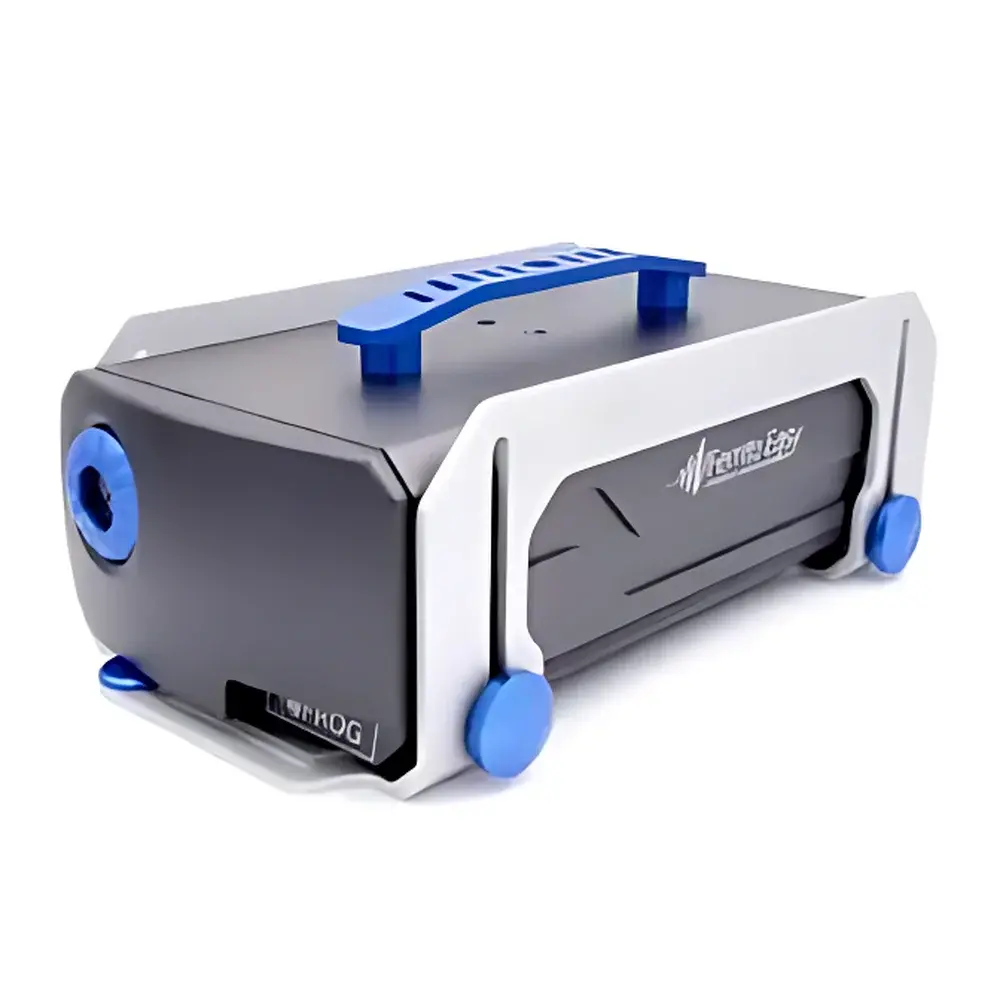
Femto Easy FAST FROG & MS-FROG Single-Shot and Multi-Shot Femtosecond Pulse Characterization Systems
| Brand | FEMTOEASY |
|---|---|
| Origin | France |
| Model Series | FROG-FC, FROG-FS, FROG-PS1, FROG-PS3 |
| Spectral Range | 480–2100 nm (FAST FROG), 500–2100 nm (MS-FROG) |
| Pulse Duration Coverage | 4 fs – 80 ps |
| Detection | CMOS, 12-bit, 3 Mpx, 72 dB dynamic range |
| Interface | USB 3.1 |
| Beam Height | 69–148 mm |
| Dimensions | 326 × 194 × 129 mm |
Overview
The Femto Easy FAST FROG and MS-FROG systems are precision-grade, frequency-resolved optical gating (FROG) instruments engineered for complete temporal and spectral characterization of ultrashort laser pulses. Based on second-harmonic generation (SHG) in nonlinear crystals, these devices reconstruct both intensity and phase profiles of femtosecond to picosecond pulses via iterative algorithms applied to two-dimensional spectrograms. Unlike single-point autocorrelation techniques, FROG delivers full electric field reconstruction — including pulse duration, spectral phase, group delay dispersion (GDD), third-order dispersion (TOD), chirp, pulse front tilt, and spatiotemporal couplings — with high fidelity and reproducibility. The FAST FROG series is optimized for single-shot operation at repetition rates up to 125 kHz (with optional enhanced detection and external triggering), while the MS-FROG platform supports multi-shot averaging for improved signal-to-noise ratio (SNR) in low-energy regimes (down to 50 pJ), enabling reliable characterization from sub-5-fs few-cycle pulses to 80-ps broadband sources.
Key Features
- Single-shot & multi-shot flexibility: FAST FROG captures full pulse parameters from individual laser shots; MS-FROG leverages averaging across multiple shots to enhance sensitivity and resolution, particularly for pJ-level pulses.
- Ultra-broad spectral coverage: Configurable SHG crystals and interchangeable MISS imaging spectrometers support operation from 480 nm to 2100 nm — spanning UV, visible, NIR, and mid-IR spectral regions.
- Sub-femtosecond time resolution: MS-FROG-SP achieves 50 as temporal resolution in fine-scan mode, enabling accurate retrieval of carrier-envelope phase (CEP)-sensitive few-cycle pulses.
- Modular, field-upgradeable architecture: Hot-swappable crystals and plug-and-play spectrometers allow rapid adaptation to new wavelength bands or experimental requirements without recalibration.
- Real-time pulse analysis: Integrated software provides live FROG trace acquisition, iterative retrieval (via principal component generalized projections), and quantitative metrics (e.g., pulse width, GDD, TOD) with uncertainty estimation.
- Robust polarization handling: Designed for linear vertical polarization input; optional waveplate integration enables characterization of arbitrary polarization states.
Sample Compatibility & Compliance
Both FAST FROG and MS-FROG systems accommodate free-space and fiber-coupled (FC/APC or FC/PC) beam inputs, with adjustable beam height (69–148 mm) and collimation modules ensuring compatibility with standard ultrafast laser platforms — including Ti:sapphire oscillators, Yb-fiber amplifiers, OPAs, and HHG sources. The instruments comply with CE marking requirements for electromagnetic compatibility (EMC) and low-voltage directive (LVD). While not certified for medical or industrial safety standards (e.g., IEC 61000-6-3, IEC 60825-1), their optical design adheres to ISO 11146-1/-2 for beam parameter measurement and supports GLP/GMP-aligned data integrity when used with audit-trail-enabled software configurations. Traceability of calibration is maintained through factory-characterized crystal phase-matching curves and spectrometer pixel-to-wavelength mapping files supplied with each unit.
Software & Data Management
Femto Easy’s proprietary FROG Lab software provides a unified interface for acquisition, retrieval, visualization, and export. It supports batch processing of time-series FROG traces for stability monitoring, includes built-in tools for spatiotemporal coupling correction (pulse front tilt, spatial chirp), and offers optional closed-loop feedback for pulse shaper optimization via phase-loop add-on. All raw spectrograms and retrieved fields are stored in HDF5 format with embedded metadata (wavelength axis, delay step, crystal type, acquisition timestamp). Export options include CSV, MATLAB .mat, and standardized XML schemas compatible with third-party analysis pipelines. For regulated environments, the software can be configured to meet FDA 21 CFR Part 11 requirements — including electronic signatures, audit trails, and user-access controls — upon request and validation support.
Applications
- Ultrafast laser development and commissioning (oscillators, amplifiers, OPCPA systems)
- Characterization of attosecond pulse trains generated via high-harmonic generation
- Temporal diagnostics in pump-probe spectroscopy and time-resolved photoelectron experiments
- Validation of adaptive optics and pulse compression systems (e.g., deformable mirrors, Dazzlers, MIIPS)
- Industrial process monitoring in ultrafast micromachining and thin-film ablation
- Academic research in strong-field physics, coherent control, and quantum optics
FAQ
What is the minimum pulse energy required for reliable measurement with FAST FROG?
For single-shot operation at 1 kHz repetition rate, typical thresholds are 1 µJ (for >500 fs pulses) down to 250 µJ (for <150 fs pulses). With the Low Energy option, sensitivity improves by ~20 dB, enabling measurements at ~10 nJ for 1-kHz sources.
Can MS-FROG measure pulses shorter than 5 fs?
Yes — the MS-FROG-SP and MS-FROG-SLP variants support retrieval of pulses as short as 4 fs in fine-scan mode, provided sufficient spectral bandwidth and SNR are available.
Is external triggering supported for synchronization with custom laser systems?
FAST FROG supports TTL-compatible external triggering up to 36 kHz for deterministic single-pulse capture; MS-FROG uses internal clock synchronization but accepts external gate signals for gated averaging in low-repetition-rate applications (<200 kHz).
How does crystal replacement affect measurement accuracy?
Each SHG crystal is pre-characterized for phase-matching bandwidth and conversion efficiency. Switching crystals takes <5 seconds and requires no realignment; spectral calibration files are auto-loaded based on crystal ID encoded in the hardware.
Are software updates and technical support included post-purchase?
Femto Easy provides lifetime software updates and remote technical assistance for registered users. On-site service and application-specific training are available under extended support contracts.



