
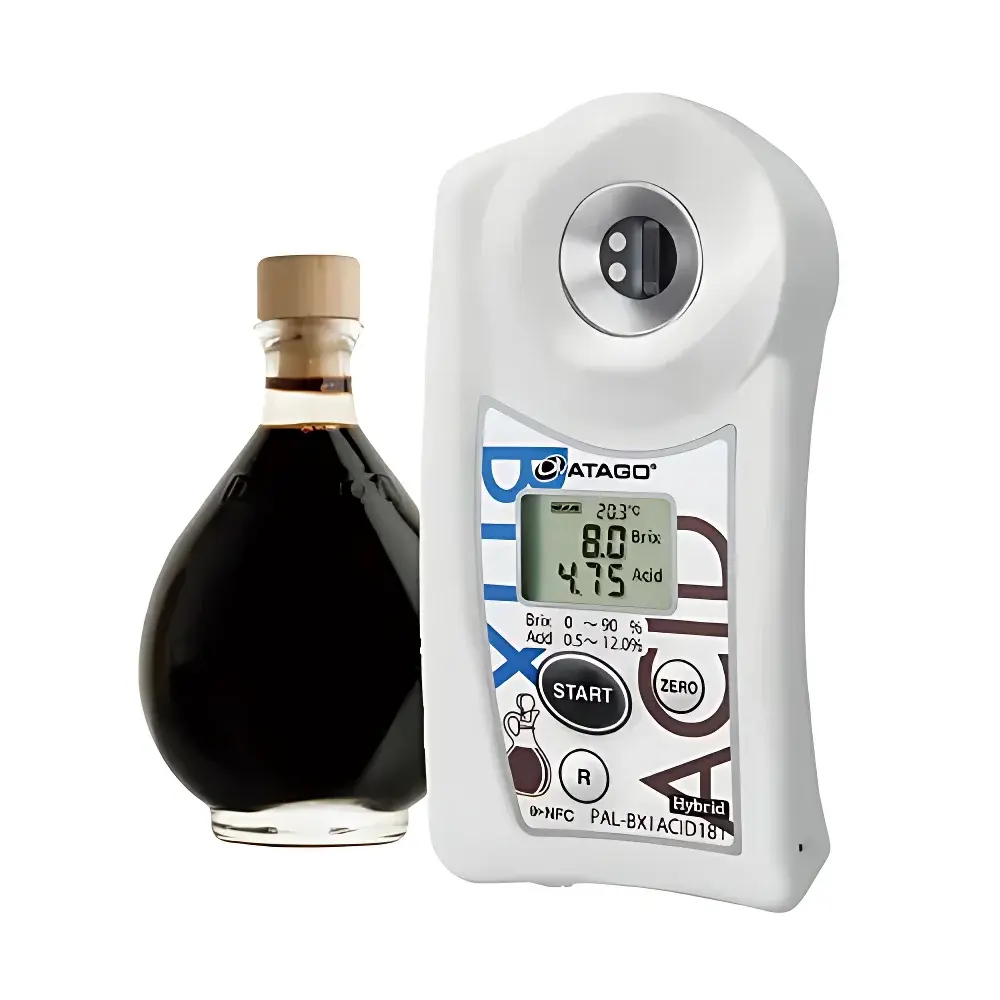
ATAGO PAL-BX/ACID 181 Portable Dual-Parameter Refractometer for Vinegar Brix and Acidity Measurement
| Brand | ATAGO |
|---|---|
| Origin | Japan |
| Model | PAL-BX/ACID 181 |
| Product Type | Handheld Refractometer |
| Display | Digital LCD |
| Temperature Compensation Range | 10–40 °C |
| Brix Range | 0.0–90.0 % |
| Acid Range (as acetic acid) | 0.50–12.00 % |
| Brix Accuracy | ±0.2 % |
| Acid Accuracy | ±0.10 % (0.10–1.00 %), ±10 % relative (1.01–8.80 %) |
| Brix Resolution | 0.1 % |
| Acid Resolution | 0.01 % (0.00–9.99 %), 0.1 % (≥10.0 %) |
| Sugar-Acid Ratio Resolution | 0.01 (0.00–9.99), 0.1 (10.0–99.9), 1 (≥100) |
| IP Rating | IP65 |
| Dimensions | 5.5 × 3.1 × 10.9 cm |
| Weight | 100 g (main unit only) |
| Power | Two AAA alkaline batteries |
Overview
The ATAGO PAL-BX/ACID 181 is a handheld, dual-parameter optical refractometer engineered for rapid, field-deployable quantification of soluble solids (Brix) and total acidity in vinegar and other acidic food liquids. It operates on the principle of critical-angle refractometry: incident light undergoes total internal reflection at the prism–sample interface, with the resulting shadow line position directly correlated to the sample’s refractive index. This index is empirically calibrated to Brix concentration (°Bx) and, via a secondary algorithmic conversion, to titratable acidity expressed as percent acetic acid. Unlike classical potentiometric or titrimetric methods requiring reagents, glassware, and trained personnel, the PAL-BX/ACID 181 delivers repeatable results within seconds using minimal sample volume (0.3 mL) and no consumables beyond distilled water for dilution. Its design targets QC laboratories, production floor technicians, and R&D teams working with fermented condiments, fruit vinegars, and blended acidified beverages where real-time process feedback and batch consistency are essential.
Key Features
- Simultaneous Brix and acidity measurement on a single instrument—eliminates need for separate refractometers and titration setups
- Dedicated vinegar calibration mode optimized for acetic acid–water–sugar matrices, minimizing matrix interference from organic acids and volatiles
- One-touch “R” key computes and displays sugar-acid ratio (Brix ÷ % Acidity) instantly—critical for sensory balance assessment and formulation standardization
- Automatic temperature compensation (ATC) across 10–40 °C ensures measurement stability under ambient workshop or warehouse conditions without external thermostating
- Rugged, IP65-rated housing resists dust ingress and incidental water exposure—suitable for humid production environments and mobile field use
- High-contrast LCD with backlight enables readability in low-light settings; intuitive icon-driven interface requires no software training
Sample Compatibility & Compliance
The PAL-BX/ACID 181 is validated for use with rice vinegar, apple cider vinegar, balsamic condiments, and diluted fruit-based vinegars. For accurate acidity determination, samples must be diluted 1:50 (w/w) with distilled water prior to measurement—a protocol aligned with AOAC Official Method 978.15 for titratable acidity in vinegar. While not a primary compliance instrument for regulatory submissions, its precision (±0.10 % acidity in low-concentration range) supports in-process verification per ISO 20483:2013 (fruit juice and vinegar analysis) and internal quality control benchmarks traceable to NIST SRM 84d (standard sucrose solutions). The device complies with IEC 61010-1 for electrical safety and meets RoHS Directive 2011/65/EU for hazardous substance restrictions.
Software & Data Management
The PAL-BX/ACID 181 operates as a standalone instrument with no embedded data logging or PC connectivity. All measurements are displayed in real time and retained only visually—consistent with GLP-aligned manual recording practices. Users are expected to transcribe results into laboratory notebooks or LIMS-compatible spreadsheets. Though it lacks FDA 21 CFR Part 11-compliant audit trails or electronic signatures, its fixed calibration and mechanical simplicity ensure long-term measurement integrity without firmware updates or software validation overhead. Calibration verification using certified sucrose standards (e.g., NIST-traceable 10.00 ±0.02 % Brix solution) is recommended before each shift or after transport-induced shock.
Applications
- Batch release testing of commercial vinegar products against label claims (e.g., “5% acidity”) per USDA Food Standards and Labeling Policy Book guidelines
- Monitoring fermentation progress in artisanal vinegar production by tracking concurrent Brix decline and acidity rise
- Formulating balanced salad dressings and marinades where sugar-acid ratio directly influences perceived palatability and microbial stability
- Verifying incoming raw material specifications for malt extract, wine must, or fruit concentrates used in vinegar blending
- Educational use in food science curricula for teaching fundamental principles of refractometry, acid-base equilibria, and sensory threshold relationships
FAQ
How is acidity measured without titration?
The instrument uses refractive index correlation calibrated against reference vinegar standards analyzed by AOAC-approved titration. It does not measure pH or hydrogen ion activity—it reports total titratable acidity converted to % acetic acid equivalents.
Why is 1:50 dilution required for acidity but not for Brix?
Undiluted vinegar exhibits high refractive index nonlinearity and strong acetic acid volatility effects that compromise accuracy; dilution brings the sample into the linear, stable region of the calibration curve.
Can this unit measure citric or lactic acid concentrations directly?
No. Its acidity scale is factory-calibrated exclusively for acetic acid. Other organic acids require method-specific validation and are outside the scope of its certified performance.
Is calibration traceable to national standards?
Yes—ATAGO provides optional NIST-traceable calibration verification kits (e.g., Brix Standard Set No. 100), and factory calibration adheres to JIS Z 8807:2015 for refractometer accuracy.
What maintenance is required?
Daily prism cleaning with lens tissue and distilled water; annual recalibration recommended by ATAGO-authorized service centers to maintain stated accuracy specifications.





