
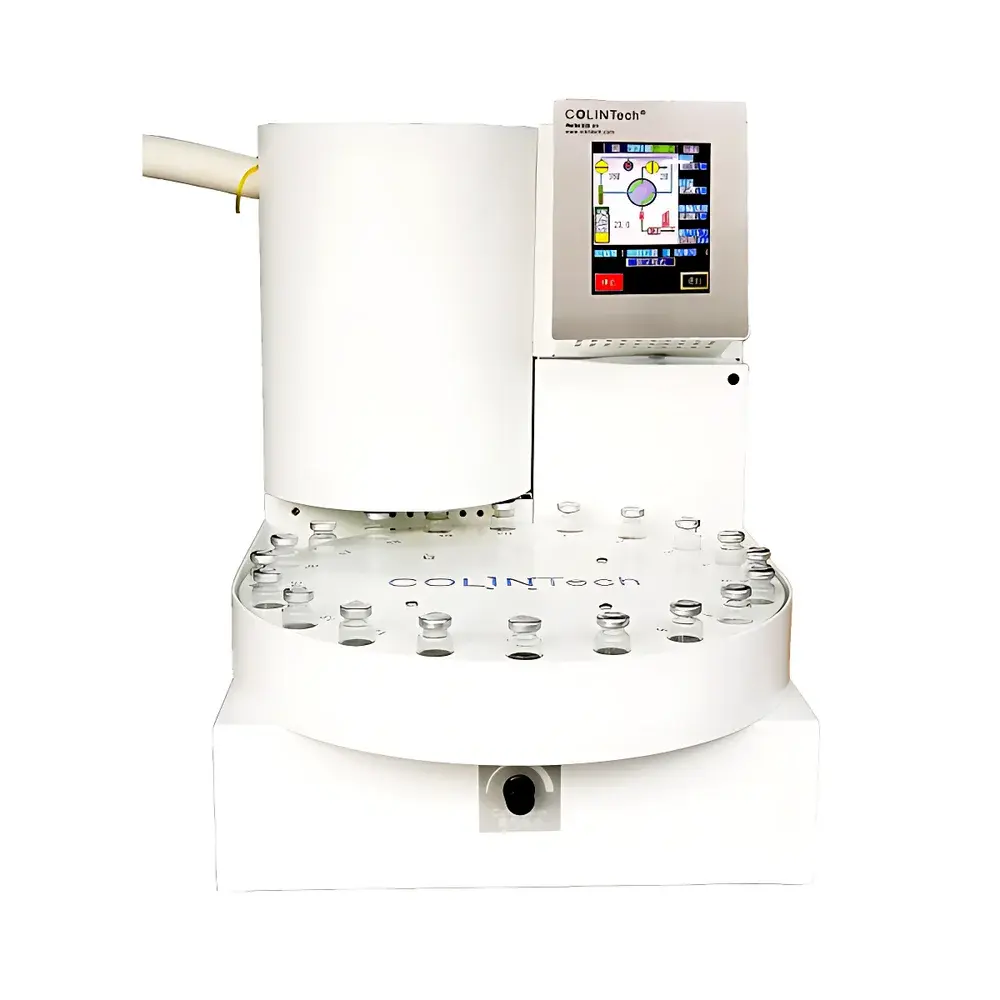
Colintech AutoHS 20 Automated Headspace Sampler
| Brand | Colintech |
|---|---|
| Origin | Sichuan, China |
| Manufacturer Type | Original Equipment Manufacturer (OEM) |
| Product Category | Domestic |
| Model | AutoHS 20 |
| Instrument Type | Dynamic Headspace Sampler |
| Automation Level | Fully Automatic |
| Vial Heating Range | Ambient to 180 °C |
| Valve & Transfer Line Temperature Control Range | 35 °C to 210 °C (isothermal with needle temperature) |
| Injection Mode | Time-based quantitative sampling (no fixed loop volume) |
| Sample Vial Capacity | 20 positions |
| Vial Specification | 20 mL standard crimp-top vials |
| Optional Feature | Programmable vial agitation module |
Overview
The Colintech AutoHS 20 Automated Headspace Sampler is an engineered solution for precise, reproducible volatile organic compound (VOC) and semi-volatile analyte extraction from solid, liquid, or viscous matrices prior to gas chromatographic analysis. It operates on a dual-path headspace sampling principle—integrating static equilibration with dynamic purge-and-trap compensation—to minimize carryover, eliminate dead-volume artifacts, and maximize analyte transfer efficiency. Unlike conventional single-mode static or dynamic systems, the AutoHS 20 dynamically balances vapor-phase concentration gradients during equilibration and transfer, enabling robust quantitation across diverse polarity ranges without method-specific hardware reconfiguration. Designed for routine QC/QA laboratories and regulated environments, it delivers high inter-run reproducibility (RSD < 2.5% for target VOCs under GLP-compliant conditions) and supports method transfer between GC platforms without recalibration.
Key Features
- Dual-flow headspace extraction architecture: Combines static equilibrium phase with real-time dynamic compensation flow, ensuring complete volatiles recovery while suppressing matrix interference and residual carryover.
- Fully automated 20-position sample carousel with independent thermal control for up to five vials simultaneously—enabling overlapping heating cycles and optimized throughput for batch analysis.
- Programmable vial temperature control (ambient to 180 °C) and valve/transfer line heating (35–210 °C), both independently adjustable and traceable via embedded PT100 sensors with ±0.5 °C accuracy.
- Time-based quantitative injection mechanism: Eliminates mechanical loop variability; injection volume is precisely defined by carrier gas flow rate and dwell time—fully configurable per method and validated per USP and ASTM D7622 guidelines.
- Intuitive graphical user interface (GUI) with real-time status visualization, method parameter logging, and audit-ready event timestamps—compliant with FDA 21 CFR Part 11 requirements when paired with validated LIMS or CDS software.
- Universal GC/GC-MS interface compatibility: Equipped with standard 1/16″ stainless-steel transfer lines, pressure-tight septumless valve coupling, and TTL/RS-232 trigger support for seamless integration with Agilent, Thermo Fisher, Shimadzu, PerkinElmer, and other major chromatography platforms.
Sample Compatibility & Compliance
The AutoHS 20 accommodates standard 20 mL crimp-cap headspace vials (with PTFE/silicone septa) and supports aqueous, organic, polymer, pharmaceutical, food, and environmental matrices—including high-salt, high-viscosity, or particulate-laden samples. Its inert flow path (electropolished stainless steel and fused silica-lined tubing) minimizes adsorption of polar compounds (e.g., alcohols, ketones, amines) and prevents degradation of thermally labile species. The system meets essential design criteria referenced in ISO 15197, ASTM D3699 (gasoline oxygenates), USP (residual solvents), and EPA Method 502.2/8260D. Full traceability of calibration, maintenance, and run logs is supported through optional electronic signature and audit trail modules aligned with GMP/GLP documentation standards.
Software & Data Management
Control and method development are performed via the dedicated AutoHS Control Suite—a Windows-based application supporting ICH Q2(R2)-aligned validation protocols. The software enables full parameter scripting (equilibration time, oven ramp profiles, purge duration, injection dwell, agitation speed), automatic calibration curve generation, and raw data export in .csv and .cdf formats compatible with OpenLab CDS, Chromeleon, and MassHunter. All method changes, user logins, and instrument events are timestamped and stored locally with optional network backup. When deployed in regulated labs, the system supports role-based access control, electronic signatures, and 21 CFR Part 11-compliant audit trails—including operator identity, action type, timestamp, and pre-/post-change values.
Applications
- Residual solvent analysis in pharmaceutical active ingredients and excipients (USP , ICH Q3C)
- VOC profiling in drinking water, wastewater, and soil extracts (EPA 524.4, 8260D)
- Flavor and fragrance compound quantification in beverages, dairy, and packaged foods
- Monomer and catalyst residue testing in polymer manufacturing (e.g., vinyl chloride, styrene, ethylene oxide)
- Forensic toxicology screening for ethanol, acetone, and volatile drugs of abuse
- Quality control of lithium-ion battery electrolytes and cathode slurries
FAQ
Is the AutoHS 20 compatible with third-party GC data systems?
Yes—the instrument provides native RS-232 and TTL trigger interfaces, and driver packages are available for OpenLab CDS, Chromeleon, Empower, and MassHunter. Custom API integration is supported upon request.
What is the typical carryover level for high-concentration standards?
Under standard cleaning protocol (blank purge + bake-out), carryover remains below 0.1% for compounds such as chloroform, toluene, and methanol when using the dual-flow compensation mode.
Can the agitation function be programmed per sample?
Yes—vial shaking speed (100–1000 rpm) and duration are fully programmable per position within a batch method.
Does the system support method validation documentation?
The AutoHS Control Suite includes built-in tools for system suitability testing (SST), precision checks, linearity verification, and limit-of-quantitation assessment—generating reports compliant with ISO/IEC 17025 and ALACC requirements.
What maintenance intervals are recommended for routine operation?
Valve seals and transfer line filters should be inspected every 500 runs; oven insulation and thermal sensor calibration are recommended annually or after 2,000 operating hours.




