
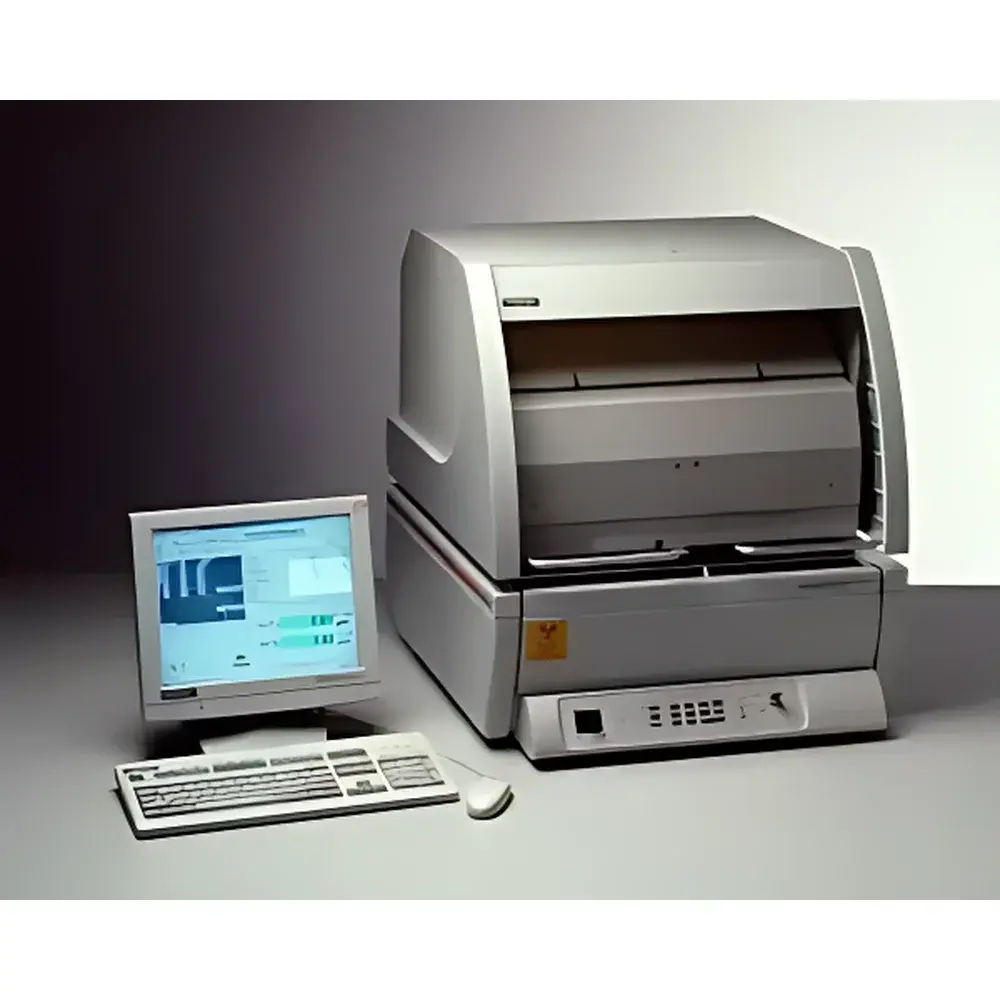
FISCHERSCOPE® X-RAY XDVM-u Micro-Focus X-Ray Fluorescence Thickness Analyzer
| Brand | Fischer |
|---|---|
| Origin | Germany |
| Model | XDVM-u |
| Measurement Principle | X-ray Fluorescence (XRF) |
| Compliance | DIN 50987, ISO 3497, ASTM B568 |
| Max. Measurable Layers | 23 |
| Elements Analyzed | Cl (Z=17) to U (Z=92) |
| Element Quantification Range | x ppm to 100% |
| Spectral Channels | 1024 (raw: 4096) |
| Minimum Spot Size | 50 × 100 µm |
| Focal Depth Range | 2.5 mm |
| X-ray Tube | Adjustable HV (30/40/50 kV), Current up to 0.8 mA |
| Detector | Peltier-cooled semiconductor with high energy resolution |
| XY Stage Travel | X=250 mm, Y=220 mm, Positioning Accuracy: ±0.005 mm |
| Z-Axis Travel | 95 mm |
| Camera Magnification | 30×–1108× with crosshair & scale grid |
| Software | WinFTM® V6 with PDM (Product Data Management) |
| Interface | RS232, Ethernet, removable storage |
| Languages | English, German, French, Italian, Spanish, Chinese |
Overview
The FISCHERSCOPE® X-RAY XDVM-u is a benchtop micro-focus X-ray fluorescence (XRF) thickness analyzer engineered for non-destructive, high-precision measurement of metallic and alloy coatings on substrates. It operates on the fundamental principle of X-ray fluorescence spectroscopy: a focused primary X-ray beam excites atoms in the sample, causing emission of characteristic secondary (fluorescent) X-rays. The energy and intensity of these emitted photons are directly correlated to elemental identity and concentration, enabling simultaneous quantification of layer composition and thickness across up to 23 stratified layers. Designed for demanding quality control environments—including PCB manufacturing, semiconductor packaging, connector plating, and precision electroplating—the XDVM-u delivers trace-level detection sensitivity (down to x ppm), sub-micrometer spatial resolution, and metrological traceability aligned with international standards including DIN 50987, ISO 3497, and ASTM B568.
Key Features
- Micro-focus X-ray optics delivering high photon flux density at spot sizes as small as 50 × 100 µm—enabling reliable analysis of fine-pitch solder finishes, ENIG (electroless nickel immersion gold), and thin palladium or ruthenium barrier layers.
- Motorized XYZ stage with ±0.005 mm positioning repeatability, programmable multi-point scanning (grid, linear, random), and intuitive mouse-driven point selection for rapid setup and reproducible measurement sequences.
- Peltier-cooled semiconductor detector with 4096-channel ADC (compressed to 1024 output channels), providing high energy resolution for accurate peak deconvolution in complex multi-element spectra.
- Automated X-ray beam alignment via crosshair calibration routine—critical for maintaining measurement fidelity on miniature components where beam drift would otherwise compromise accuracy.
- Integrated high-resolution color camera with dual magnification (30×–1108×), on-screen crosshair overlay, real-time scale grid, and dynamic measurement spot visualization for precise targeting without physical contact.
- Adjustable X-ray tube parameters (30/40/50 kV HV, 0–0.8 mA current) optimized per application—ensuring optimal excitation efficiency for light elements (e.g., Al, Si, P) and heavy metals (e.g., Au, Pt, Pb) alike.
Sample Compatibility & Compliance
The XDVM-u accommodates a broad range of industrial samples—from flat PCB coupons and cylindrical connectors to irregularly shaped stamped parts—within its robust 720 × 660 × 950 mm measurement chamber. Internal cavity dimensions (140 × 560 × 530 mm) and upward-swinging hinged door facilitate easy loading. All measurements adhere strictly to internationally recognized test methods: DIN 50987 (metallic coatings on metallic substrates), ISO 3497 (XRF coating thickness determination), and ASTM B568 (standard test method for coating thickness by X-ray spectrometry). The system supports GLP/GMP-aligned workflows through audit-trail-enabled software logging, user-access controls, and electronic signature capability in WinFTM® V6—fully compliant with FDA 21 CFR Part 11 requirements when configured with appropriate validation documentation.
Software & Data Management
WinFTM® V6 serves as the integrated analytical platform, combining spectral acquisition, quantitative modeling (fundamental parameters method, FP), and multilayer thickness inversion algorithms. Its Product Data Management (PDM) module enables structured archiving of applications, report templates, display configurations, and notebook entries within customizable folder hierarchies. Users define print layouts—including corporate logos, custom headers, and font/page settings—and link individual measurement applications to specific product files—reducing requalification effort during process changes. Barcode integration allows automatic selection of preconfigured measurement routines upon part scan. Data export is supported via RS232, Ethernet, or removable media; statistical evaluation tools permit selective data block processing, single-read extraction, and trend analysis across production lots.
Applications
- Thickness and composition verification of ENIG, ENEPIG, immersion silver/tin, and hard gold plating on PCBs and IC substrates.
- Quantitative analysis of Ni/Pd/Au stack thicknesses in RF connectors and high-frequency interconnects.
- Measurement of chromium passivation layers on zinc-nickel alloys per automotive OEM specifications (e.g., VW TL226).
- Validation of precious metal deposition (e.g., Rh, Pt, Ir) in medical device electrodes and catalytic components.
- Quality assurance of decorative chrome on ABS plastics and functional coatings on aluminum die-cast housings.
- Failure analysis support—identifying interdiffusion, oxidation, or contamination at interface boundaries via depth-resolved spectral mapping.
FAQ
Does the XDVM-u require certified reference standards for calibration?
Yes—while the Fundamental Parameters (FP) method enables rapid screening using built-in pure-element libraries (14 elements), traceable thickness and composition results require calibration with up to 10 certified standard foils or coated reference materials per application.
Can the system measure coatings on non-conductive substrates such as ceramics or plastics?
Yes—XRF is inherently substrate-agnostic; however, measurement uncertainty increases with low-Z substrates due to enhanced background scattering. Optimized tube voltage and filter selection mitigate this effect.
Is remote operation or network-based data collection supported?
Yes—Ethernet connectivity enables centralized data aggregation, remote monitoring via secure client access, and integration into MES or LIMS platforms using standard TCP/IP protocols.
What maintenance is required for long-term stability?
Annual detector energy calibration and X-ray tube performance verification are recommended; Peltier cooler health and optical path cleanliness should be verified quarterly per ISO/IEC 17025 laboratory practice guidelines.
How does the XDVM-u handle overlapping spectral peaks (e.g., Sb Kα and Sn Kβ)?
WinFTM® V6 employs iterative least-squares fitting with library-based peak shape modeling and background subtraction algorithms, validated against NIST SRM reference spectra to resolve interference in complex multi-element systems.



