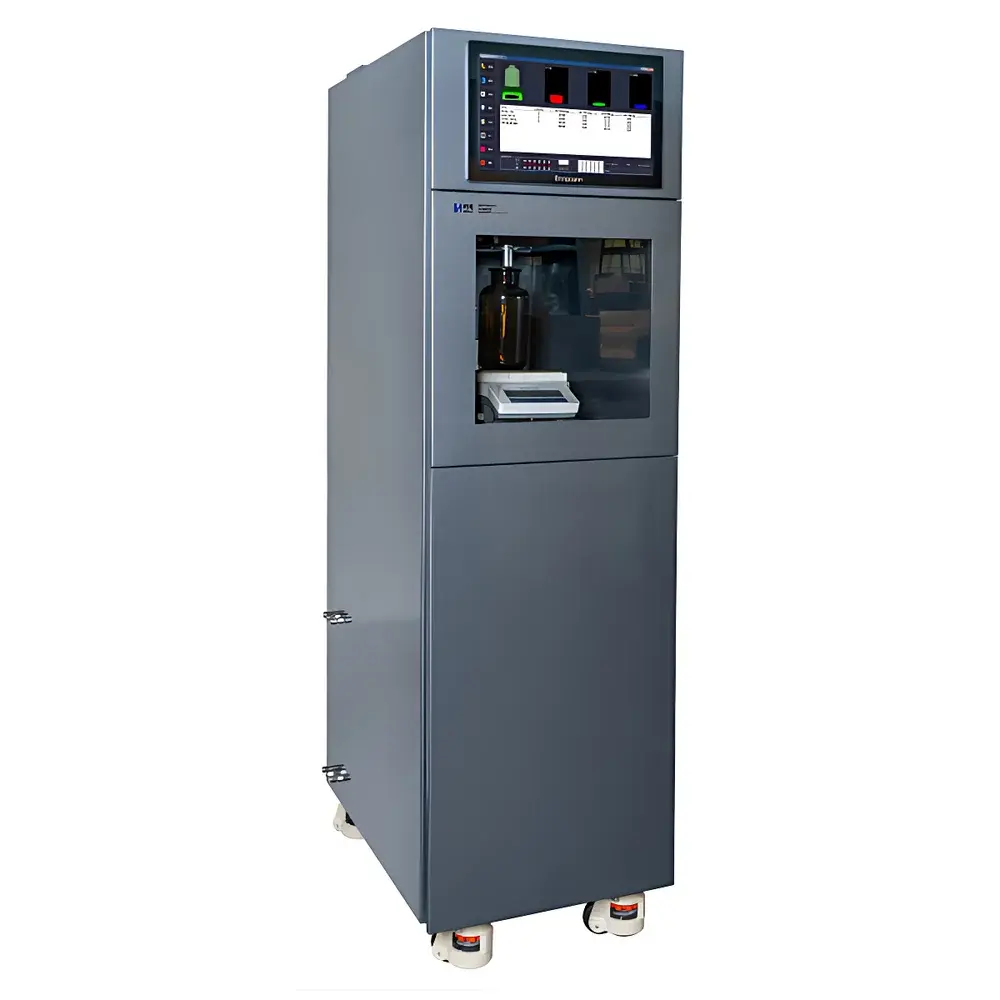
Shenkai SKY2102ZP-II Automated Fuel Blending System for Octane and Cetane Reference Fuel Preparation
| Brand | Shenkai |
|---|---|
| Origin | Shanghai, China |
| Model | SKY2102ZP-II |
| Measurement Parameters | Gasoline Octane Number (ON), Diesel Cetane Number (CN) |
| Form Factor | Benchtop |
| Compliance Standards | ASTM D2699, ASTM D2700, ASTM D613, GB/T 5487, GB/T 503, GB/T 386, ISO 5164, ISO 5163, ISO 5165, EN ISO 5164, EN ISO 5163, IP 237, IP 236, IP 41 |
| Blending Accuracy | ±0.01 ON/CN or ≤ 0.1 g |
| Blending Volume Range | 100–1000 mL |
| Blending Time per 1 L | 3–4 min |
| Number of Integrated Fuel Reservoirs | 6 × 10 L |
| Balance Capacity | 2200 g |
| Balance Readability | 0.5 g |
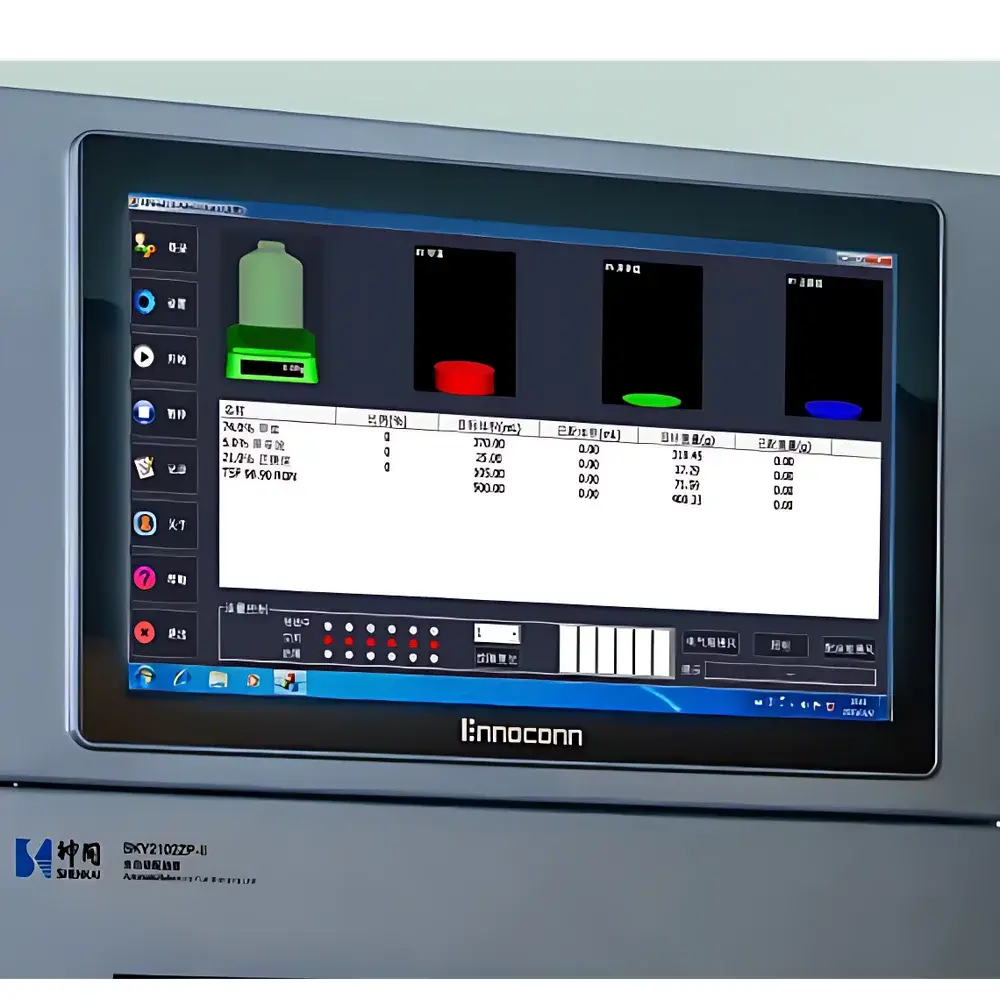
| Control Interface | 15″ color capacitive touchscreen |
| Data Storage Capacity | ≥5000 records |
| Communication Interfaces | USB 2.0, RJ-45 Ethernet |
| Power Supply | AC 220 V ±10%, 50/60 Hz |
| Dimensions (W×D×H) | 500 × 750 × 1720 mm |
| Net Weight | 197 kg |
| Environmental Operating Range | 5–35 °C, ≤80% RH |
| Safety Features | Overload circuit protection, low-reservoir level alarm with auto-refill logic, remote tank empty detection with pump shutdown, container presence verification, post-blend activated carbon-filtered exhaust ventilation |
Overview
The Shenkai SKY2102ZP-II Automated Fuel Blending System is an engineered solution for the precise, reproducible, and fully traceable preparation of reference fuel blends required in standardized octane number (ON) and cetane number (CN) testing laboratories. Designed specifically for compliance with ASTM D2699 (RON), ASTM D2700 (MON), ASTM D613 (CN), GB/T 5487, GB/T 503, GB/T 386, and corresponding ISO, EN, and IP test methods, the system implements gravimetric blending—where mass-based proportioning ensures metrological rigor unattainable with volumetric dispensing alone. Unlike manual or semi-automated approaches, the SKY2102ZP-II eliminates operator-induced variability by integrating high-stability dynamic electronic balances, corrosion-resistant fluid handling components, and closed-loop feedback control algorithms that continuously adjust pump timing and valve actuation based on real-time mass acquisition. The system operates as a critical front-end module in accredited fuel analysis workflows—ensuring that every test sample meets the strict compositional tolerances mandated by regulatory and quality assurance frameworks including ISO/IEC 17025, GLP, and refinery internal QA protocols.
Key Features
- Gravimetric blending architecture with six independent 10 L reservoirs, each monitored in real time for remaining volume and automatically replenished via six high-head, chemically resistant diaphragm pumps connected to external source tanks
- 15″ industrial-grade capacitive touchscreen HMI providing intuitive navigation, live process visualization (mass accumulation curves, pump status, reservoir levels), and context-sensitive help overlays
- Preloaded blending templates for four common reference fuel formulations (e.g., primary reference fuels PRF90, PRF100, CN40, CN60), editable to reflect site-specific raw material specifications including density, certified ON/CN values, and batch traceability identifiers
- Automated safety interlocks: container presence detection prior to dispensing, dual-stage exhaust ventilation with activated carbon filtration, overload-protected power distribution, and fail-safe shutdown upon remote tank depletion or reservoir underfill
- Full audit trail generation: timestamped event logging for all user actions, balance readings, pump activations, and environmental parameter deviations (temperature/humidity), compliant with FDA 21 CFR Part 11 data integrity requirements when integrated with validated LIMS
Sample Compatibility & Compliance
The SKY2102ZP-II accommodates hydrocarbon-based liquid fuels within standard volatility and viscosity ranges typical of gasoline fractions (ASTM D4057), diesel distillates (ASTM D4177), and certified reference materials (CRMs) from NIST, CRM-EC, or equivalent national metrology institutes. All wetted surfaces—including tubing, valves, and reservoir interiors—are constructed from PTFE, EPDM, and 316 stainless steel to resist oxidation, sulfur compound degradation, and aromatic swelling. The system’s gravimetric accuracy of ±0.01 ON/CN or ≤0.1 g satisfies the repeatability criteria defined in ASTM D2699 Annex A1, ISO 5164 Clause 8.3, and GB/T 5487 Section 6.2. It supports method validation per ISO/IEC 17025:2017 Clause 7.7 and is routinely deployed in laboratories undergoing CNAS or UKAS accreditation audits.
Software & Data Management
Embedded firmware (v3.2+) provides deterministic real-time control using a deterministic RTOS kernel. Data are stored locally in encrypted SQLite databases with SHA-256 hashing and automatic daily backup to USB or network share. The system exports CSV-formatted reports compatible with LIMS integration via TCP/IP socket communication over RJ-45—supporting HL7, ASTM E1384, and custom XML schemas. Audit logs retain full forensic detail: operator ID, session start/end timestamps, parameter modifications, balance calibration events, and exception flags (e.g., “reservoir #3 refill initiated at 14:22:18 UTC”). Optional software upgrade enables 21 CFR Part 11 compliance mode, including electronic signatures, role-based access control, and immutable record archiving.
Applications
- Primary reference fuel (PRF) and secondary reference fuel (SRF) preparation for engine-based octane and cetane rating per ASTM D2699/D2700/D613
- Calibration standard generation for FTIR, GC-FID, and NIR analyzers used in fuel property prediction models
- Blending of surrogate fuel mixtures for combustion research in single-cylinder optical engines and shock tubes
- Quality control of commercial gasoline and diesel batches against specification limits (e.g., ASTM D4814, EN 228, GB 17930)
- Supporting round-robin interlaboratory studies under ISO 5725-2 precision evaluation protocols
FAQ
What standards does the SKY2102ZP-II directly support for method compliance?
It is validated for ASTM D2699, D2700, D613; ISO 5164, 5163, 5165; GB/T 5487, 503, 386; EN ISO 5164/5163; and IP 237/236/41.
Can the system blend non-hydrocarbon additives such as ethanol or biodiesel blends?
Yes—provided the additive’s density, vapor pressure, and chemical compatibility with PTFE/EPDM are documented and entered into the raw material database; viscosity limits apply (≤15 cSt at 20 °C).
Is remote monitoring and control possible via network connection?
Yes—via secure HTTPS web interface or Modbus TCP for integration into plant-wide SCADA systems; no proprietary client software required.
How is measurement traceability maintained across calibration cycles?
Internal balance calibration uses NIST-traceable weights; all calibrations are logged with certificate IDs, dates, and technician signatures; optional external calibration service documentation upload is supported.
What maintenance intervals are recommended for fluid path components?
Pump diaphragms and check valves require inspection every 6 months or after 5000 blending cycles; reservoirs must be purged and inspected quarterly per ISO 8573-1 Class 4 particulate protocol.