
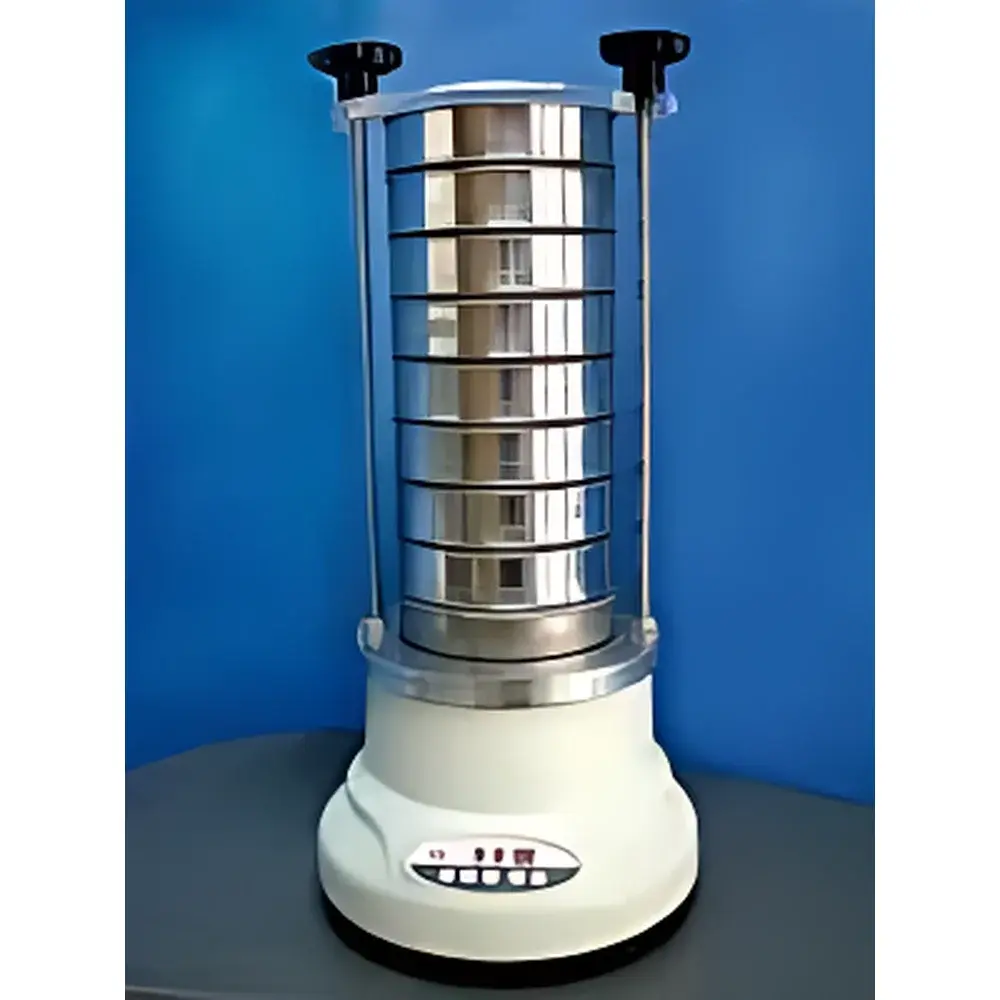
Filtra FTL-0150 Digital Electronic Dry Sieve Shaker
| Brand | Filtra |
|---|---|
| Origin | Spain |
| Model | FTL-0150 |
| Sieving Range | ≥ 40 µm |
| Sieve Capacity | 8 × 50 mm-height sieves or 16 × 25 mm-height sieves |
| Drive Mechanism | 3D orbital motion with programmable intermittent operation |
| Construction | Polyurethane resin housing |
| Clamping System | Dual stainless steel threaded rods, phenolic knobs, acrylic sieve cover with diffuser |
| Power Control | Digital timer-based on/off cycling |
Overview
The Filtra FTL-0150 Digital Electronic Dry Sieve Shaker is an electromechanical laboratory instrument engineered for standardized dry particle size analysis via mechanical sieving. It operates on the principle of controlled 3D orbital motion—combining horizontal circular displacement with vertical oscillation and slight rotational torque—to ensure uniform energy distribution across the sieve stack. This motion profile minimizes particle stratification and agglomeration, promoting efficient particle passage through mesh apertures in accordance with ISO 9048, ASTM E11, and ISO/IEC 17025-compliant sieving protocols. Designed exclusively for dry-sieving applications, the FTL-0150 excludes liquid or wet-suspension processing; it is not intended for use with cohesive, hygroscopic, or electrostatically charged powders without prior conditioning (e.g., antistatic treatment or blending with dispersing agents). Its polyurethane resin housing provides inherent vibration damping, structural rigidity, and chemical resistance to common laboratory solvents and dust abrasion—critical for long-term dimensional stability and repeatable amplitude transmission.
Key Features
- Programmable intermittent operation mode: Enables precise control over shaking duration and rest intervals via digital timer, supporting method reproducibility across shifts and operators.
- Three-dimensional orbital drive system: Delivers consistent kinetic energy transfer to all sieve levels—eliminating preferential settling and improving sieve efficiency for particles near the cut-point (e.g., 45 µm, 75 µm, 150 µm).
- Modular sieve stack compatibility: Accommodates up to eight 50 mm-height test sieves (ISO 3310-1 or ASTM E11 compliant) or sixteen 25 mm-height sieves—supporting multi-stage fractionation per EN 933-1 or USP <786> requirements.
- Robust clamping architecture: Dual stainless steel tension rods with phenolic hand knobs ensure uniform compression force across the full sieve diameter, preventing lateral slippage and seal leakage during high-amplitude cycles.
- Acrylic sieve cover with integrated diffuser: Reduces airborne particulate dispersion while maintaining visual process monitoring; the diffuser design equalizes pressure differentials across the sieve surface, minimizing fines loss due to turbulence.
- Low-maintenance solid-state electronics: No brushes or belts; digitally regulated motor control ensures stable RPM output over extended service life (>10,000 hours MTBF).
Sample Compatibility & Compliance
The FTL-0150 is validated for use with free-flowing, non-fibrous, non-sticky granular materials—including metal powders (e.g., stainless steel 316L, Ti-6Al-4V), mineral aggregates (silica sand, limestone), pharmaceutical excipients (microcrystalline cellulose, lactose monohydrate), and ceramic precursors (alumina, zirconia). It complies with mechanical safety standards IEC 61000-6-2 (immunity) and IEC 61000-6-4 (emissions), and its construction meets IP20 ingress protection rating for indoor laboratory environments. While not intrinsically safe, optional grounding kits are available for conductive powder handling under ATEX Zone 22 guidelines. The instrument supports GLP documentation workflows via external logging of cycle parameters (time, interval, start/stop timestamps) when interfaced with LIMS-compatible data acquisition systems.
Software & Data Management
The FTL-0150 operates as a standalone hardware platform with no embedded firmware or proprietary software. All operational parameters—including total shaking time, pause duration, and cycle count—are set via front-panel push-button interface with LED feedback. For traceability in regulated environments (e.g., FDA 21 CFR Part 11, EU GMP Annex 11), users integrate the shaker into validated lab workflows using external electronic lab notebooks (ELNs) or chromatography data systems (CDS) that record operator ID, sample ID, sieve mesh sequence, and environmental conditions (temperature/humidity logged separately). Audit trails must be maintained externally, as the unit itself does not store or timestamp events.
Applications
- Quality control of raw material particle size distribution in pharmaceutical manufacturing (per USP <786> and Ph. Eur. 2.9.32).
- Aggregate gradation analysis in civil engineering laboratories (ASTM C136/C136M, EN 933-1).
- Characterization of additive manufacturing feedstocks (ASTM F3049).
- Validation of milling process endpoints in fine chemical synthesis.
- Research-scale fractionation of catalyst supports and battery electrode materials (e.g., graphite, NMC cathodes).
- Compliance testing for ISO 13320 laser diffraction cross-validation using reference standards (e.g., NIST SRM 1990).
FAQ
Is the FTL-0150 suitable for wet sieving?
No. It is strictly designed for dry-sieving applications. Wet sieving requires sealed fluid containment, corrosion-resistant wetted parts, and hydraulic pressure regulation—none of which are present in this model.
Can it accommodate ASTM E11 standard 8-inch (203 mm) diameter sieves?
No. The FTL-0150 accepts only 50 mm and 25 mm height sieves with standard 100 mm or 200 mm diameters per ISO 3310-1. Larger formats require the FTL-0200 variant.
Does the unit include calibration certificates or metrological traceability?
Filtra supplies factory verification reports for amplitude and timing accuracy at time of shipment. Full ISO/IEC 17025 calibration must be performed by an accredited third-party lab using laser vibrometry and calibrated timers.
What maintenance is required for long-term performance?
Annual inspection of rod thread integrity, knob torque consistency, and motor bearing play is recommended. No lubrication is required; polyurethane housing should be wiped with isopropyl alcohol to remove static-attracting dust residues.



