
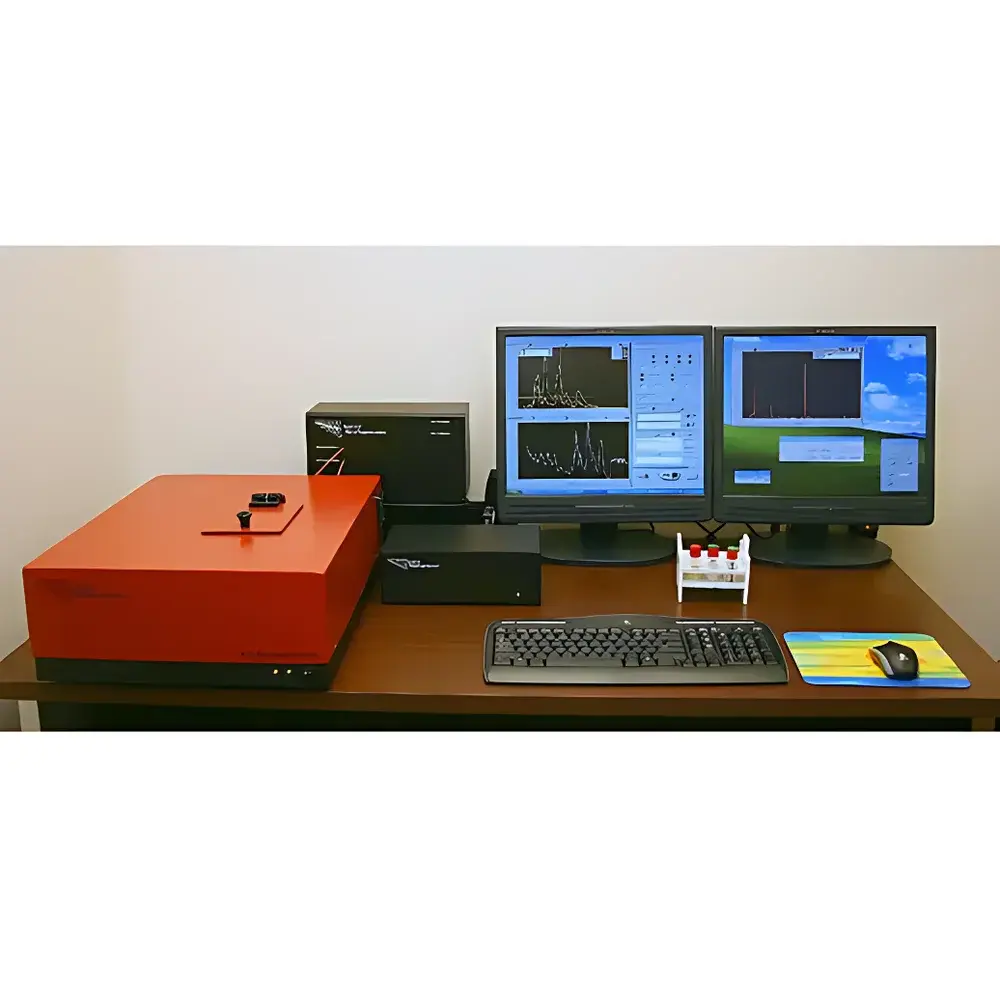
Applied NanoFluorescence Nano Spectralyzer NS3 Carbon Nanotube and Graphene Characterization System
| Brand | Applied NanoFluorescence |
|---|---|
| Origin | USA |
| Manufacturer Type | Authorized Distributor |
| Import Status | Imported |
| Model | Nano Spectralyzer NS3 |
| Pricing | Available Upon Request |
Overview
The Applied NanoFluorescence Nano Spectralyzer NS3 is a purpose-built, integrated optical characterization platform engineered for quantitative structural and electronic property analysis of single-walled carbon nanotubes (SWCNTs) and graphene-based materials. It operates on the physical principles of photoluminescence excitation–emission mapping (PLEM), absorption spectroscopy, and resonant Raman scattering—techniques uniquely sensitive to the (n,m) chiral index, diameter distribution, defect density, layer stacking, and electronic band structure of sp²-carbon nanomaterials. Unlike generic spectrometers, the NS3 system incorporates co-registered, synchronized detection across ultraviolet–visible–near-infrared (UV-Vis-NIR) spectral domains, enabling simultaneous acquisition of absorption, photoluminescence (PL), and Raman signatures from the same micro-volume sample region. This multi-modal correlation eliminates inter-measurement sample repositioning errors and supports rigorous, traceable metrology for academic research, process development, and quality control in nanomaterial synthesis and device fabrication.
Key Features
- Fully integrated triple-mode optical architecture: simultaneous UV-Vis-NIR absorption, near-infrared photoluminescence (900–1600 nm, extendable to 2000 nm), and resonant Raman spectroscopy (150–3000 cm⁻¹)
- Electrically cooled InGaAs and Si-based detector arrays—eliminating reliance on liquid nitrogen while maintaining thermal stability ( 10⁴:1 at 1200 nm)
- Automated PLE mapping with programmable excitation wavelengths (532 nm and/or 671 nm lasers) and step-scan emission collection for (n,m) assignment via E₁₁ and E₂₂ transition identification
- Compact benchtop footprint (45 × 35 × 22 cm) with vibration-isolated optical path and fiber-coupled probe interface for flexible sample handling (solution, film, substrate-mounted, or in situ flow cell configurations)
- Sub-microliter sample volume requirement—enabling characterization of precious or low-yield synthetic batches without dilution or concentration steps
- Real-time spectral acquisition engine capable of full-range PL emission scans in <8 seconds and absorption spectra in <3 seconds per scan, supporting kinetic monitoring of functionalization or degradation processes
Sample Compatibility & Compliance
The NS3 accommodates diverse carbon nanomaterial formats including aqueous/dispersion suspensions, spin-coated or drop-cast thin films, CVD-grown graphene on Cu/Ni foils or SiO₂/Si wafers, and electrospun nanocomposite fibers. No vacuum or cryogenic environments are required; measurements are performed under ambient laboratory conditions. The system complies with ISO/IEC 17025:2017 general requirements for competence of testing and calibration laboratories. Spectral data output adheres to ASTM E275-22 (Standard Practice for Describing and Measuring Performance of UV-Vis-NIR Spectrophotometers) and ASTM E1840-21 (Standard Guide for Raman Spectroscopy Data Acquisition and Processing). Instrument firmware supports audit-trail logging and user-access controls aligned with GLP and FDA 21 CFR Part 11 requirements for regulated environments.
Software & Data Management
NS3Control v4.2 software provides a unified interface for instrument control, real-time visualization, and automated post-processing. Key modules include: (1) Chirality Assignment Engine—using reference databases of E₁₁/E₂₂ transition energies calibrated against NIST-traceable SWCNT standards; (2) Quantitative Absorption Deconvolution—applying constrained non-negative matrix factorization (cNMF) to resolve overlapping (n,m)-specific peaks; (3) Time-Series Kinetics Dashboard—for exporting normalized intensity traces, spectral centroid shifts, and FWHM evolution during reaction monitoring; and (4) Export-ready reporting with embedded metadata (instrument ID, operator, timestamp, environmental conditions, calibration status). All raw and processed data are stored in HDF5 format with embedded schema definitions compliant with FAIR (Findable, Accessible, Interoperable, Reusable) data principles.
Applications
- Determination of (n,m) chirality distribution and metallic/semiconducting ratio in as-synthesized or sorted SWCNT dispersions
- Quantitative assessment of graphene layer count, stacking order (AB vs. twisted), and strain-induced bandgap modulation via combined Raman G/2D peak analysis and NIR absorption edge fitting
- In situ monitoring of sidewall functionalization kinetics (e.g., diazonium chemistry), oxidative defect generation, or polymer wrapping efficiency
- Batch-to-batch consistency evaluation for industrial-scale nanomaterial production—supporting statistical process control (SPC) charting of spectral metrics
- Correlation of optical signatures with electrical transport measurements (e.g., mobility, on/off ratio) in field-effect transistor (FET) test structures
FAQ
Does the NS3 require external calibration standards for routine operation?
No—factory-installed wavelength and intensity calibrations are maintained via internal LED references and NIST-traceable photodiode monitors. Optional annual verification using certified SWCNT reference materials (e.g., NIST SRM 2483) is available.
Can the system measure samples in solid-state formats such as dry films or powders?
Yes—reflectance mode accessories (integrating sphere, specular reflectance probe) are supported for quantitative absorbance and PL quantum yield estimation on opaque or scattering substrates.
Is remote operation and data sharing supported?
Yes—NS3Control includes secure HTTPS-based web interface for off-site monitoring, live spectrum streaming, and role-based cloud repository synchronization (AWS S3 or on-premise NAS).
What level of technical support is provided post-installation?
Applied NanoFluorescence offers 24-month comprehensive warranty, on-site installation and validation (IQ/OQ), and access to application scientists for method development—including custom (n,m) library expansion and kinetic model integration.



