
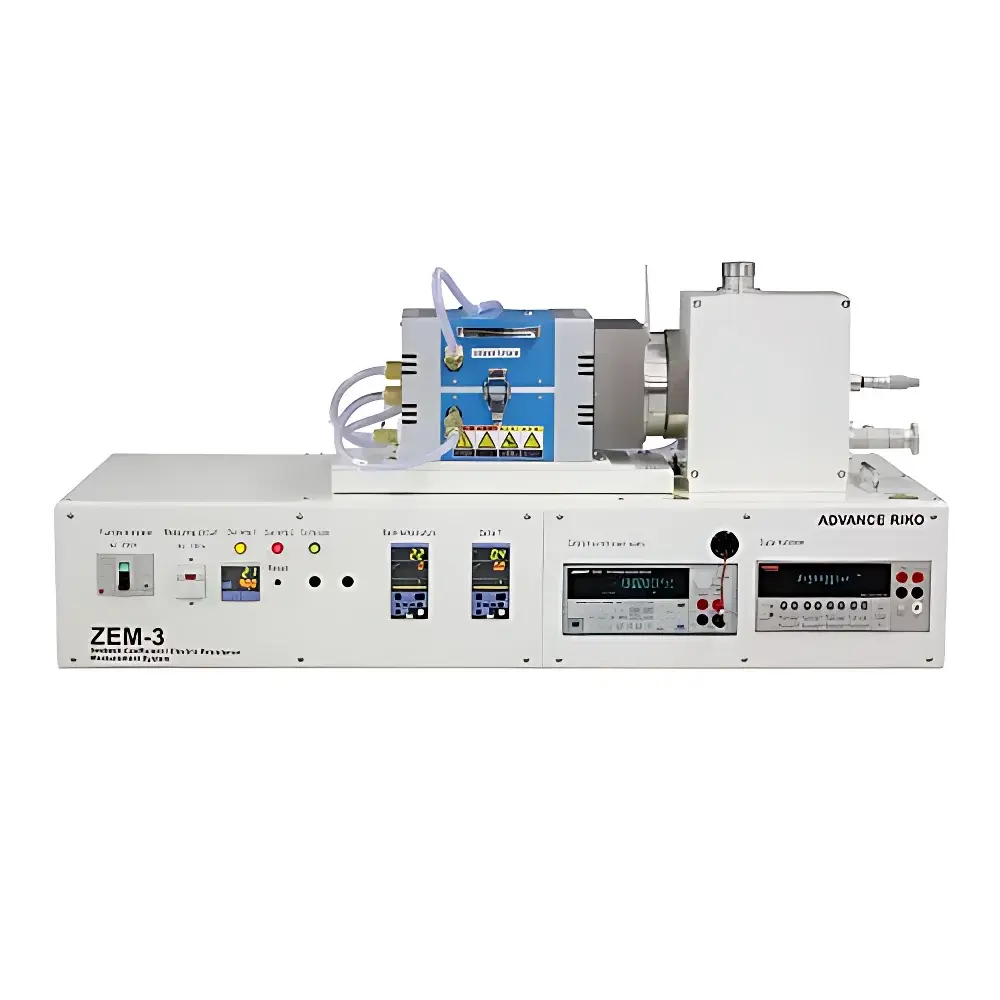
Advance Riko ZEM-3 Seebeck Coefficient and Electrical Resistivity Measurement System
| Brand | Advance Riko |
|---|---|
| Origin | Japan |
| Model | ZEM-3 |
| Temperature Range | 50–800 °C (ZEM-3M8) / 50–1000 °C (ZEM-3M10) |
| Sample Geometry | Square (2–4 mm × 6–22 mm L) or Circular (Ø2–4 mm × 6–22 mm L) |
| Heating Method | Infrared gold-coated furnace with micro-heater for ΔT control |
| Max. Sample ΔT | 50 °C |
| Atmosphere | Ultra-high-purity helium (99.999%) |
| Automation | Fully computer-controlled measurement with background EMF compensation |
| Contact Verification | Real-time V–I curve analysis for ohmic contact validation |
| Optional Accessories | Thin-film adapter, cryogenic module (−100 to 200 °C), high-resistivity kit (up to 10 MΩ) |
Overview
The Advance Riko ZEM-3 is a precision thermoelectric property characterization system engineered for simultaneous, quantitative measurement of the Seebeck coefficient (S) and electrical resistivity (ρ) of bulk and thin-film thermoelectric materials. Based on the steady-state differential method—compliant with ASTM E1577 and ISO 8503-2—it applies a controlled thermal gradient across a sample while measuring the resulting thermoelectric voltage and four-point probe resistance. This dual-parameter acquisition eliminates inter-instrument calibration drift and ensures intrinsic correlation between S and ρ data, critical for accurate calculation of power factor (S²σ) and figure-of-merit (zT). The system operates under inert helium atmosphere to suppress oxidation during high-temperature testing and features active ΔT stabilization via integrated micro-heaters, enabling reproducible measurements at temperature increments as fine as 1 °C from 50 °C up to 800 °C (ZEM-3M8) or 1000 °C (ZEM-3M10).
Key Features
- Infrared gold-coated heating furnace with rapid thermal response and ±0.5 °C temperature stability over full operating range
- Computer-synchronized dual-channel measurement: thermovoltage acquisition (nano-volt resolution) and four-point DC resistivity (μΩ–MΩ range)
- Automated background EMF compensation routine executed prior to each temperature step, eliminating thermal offset artifacts
- Real-time V–I curve generation for automatic ohmic contact verification—rejects non-linear contacts before data recording
- Modular design supporting optional accessories: thin-film adapter (for samples ≥100 nm thickness), cryogenic stage (−100 to 200 °C), and high-resistivity module (extended range up to 10 MΩ)
- Compliance-ready architecture: audit trail logging, user-access controls, and timestamped raw data export—aligned with GLP/GMP documentation requirements per FDA 21 CFR Part 11
Sample Compatibility & Compliance
The ZEM-3 accommodates diverse material classes—including doped semiconductors (e.g., SnSe, GeTe, AgSbTe₂), intermetallics (SiGe), chalcogenides, oxides, and conductive ceramics—without requiring metallization or complex sample preparation. Its flexible sample holder accepts square or cylindrical geometries (2–4 mm cross-section, 6–22 mm length), minimizing edge effects and ensuring uniform current/heat flux distribution. All measurements are performed under ultra-high-purity helium (99.999%), preventing surface degradation in air-sensitive compounds such as sulfides and tellurides. The system conforms to international standards for thermoelectric metrology: ASTM E1577 (Standard Test Method for Seebeck Coefficient of Thermoelectric Materials), ISO 8503-2 (Thermal conductivity and Seebeck coefficient determination), and supports traceable calibration using NIST-traceable reference materials (e.g., Constantan, Bi₂Te₃ standards).
Software & Data Management
ZEM-3 is operated via Advance Riko’s proprietary ZEM-Control Suite, a Windows-based application offering fully automated temperature ramping, multi-step isothermal hold protocols, and real-time data visualization. Raw voltage, current, and thermocouple signals are recorded at 10 Hz sampling rate with 24-bit ADC resolution. Software enforces data integrity through mandatory metadata tagging (operator ID, sample ID, atmosphere log, calibration certificate number) and generates compliant reports in PDF and CSV formats—including calculated S, ρ, σ, PF, and zT—with uncertainty propagation based on instrument specifications and sample geometry tolerances. Exported datasets include full audit logs required for regulatory submissions and peer-reviewed publication workflows.
Applications
- High-throughput screening of earth-abundant thermoelectrics (e.g., SnS, SnSe, Cu₂Se) for mid-temperature power generation (400–800 K)
- Quantification of band convergence effects in multiband systems—validated in recent Science studies on quadruple-band synglisis in SnS and momentum-aligned transport in Pb-doped SnSe
- High-entropy alloy optimization: correlating configurational disorder (e.g., Ge₀.₆₁Ag₀.₁₁Sb₀.₁₃Pb₀.₁₂Bi₀.₀₁Te) with electron localization and lattice thermal suppression
- Thin-film thermoelectric development for microcooling applications, enabled by film-specific correction algorithms in ZEM-Control Suite
- Accelerated aging studies: repeated thermal cycling under controlled ΔT to assess contact stability and interfacial degradation
FAQ
What temperature ranges does the ZEM-3 support?
The standard ZEM-3M8 configuration operates from 50 °C to 800 °C; the high-temperature ZEM-3M10 variant extends to 1000 °C. A cryogenic option (-100 to 200 °C) is available for low-T characterization of narrow-gap materials.
Can the ZEM-3 measure thin films?
Yes—using the optional thin-film adapter, which enables precise alignment and contact force control for samples ≥100 nm thick. Film-specific geometric corrections are applied automatically in software.
How is ohmic contact verified during measurement?
The system performs an in-situ V–I sweep before each thermoelectric run and analyzes linearity (R² > 0.9995 threshold); non-ohmic contacts trigger operator alert and abort protocol.
Is the system compatible with GLP/GMP environments?
Yes—audit trail logging, electronic signatures, and 21 CFR Part 11–compliant data export are natively supported without third-party add-ons.
What reference materials are recommended for calibration?
NIST-traceable Constantan (for Seebeck), pure copper (for resistivity), and certified Bi₂Te₃ standards (for combined S/ρ validation) are recommended per ASTM E1577 Annex A1.



