
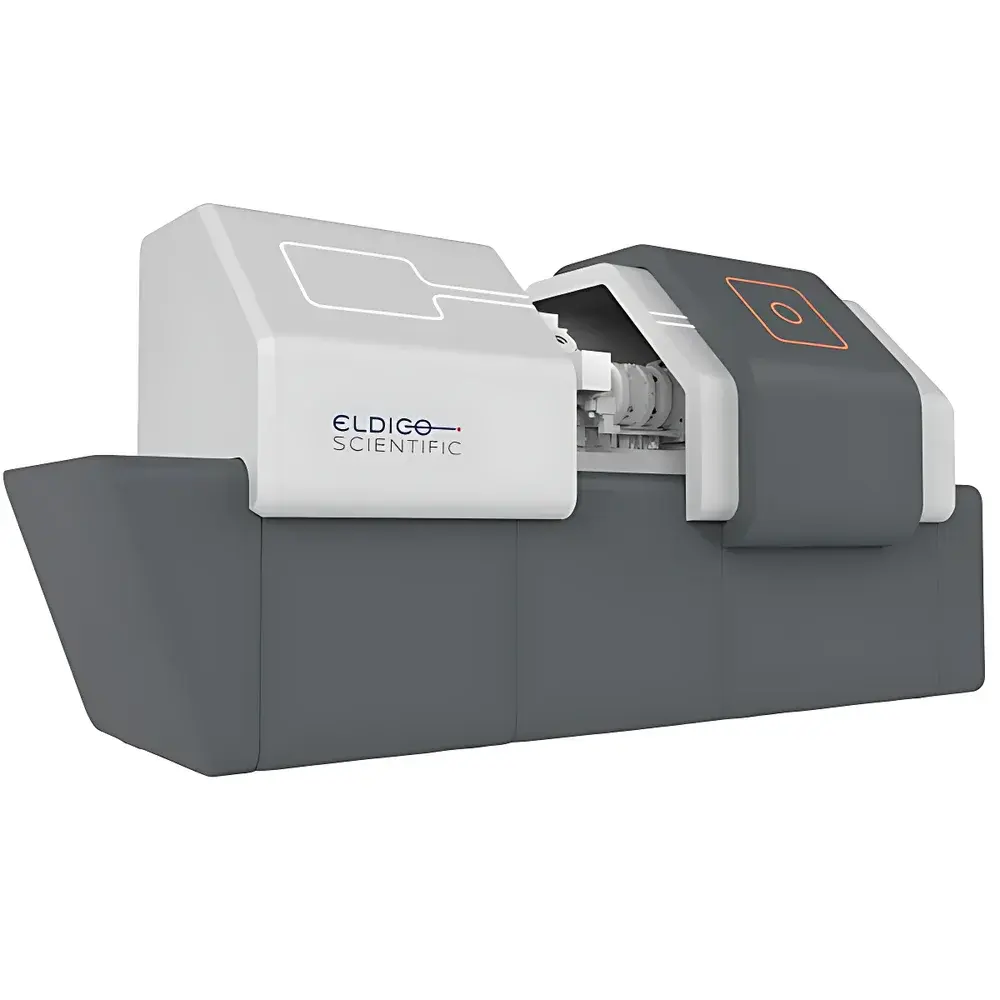
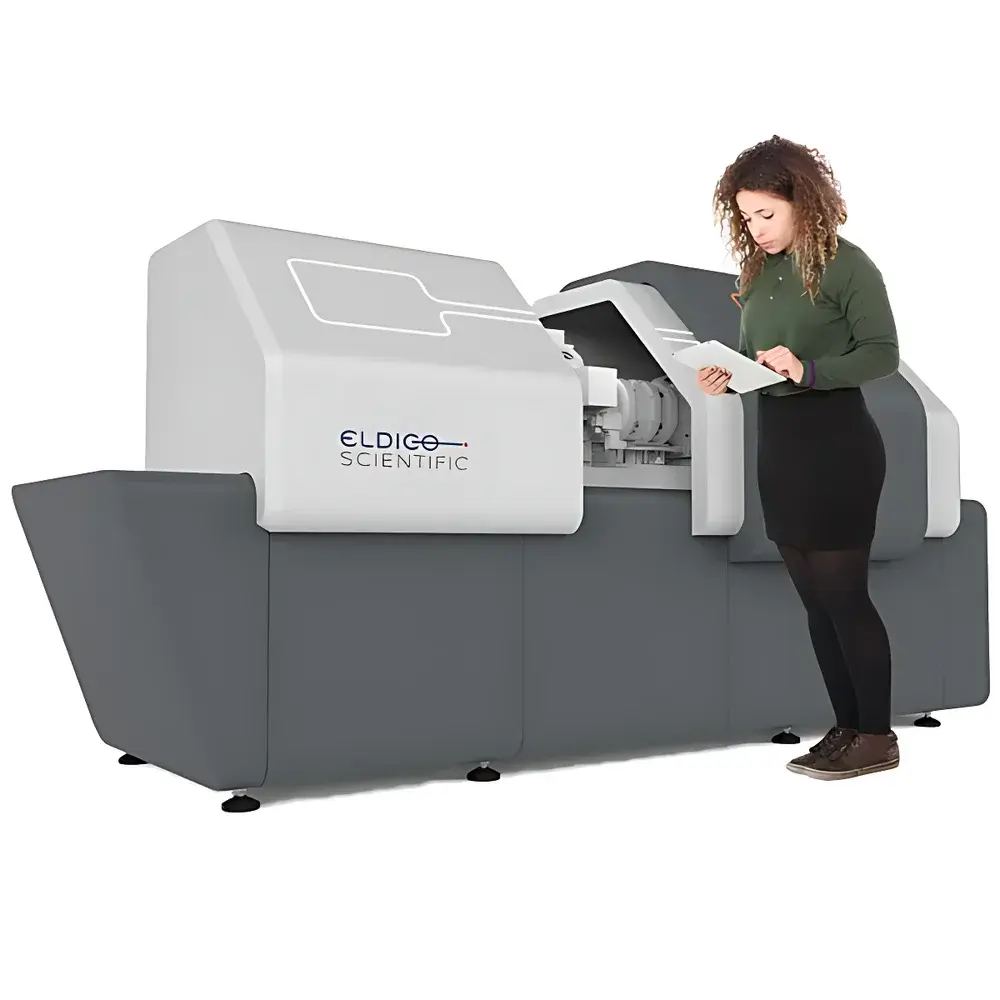
ELDICO ED-1 3D Microcrystal Electron Diffraction System
| Brand | ELDICO Scientific AG |
|---|---|
| Origin | Switzerland |
| Model | ED-1 |
| Instrument Type | Single-Crystal Electron Diffractometer |
| Sample Size Range | < 1000 nm |
| Beam Energy | 160 keV |
| Detector | DECTRIS QUADRO |
| Angular Precision | Sub-micrometer five-axis goniometer |
| Resolution | 0.82 Å |
| Chamber Geometry | Octagonal sample chamber |
Overview
The ELDICO ED-1 3D Microcrystal Electron Diffraction System is a purpose-built, high-precision electron diffractometer engineered for ab initio structural determination of nanoscale crystalline materials. Unlike conventional single-crystal X-ray diffractometers—whose resolution and success rate are constrained by crystal size requirements (>10 µm)—the ED-1 leverages 160 keV relativistic electrons to generate high-quality 3D diffraction datasets from crystals as small as <1000 nm. This capability stems from the significantly stronger interaction cross-section of electrons with matter compared to X-rays, enabling robust diffraction signal generation even from sub-micron or disordered microcrystalline domains. The system implements continuous rotation electron diffraction (cRED) methodology, where the sample rotates continuously during data acquisition, allowing full reciprocal space sampling with minimal beam damage. Designed and manufactured in Switzerland by ELDICO Scientific AG—a spin-off from ETH Zurich’s Center for Electron Microscopy and C-CINA Basel—the ED-1 bridges the gap between transmission electron microscopy (TEM) and dedicated crystallographic analysis, delivering single-crystal-quality structural data without the need for large, defect-free crystals.
Key Features
- Sub-micrometer five-axis goniometer with 360° continuous rotation capability, enabling full 3D reciprocal space mapping with sub-arcsecond angular reproducibility
- Integrated 160 keV high-brightness electron source optimized for low-dose, high-SNR diffraction from radiation-sensitive organic and hybrid materials
- DECTRIS QUADRO direct electron detection system with high dynamic range, single-electron sensitivity, and zero readout noise—ensuring quantitative intensity measurement critical for structure solution
- Octagonal vacuum chamber architecture supporting modular expansion: optional cryo-stage, energy-filtered imaging module, or in situ reaction cell integration
- Fully automated workflow—from sample loading and alignment to data collection, indexing, integration, and initial phasing—reducing user dependency and operator-induced variability
- Robust mechanical and thermal stability design, minimizing drift during multi-minute acquisitions required for high-resolution datasets
Sample Compatibility & Compliance
The ED-1 accommodates diverse sample formats including nanocrystalline powders, microcrystalline precipitates, MOF/COF thin films, zeolite aggregates, pharmaceutical polymorphs, and mixed-phase inorganic-organic composites. Its electron-based approach eliminates traditional constraints on crystal morphology, transparency, or macroscopic homogeneity. The system complies with international standards for structural characterization workflows: data integrity adheres to principles outlined in ICH Q5B (structural characterization of biotechnology products), ISO 17025 (general requirements for competence of testing laboratories), and supports audit-ready metadata logging aligned with GLP and GMP documentation practices. While not an FDA-regulated device per se, its output meets the evidentiary threshold for regulatory submissions requiring atomic-level structural confirmation (e.g., USP , EP 2.2.31).
Software & Data Management
The ED-1 operates via ELDICO’s proprietary AcqSuite™ software platform, which integrates real-time beam alignment, auto-centering, dose-controlled exposure, and on-the-fly diffraction pattern indexing. Raw .tif/.h5 datasets are stored with embedded experimental metadata (voltage, tilt range, exposure time, detector gain, stage position). Integrated processing pipelines support standard crystallographic workflows—including space group determination (using POINTLESS), intensity integration (AIMLESS), structure solution (SHELXT), and refinement (SHELXL)—with native compatibility for CCP4, Phenix, and Olex2 environments. All processing steps are timestamped and logged with user ID and parameter history, satisfying traceability requirements under 21 CFR Part 11 for electronic records and signatures in regulated environments.
Applications
- De novo structure determination of metal–organic frameworks (MOFs) and covalent organic frameworks (COFs) where bulk crystallization fails
- Polymorph identification and relative stability assessment in active pharmaceutical ingredients (APIs) using sub-milligram quantities
- Phase mapping of heterogeneous catalysts and battery electrode materials containing nanoscale crystalline domains embedded in amorphous matrices
- Absolute configuration assignment of chiral small molecules without heavy-atom derivatives or anomalous scattering agents
- Structural validation of synthetic intermediates and transient crystalline phases inaccessible via conventional SC-XRD
- Microcrystallinity screening in amorphous solid dispersions and lyophilized biologics formulations
FAQ
How does electron diffraction differ from X-ray diffraction in structural analysis?
Electron diffraction exploits the ~10⁴× stronger scattering power of electrons versus X-rays, permitting high-fidelity diffraction from crystals orders of magnitude smaller than those required for SC-XRD. However, dynamical scattering effects necessitate specialized data processing protocols—fully implemented in ED-1’s software stack.
Can the ED-1 handle beam-sensitive organic compounds?
Yes. The 160 keV beam, combined with dose fractionation and rapid data acquisition (<5 minutes per dataset), preserves molecular integrity while delivering interpretable diffraction intensities—even for fragile pharmaceuticals and porphyrinoids.
Is cryogenic operation supported?
The octagonal chamber architecture permits integration of a liquid-nitrogen-cooled stage (optional), enabling data collection at 100 K to mitigate radiation damage and improve signal-to-noise ratios for volatile or thermally labile samples.
What crystallographic software formats are natively supported?
ED-1 outputs standard .mtz files compliant with CCP4 conventions, along with .hkl and .ins files directly readable by SHELX, Olex2, and Phenix. Integration with CSD (Cambridge Structural Database) search and validation tools is also enabled.
Does the system require TEM expertise to operate?
No. ED-1 abstracts TEM-specific complexities through automated alignment routines and guided workflows. Operators with foundational crystallography training—not electron microscopy certification—can achieve reliable results after standardized qualification.
Related Products






