
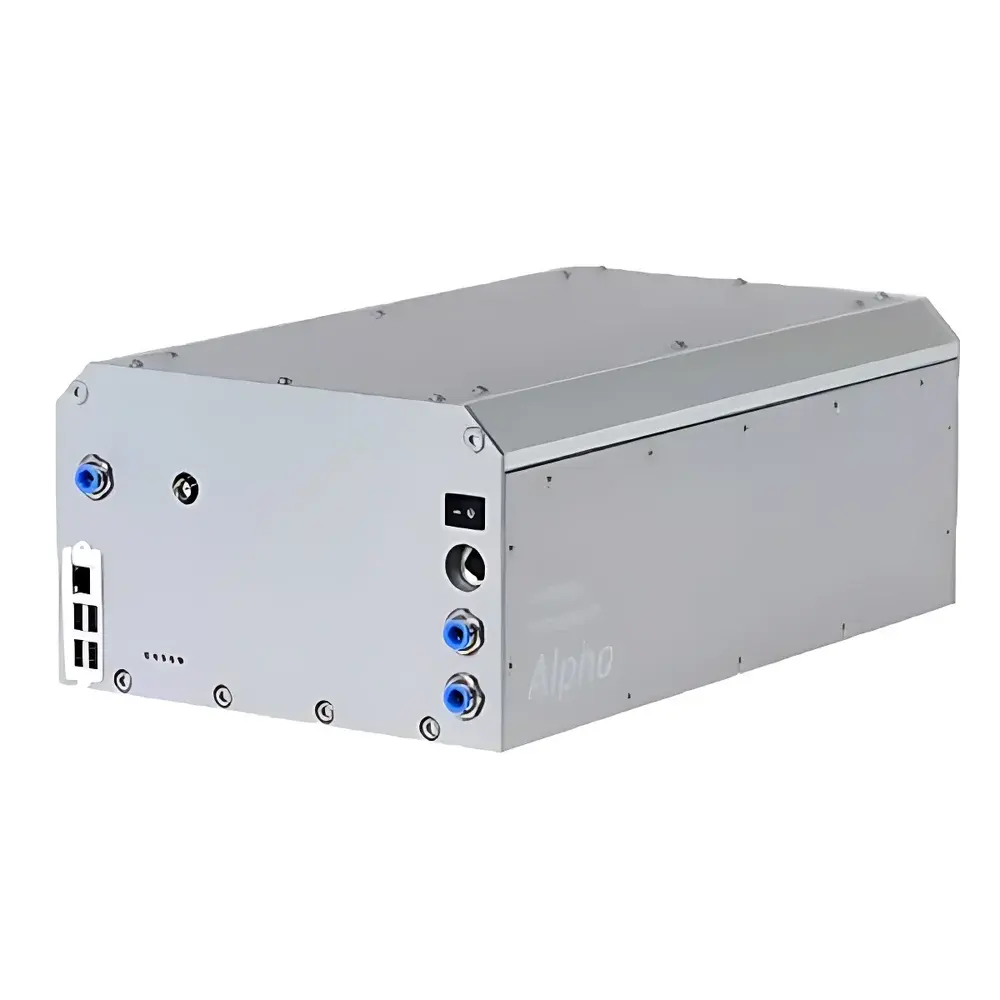
Stuttgart Instruments Alpha Ultrafast Continuously Tunable Femtosecond Laser System
| Brand | Stuttgart Instruments |
|---|---|
| Origin | Germany |
| Manufacturer Type | Authorized Distributor |
| Origin Category | Imported |
| Model | Alpha |
| Component Category | Tunable Ultrafast Light Source |
| Pulse Duration Options | 100 fs / 350 fs / 1 ps |
| Tuning Mechanism | Fiber-Feedback Optical Parametric Oscillator (FF-OPO) |
| Power Stability | <0.5% RMS |
| Spectral Stability | <0.02% RMS |
| Wavelength Reproducibility | <0.1 nm |
| Intensity Noise | <−160 dB/Hz (relative intensity noise, RIN, at 1 MHz) |
Overview
The Stuttgart Instruments Alpha Ultrafast Continuously Tunable Femtosecond Laser System is a high-performance, fiber-feedback optical parametric oscillator (FF-OPO)-based light source engineered for precision spectroscopic and nonlinear optical applications requiring broad spectral coverage, exceptional temporal coherence control, and long-term operational stability. Unlike conventional OPO architectures, the Alpha series employs a passively stabilized cavity design with intrinsic mode-locking feedback, eliminating active electronic stabilization loops and significantly reducing sensitivity to environmental perturbations. This architecture delivers shot-to-shot phase stability essential for time-resolved pump–probe experiments, coherent anti-Stokes Raman scattering (CARS), and stimulated Raman scattering (SRS) microscopy. The system operates in the near-infrared to mid-infrared spectral range (typically 1.1–4.0 µm signal/idler output), with optional harmonic generation extending coverage into the visible (550–1000 nm). Its fundamental repetition rate is fixed at 80 MHz (standard), with custom configurations available upon request. Designed for integration into advanced optical laboratories, the Alpha system meets the mechanical, thermal, and electromagnetic compatibility requirements of ISO 14644 Class 5 cleanroom environments and complies with IEC 61000-6-3 (EMI emission) and IEC 61000-6-2 (immunity) standards.
Key Features
- Fiber-feedback OPO architecture enabling passive, long-term wavelength stability without active lock electronics
- Three standard pulse duration variants: 100 fs, 350 fs, and 1 ps — each optimized for specific nonlinear interaction cross-sections and dispersion management
- Automated, software-controlled continuous tuning across >2000 nm spectral bandwidth with <0.1 nm reproducibility
- Intensity noise floor <−160 dB/Hz (RIN), approaching the quantum-limited shot-noise floor critical for heterodyne detection and low-light spectroscopy
- Integrated synchronization output module supporting state snapshotting and one-click restoration of full system configuration (wavelength, power, module selection)
- Optional high-speed electro-optic modulator enabling synchronized amplitude modulation across all output beams via single TTL/analog input
- Narrow-linewidth option (<10 cm⁻¹) available for visible, NIR, and MIR bands — suitable for high-resolution vibrational imaging and cavity-enhanced absorption spectroscopy
- Multi-branch configuration support: up to four optically synchronized, independently tunable output arms for parallelized pump–probe or multi-color excitation schemes
Sample Compatibility & Compliance
The Alpha system is compatible with standard optical tables, vacuum-compatible beam paths (with optional vacuum feedthroughs), and common ultrafast diagnostic tools including autocorrelators, FROG devices, and spectrometers equipped with InGaAs or MCT detectors. It supports alignment-free coupling into single-mode fibers (SMF-28 or PM980) and free-space collimated beam delivery. All optical components conform to RoHS 2011/65/EU and REACH SVHC regulations. Firmware and control software comply with FDA 21 CFR Part 11 requirements for audit trail logging, user access control, and electronic signature support — making the system suitable for GLP/GMP-regulated analytical laboratories. Full traceability documentation (including calibration certificates per ISO/IEC 17025) is provided with each unit.
Software & Data Management
AlphaTune is the native GUI-based control suite built on Qt and Python 3.9, offering real-time spectral monitoring, automated wavelength calibration using internal reference lines, and scriptable experiment sequencing via RESTful API. All system states — including motor positions, laser diode currents, temperature setpoints, and modulator bias voltages — are logged with microsecond timestamp resolution to HDF5 files compliant with NeXus format standards. Data export supports CSV, MATLAB .mat, and ASDF formats. Integration with LabVIEW, MATLAB, and Python-based acquisition frameworks (e.g., PyVISA, PycroManager) is supported through documented DLL and TCP/IP interfaces. Audit trails record operator login/logout events, parameter changes, and firmware updates — fully traceable for regulatory review.
Applications
- Coherent Raman microscopy (SRS/CARS) for label-free chemical imaging of biological tissues and polymer composites
- Time-resolved pump–probe spectroscopy of carrier dynamics in 2D materials and perovskite photovoltaics
- Mid-infrared vibrational spectroscopy for gas-phase molecular fingerprinting and breath analysis
- Scanning near-field optical microscopy (SNOM) with sub-diffraction spatial resolution
- Multi-photon fluorescence lifetime imaging (FLIM) using tunable excitation for spectral unmixing
- Frequency-comb-referenced metrology and absolute frequency calibration of high-finesse cavities
FAQ
What pump laser sources are compatible with the Alpha system?
The Alpha series is designed for seamless integration with industry-standard Yb-fiber femtosecond oscillators (e.g., Toptica FemtoFErb, Menlo Systems C-Fiber) delivering ~1040 nm center wavelength, 80 MHz repetition rate, and ≥1 W average power.
Can the Alpha system be operated in a Class 100 cleanroom environment?
Yes — the optical head and controller chassis meet ISO 14644-1 Class 5 particulate limits when installed with filtered air purge and vibration-isolated optical tables.
Is remote operation supported over Ethernet or USB?
Full bidirectional control is supported via Gigabit Ethernet (TCP/IP) with TLS 1.2 encryption; USB 3.0 is available for local debugging and firmware updates only.
Does the narrow-linewidth option affect tuning speed or power stability?
No — spectral narrowing is achieved via intracavity etalons without compromising RMS power stability (<0.5%) or tuning repeatability (<0.1 nm).
How is wavelength calibration performed, and how often is recalibration required?
Internal iodine vapor absorption lines serve as primary references; factory calibration is valid for 12 months under normal operating conditions, with optional annual traceable recalibration available through Stuttgart Instruments’ accredited service lab.





