
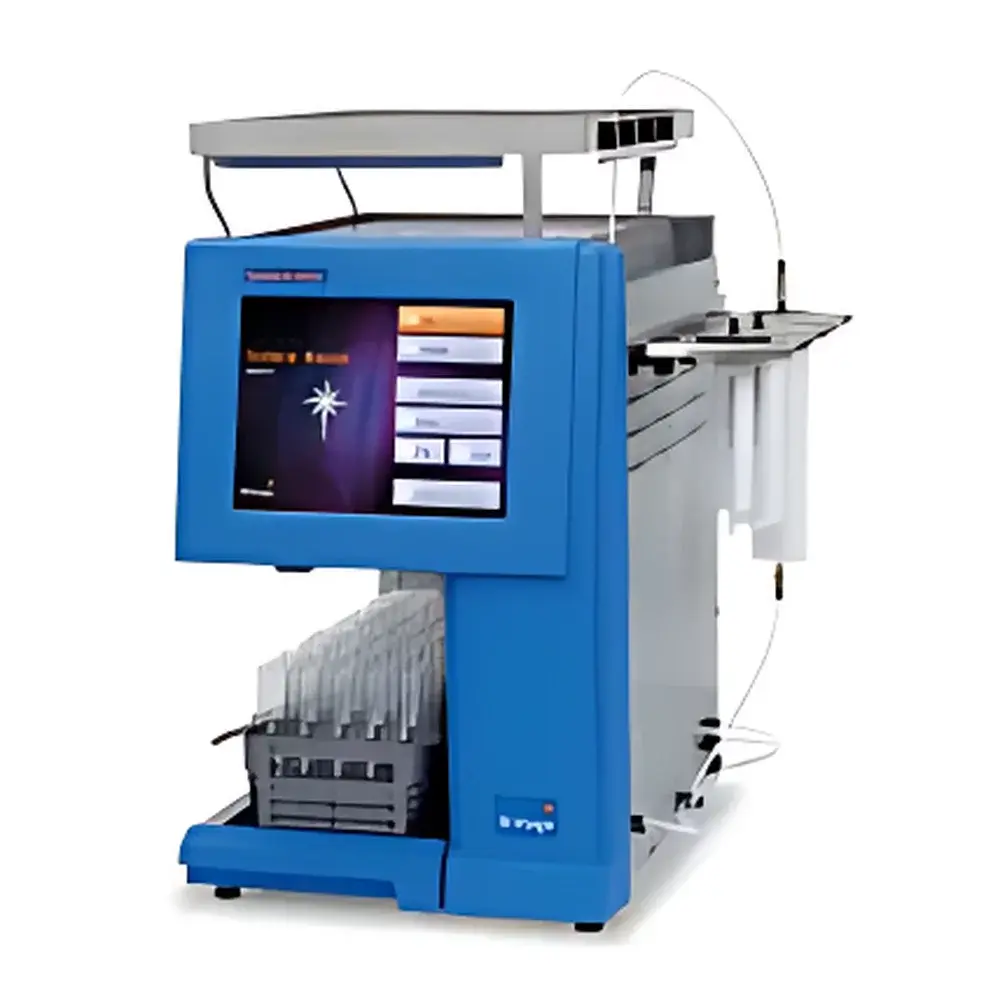
Biotage Isolera Automated Flash Chromatography System
| Brand | Biotage |
|---|---|
| Origin | Sweden |
| Model | Isolera |
| Instrument Type | Medium- to Low-Pressure Preparative Liquid Chromatography |
| Flow Rate Range | 1–200 mL/min |
| Maximum Pressure | 145 psi (10 bar) |
| Detection Wavelengths | 254 nm, 200–400 nm, 200–800 nm (optional) |
| UV Flow Cell Path Length | 0.3 mm |
| Fraction Collection Tube Diameters | 13, 16, 18, or 25 mm |
| Solvent Channels | 2 or 4 (configurable) |
| Sample Loading Capacity | mg to 75 g |
| Application Level | Laboratory-Scale Purification |
Overview
The Biotage Isolera is an automated, medium-to-low-pressure flash chromatography system engineered for rapid, reproducible purification of organic compounds in synthetic chemistry, natural product isolation, and early-stage pharmaceutical development. Operating on the principle of normal- or reversed-phase liquid chromatography, the Isolera platform integrates intelligent method translation from thin-layer chromatography (TLC) data with real-time UV spectral acquisition and adaptive baseline correction—enabling robust separation of complex mixtures without prior knowledge of compound absorbance maxima. Designed for laboratory-scale throughput, it bridges the gap between manual flash systems and high-pressure preparative HPLC, delivering consistent resolution at pressures up to 10 bar (145 psi), with flow rates scalable from 1 mL/min for micro-scale purifications to 200 mL/min for gram-scale isolations.
Key Features
- TLC-to-Step Gradient Prediction: Converts Rf values from user-supplied TLC plates into optimized step-gradient elution profiles—reducing method development time by 20–50% while maintaining separation fidelity.
- Intelligent Column & Method Recommendation: Based on input parameters—including target compound polarity, sample mass, and solvent compatibility—the system recommends appropriate column dimensions (e.g., silica or C18), flow rate, gradient slope, and total solvent volume required for complete elution.
- λ-All Full-Spectrum UV Detection: Captures absorbance across 200–800 nm in real time, eliminating the need for pre-defined detection wavelengths. This capability enhances detection sensitivity for unknown or weakly absorbing analytes and minimizes sample loss due to suboptimal wavelength selection.
- Dynamic Baseline Correction: Compensates for UV-absorbing solvents during gradient elution by continuously modeling and subtracting solvent-induced baseline drift—improving peak integration accuracy and enabling precise, trigger-based fraction collection.
- Modular Solvent Delivery: Configurable dual- or quad-solvent channels support binary, ternary, or quaternary gradient formation with seamless solvent switching and automatic line priming.
- Flexible Fraction Collection: Supports standard tube formats (13, 16, 18, and 25 mm OD) with programmable collection logic—including time-, peak-, or threshold-based triggers—and optional UV-triggered re-collection for overlapping peaks.
Sample Compatibility & Compliance
The Isolera accommodates a broad range of sample types—from milligram-scale reaction mixtures to 75 g crude extracts—across silica, diol, amino, cyano, and reversed-phase media. Its low-pressure architecture ensures compatibility with standard glass or plastic columns (4–340 g stationary phase), including disposable cartridges and custom-packed beds. The system complies with fundamental GLP documentation requirements through audit-trail-enabled software logging (user actions, method parameters, run timestamps, and detector output). While not certified for GMP production environments, its operational consistency and traceability align with ASTM D8077–17 (Standard Guide for Flash Chromatography) and supports method validation per ICH Q2(R2) principles when integrated into controlled laboratory workflows.
Software & Data Management
Controlled via Biotage’s intuitive Isolera Software (v6.x or later), the system provides a fully navigable GUI for method creation, real-time chromatogram visualization, spectral overlay, and post-run analysis. All acquisition and processing metadata—including raw UV spectra, gradient profiles, flow/pressure logs, and fraction mapping—are stored in vendor-neutral .csv and .pdf formats. The software supports 21 CFR Part 11-compliant user access control (role-based permissions), electronic signatures, and immutable audit trails—facilitating regulatory review in academic, CRO, and preclinical research settings. Data export is compatible with third-party cheminformatics platforms (e.g., ChemDraw, ELN integrations via API).
Applications
- Rapid purification of intermediates and final products in multi-step organic synthesis
- Isolation of bioactive constituents from plant extracts, fermentation broths, or marine sources
- Parallel purification of compound libraries for structure–activity relationship (SAR) studies
- Desalting and buffer exchange of peptides and small-molecule conjugates
- Method scouting and scalability assessment prior to transfer to analytical or preparative HPLC
FAQ
What pressure range does the Isolera operate within, and how does that affect column selection?
The Isolera operates at pressures up to 10 bar (145 psi), making it suitable for standard flash silica columns, prepacked cartridges, and polymeric reversed-phase media—not for sub-2 µm HPLC-grade particles.
Can the system automatically detect and collect fractions based on UV spectral deconvolution?
No—it does not perform real-time spectral deconvolution. However, λ-All acquisition enables retrospective peak identification and re-triggering of collection based on stored full-spectrum data.
Is method transfer from TLC guaranteed to yield identical selectivity?
TLC-to-Step prediction provides a high-probability starting point; minor optimization of gradient slope or solvent strength may be required depending on column batch variability and mobile phase compressibility.
Does the Isolera support automated system suitability testing (SST)?
SST is not automated, but users can define retention time windows, peak symmetry thresholds, and resolution criteria within the software for manual pass/fail evaluation per run.
What solvent compatibility limitations apply to the fluidic path?
The wetted materials (PEEK, stainless steel, sapphire) are compatible with common organic solvents (DCM, EtOAc, MeOH, ACN, hexane) and aqueous buffers (pH 2–8); strong acids, bases, or halogenated solvents above 50% concentration require validation for long-term seal integrity.







