
Attocube attoAFM/MFM/SHPM Cryogenic and High-Magnetic-Field Integrated Scanning Probe Microscopy System
| Brand | Attocube Systems AG |
|---|---|
| Origin | Germany |
| Model | attoAFM/attoMFM/attoSHPM |
| Temperature Range | mK to 373 K |
| Magnetic Field Compatibility | Up to 15 T |
| Scan Range (4 K) | 30 µm × 30 µm |
| Lateral Resolution (MFM) | <11 nm |
| Lateral Resolution (SHPM) | 250 nm (high-res mode) |
| Z-Noise (4 K) | 0.05 nm RMS |
| Z-Bit Resolution (full range) | 7.6 pm |
| XY-Bit Resolution (4 K, 12 µm scan) | 0.18 nm |
| Vacuum/He Atmosphere | 1×10⁻⁶ mbar to 1 bar |
| Compatible Cryostats | Quantum Design PPMS, 1″ & 2″ bore systems |
| Modular Functionality | AFM, MFM, SHPM, c-AFM, EFM, STM, SNOM, Confocal Microscopy |
Overview
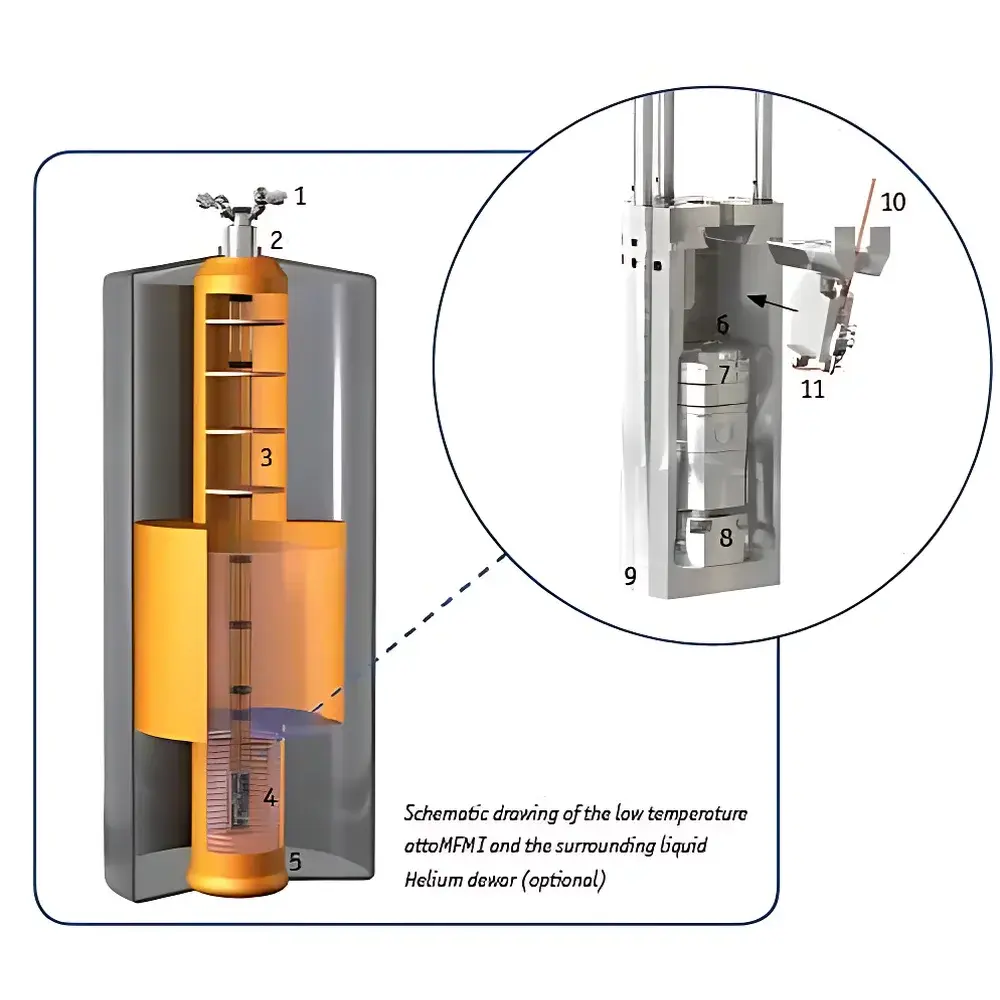
The Attocube attoAFM/MFM/SHPM system is a fully integrated, cryogenic scanning probe microscopy platform engineered for quantitative nanoscale magnetic and electronic characterization under extreme conditions—specifically ultra-low temperatures (down to millikelvin), high magnetic fields (up to 15 Tesla), and controlled vacuum or helium exchange gas environments. Unlike conventional room-temperature SPM instruments, this system implements a sample-scanning architecture with fixed probes, eliminating thermal drift and mechanical coupling issues inherent in cantilever-scanning designs. Its core measurement modalities operate on distinct physical principles: magnetic force microscopy (MFM) detects gradient forces between a magnetized tip and sample magnetization via frequency-shift or phase-shift detection in dynamic mode; scanning Hall probe microscopy (SHPM) employs molecular-beam-epitaxy (MBE)-grown GaAs/AlGaAs heterostructure Hall sensors to map local magnetic induction quantitatively and non-invasively; and atomic force microscopy (AFM) modes—including contact, intermittent-contact (tapping), and non-contact—provide topographic reference and complementary electrical property mapping (e.g., conductivity, surface potential). The system is purpose-built for studies requiring simultaneous control of thermodynamic and electromagnetic boundary conditions, such as vortex imaging in type-II superconductors, domain wall dynamics in ferromagnets, spin texture analysis in skyrmionic materials, and local susceptibility measurements in quantum magnets.
Key Features
- Modular, function-switchable architecture: Users interchange only the probe head and optical path components—no realignment or recalibration required—to transition between AFM, MFM, and SHPM operation.
- Cryogenic-optimized closed-loop piezo scanners: Achieve sub-angstrom Z-bit resolution (0.03 nm at 4 K over 2 µm range) and lateral bit resolution of 0.18 nm (XY, 4 K, 12 µm scan), ensuring traceable, reproducible positioning under thermal contraction.
- Ultra-low-noise detection: RMS z-noise of 0.05 nm at 4 K enables reliable height tracking during magnetic field sweeps or temperature ramps without feedback saturation.
- High-field compatibility: Designed for seamless integration with Quantum Design PPMS, Oxford Teslatron PT, and other 1″–2″ bore cryomagnets; maintains full functionality up to 15 T without sensor saturation or mechanical deformation.
- Multi-modal extensibility: Supports upgrade paths to conductive AFM (c-AFM), electrostatic force microscopy (EFM), scanning tunneling microscopy (STM), near-field optical microscopy (SNOM), and confocal fluorescence imaging via shared XYZ stage and optical access ports.
- Real-time position monitoring: Integrated external CCD camera provides live visual feedback of sample location inside the cryostat, critical for region-of-interest targeting and post-measurement correlation.
Sample Compatibility & Compliance
The attoAFM/MFM/SHPM accommodates a broad range of solid-state samples—including single crystals, thin films, exfoliated 2D materials, patterned nanostructures, and superconducting devices—mounted on standard 10 mm × 10 mm substrates or custom holders compatible with PPMS puck geometry. All operational parameters adhere to internationally recognized metrological frameworks: displacement linearity and hysteresis are characterized per ISO 25178-601; thermal stability and magnetic field homogeneity are validated against ASTM E2913 for low-temperature instrumentation; and data acquisition timestamps, parameter logs, and user actions are recorded with audit-trail capability compliant with GLP and FDA 21 CFR Part 11 requirements when paired with optional secure software licensing. Vacuum integrity (1×10⁻⁶ mbar base pressure) and He exchange gas compatibility meet IEC 61000-4-8 standards for electromagnetic environment resilience.
Software & Data Management
Control and analysis are executed via Attocube’s proprietary attoDRY software suite, built on a deterministic real-time kernel supporting synchronized acquisition across multiple channels (topography, frequency shift, phase, Hall voltage, current, temperature, field). Raw data are stored in HDF5 format with embedded metadata (calibration constants, environmental logs, instrument configuration), enabling FAIR (Findable, Accessible, Interoperable, Reusable) compliance. Batch processing pipelines support automated vortex identification in superconducting films, domain segmentation in multiferroics, and quantitative B-field reconstruction from SHPM voltage maps using finite-element-based inversion models. Export modules interface directly with Python (via PySPM), MATLAB, and IGOR Pro for advanced statistical modeling, machine learning–assisted feature extraction, or integration into laboratory information management systems (LIMS).
Applications
- Quantitative imaging of Abrikosov vortices and pinning landscapes in high-Tc and iron-based superconductors under variable H–T conditions.
- Nanoscale mapping of stray fields from magnetic nanoparticles, skyrmions, and domain walls in Co/Pt multilayers or FeGe thin films.
- Local magnetization reversal and hysteresis loop acquisition at individual grain boundaries or defect sites.
- Correlative topography–magnetism–conductivity studies in van der Waals heterostructures (e.g., CrI3/graphene, MnBi2Te4/WSe2).
- In situ observation of magnetic phase transitions (e.g., spin reorientation, metamagnetism) with millikelvin thermal resolution.
- Calibration-free magnetic induction quantification via SHPM for standards development in nanomagnetism metrology.
FAQ
Is the system compatible with Quantum Design PPMS platforms?
Yes—the attoAFM/MFM/SHPM is mechanically and electronically designed for direct integration with PPMS systems featuring 1″ or 2″ bore cryostats and split-pair or superconducting magnets.
What is the minimum detectable magnetic field gradient in MFM mode at 100 mK?
MFM sensitivity is limited by thermal noise and cantilever Q-factor; typical gradient resolution is ~100 µT/µm at 100 mK using high-Q silicon cantilevers and PLL-based frequency detection.
Can SHPM operate simultaneously with AFM topography feedback?
Yes—SHPM uses an independent STM or tuning-fork-based distance control loop, allowing concurrent acquisition of Hall voltage and topographic height without cross-talk.
Does the system support automated temperature- and field-swept data acquisition?
Yes—attoDRY software includes programmable multi-dimensional parameter sweeps (T, H, time) with trigger-synchronized data capture and error-handling protocols for unattended overnight runs.
Are calibration standards provided for quantitative SHPM field mapping?
Attocube supplies traceable GaAs Hall sensor calibration certificates (NIST-traceable at 4.2 K and 300 K), along with reference datasets for common test structures (e.g., lithographic current loops, Ni nanodots).



