
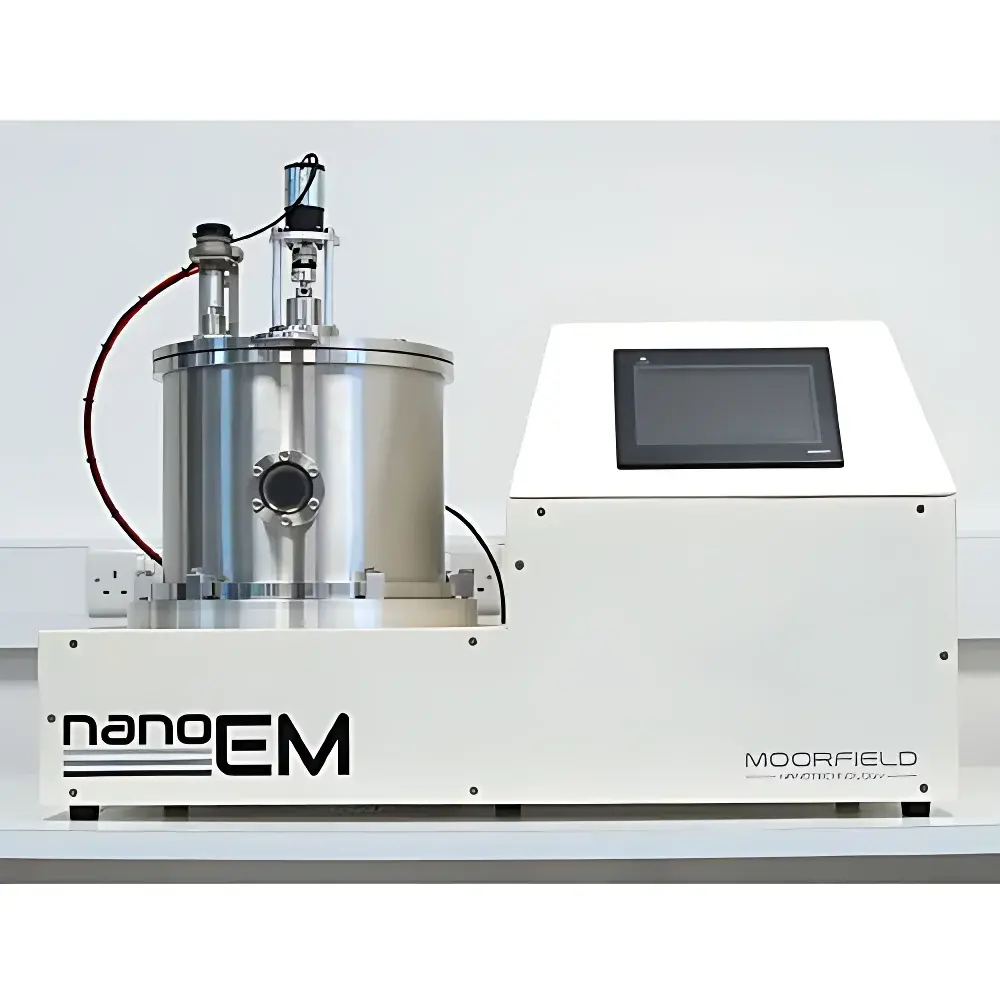
Moorfield nanoEM Advanced Multi-Function Magnetron Sputter Coater
| Brand | Moorfield |
|---|---|
| Origin | United Kingdom |
| Model | nanoEM |
| Target Material | Metal |
| Target Diameter | 2 inch |
| Control System | Fully Automatic Touchscreen Interface |
| Chamber Volume | 13 L |
| Sample Stage Diameter | 3 inch |
| Sputtering Gas | Argon (Ar) |
| Base Pressure | <5×10⁻⁷ mbar |
| DC Sputtering Power Output | Up to 300 W |
| Vacuum Pump Options | Configurable |
| Optional Features | Stage Rotation & Tilt, Plasma Glow Monitoring, Quartz Crystal Thickness Monitor, Pneumatic Shutter, Viewport, Auto Pressure Control |
| Compliance | Designed for ISO Class 5 cleanroom compatibility |
| Safety | Interlocked chamber door, overpressure/overtemperature protection, real-time arc suppression |
Overview
The Moorfield nanoEM is a compact, high-vacuum magnetron sputter coater engineered for precision conductive coating of non-conductive specimens prior to scanning electron microscopy (SEM), transmission electron microscopy (TEM), and energy-dispersive X-ray spectroscopy (EDS) analysis. Utilizing DC magnetron sputtering physics—where argon ions bombard a metallic target under controlled low-pressure plasma conditions—the system deposits uniform, ultra-thin (sub-nanometer to tens of nanometers), and low-stress metal films (e.g., Au, Pt, Au/Pd, Cr, Ir) with exceptional reproducibility. Its modular architecture enables seamless transition from routine SEM sample preparation to advanced thin-film deposition research, including sequential multi-target sputtering and in-situ thickness monitoring. The nanoEM operates within a stainless-steel UHV-compatible chamber, achieving a base pressure of <5×10⁻⁷ mbar via turbomolecular pumping, ensuring minimal hydrocarbon contamination and optimal film purity.
Key Features
- Fully automated touchscreen interface with guided workflow protocols—eliminates operator-dependent variability and supports repeatable process recall.
- Dual 2-inch magnetron sputter sources—enables co-sputtering or sequential deposition without venting; compatible with standard conductive targets (Au, Pt, Cr, Ir, Ni, Ti).
- 3-inch diameter rotating and tilting sample stage—ensures uniform coating on irregular or topographically complex specimens; tilt range ±90°, rotation speed 0–30 rpm adjustable.
- Integrated mass flow controller (MFC) for precise Ar gas dosing—maintains stable plasma impedance across varying chamber pressures (1×10⁻³ to 5×10⁻¹ mbar).
- 300 W DC power supply with real-time arc detection and suppression—minimizes arcing-induced defects and preserves target integrity during extended runs.
- UHV-grade chamber (13 L volume) with all-metal seals and bake-out capability—supports cleanroom (ISO 5) integration and long-term vacuum stability.
- Comprehensive safety architecture—including door interlock, emergency stop, overpressure relief valve, and temperature-monitored power supply.
Sample Compatibility & Compliance
The nanoEM accommodates a broad spectrum of specimen geometries and substrates: standard 3.05 cm SEM stubs, TEM grids (200–400 mesh), silicon wafers, glass slides, biological cryo-sections, and porous or fragile materials such as aerogels or MOFs. Its low-energy sputtering regime (<100 eV ion energy) mitigates beam damage and thermal degradation—critical for beam-sensitive organic and polymeric samples. The system complies with IEC 61000-6-2 (EMC immunity) and IEC 61000-6-4 (EMC emissions), and its vacuum and electrical design conforms to CE machinery directive 2006/42/EC. When equipped with audit-trail-enabled software (optional), the nanoEM meets GLP and GMP documentation requirements for regulated laboratories conducting materials characterization per ASTM E1558, ISO 13787, and USP .
Software & Data Management
The nanoEM’s embedded control firmware logs all critical process parameters—including time-stamped pressure profiles, gas flow rates, power delivery, stage position, and arc event history—in CSV format for traceability. Optional PC-based software provides remote monitoring, recipe library management, and export to LIMS-compatible formats. With optional quartz crystal microbalance (QCM) integration, real-time thickness feedback (±0.1 nm resolution) enables endpoint control for monolayer-level deposition. All data files are timestamped, user-authenticated, and stored locally with SHA-256 hash verification—supporting FDA 21 CFR Part 11 compliance when paired with electronic signature modules.
Applications
- Routine SEM sample preparation: high-resolution gold/palladium coating of insulating geological, ceramic, or polymer samples.
- TEM grid metallization: ultra-thin chromium or iridium layers for electron transparency and charging mitigation.
- Nanomaterial functionalization: conformal metal seeding for subsequent electroless plating or catalyst nucleation.
- Reference standard fabrication: calibrated conductive coatings for quantitative EDS calibration.
- Thin-film research: exploratory sputter-deposition of bilayer stacks, alloy films, or gradient compositions using dual-source configuration.
- Cryo-SEM workflows: low-temperature compatible stage options enable in-situ cryo-coating without ice contamination.
FAQ
What vacuum level does the nanoEM achieve, and which pump configuration is recommended for optimal performance?
The system achieves a base pressure of <5×10⁻⁷ mbar using a standard 200 L/s turbomolecular pump backed by a dry scroll pump. For applications requiring ultra-low hydrocarbon background (e.g., XPS-compatible coatings), a cryo-pumped configuration is available as an option.
Can the nanoEM be used for reactive sputtering (e.g., with O₂ or N₂)?
Yes—when fitted with a multi-gas MFC and corrosion-resistant internal components, the nanoEM supports reactive sputtering of oxides (e.g., ITO, SiO₂) and nitrides (e.g., TiN), subject to appropriate target and chamber conditioning protocols.
Is remote diagnostics or service support available?
Moorfield provides secure remote access for firmware updates and diagnostic troubleshooting via encrypted VNC, subject to customer network policy approval and signed support agreement.
How often does the system require preventive maintenance?
Recommended maintenance includes quarterly O-ring inspection, annual turbopump bearing check, and biannual calibration of the pressure gauge and MFC—documented in the included maintenance logbook and aligned with ISO/IEC 17025 laboratory quality requirements.



