
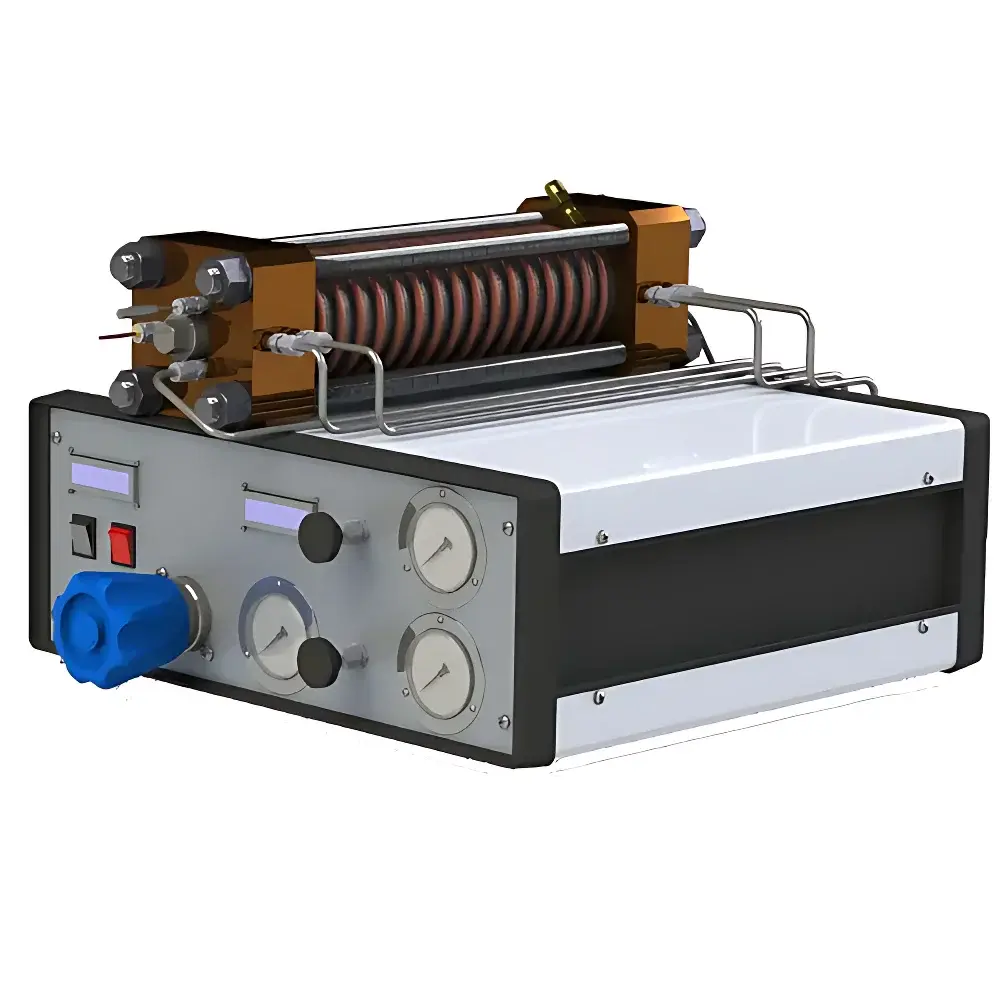
SciDre High-Pressure Oxygen Atmosphere Annealing Furnace
| Brand | SciDre |
|---|---|
| Origin | Germany |
| Manufacturer Type | Authorized Distributor |
| Origin Category | Imported |
| Model | N/A |
| Pricing | Upon Request |
Overview
The SciDre High-Pressure Oxygen Atmosphere Annealing Furnace is a precision-engineered thermal processing system designed for controlled high-temperature, high-oxygen-pressure solid-state reactions. It operates on the principle of sealed-tube resistive heating under regulated oxygen partial pressure, enabling thermodynamically stable synthesis and post-growth annealing of oxygen-sensitive, redox-active crystalline materials—particularly those requiring elevated pO₂ to stabilize high-valence cationic states (e.g., Ni³⁺/Ni⁴⁺ in perovskite oxides). With a maximum operational temperature of 1100 °C and oxygen pressure up to 160 bar (158 atm), the furnace supports stoichiometric control critical for phase-pure oxide crystal preparation, including precursor rod conditioning prior to high-pressure crystal growth and post-synthesis oxygen-annealing of layered nickelates, manganites, cobaltites, and cuprates.
Key Features
- Robust stainless-steel pressure vessel with double-walled construction and integrated safety rupture disc, conforming to PED 2014/68/EU requirements for pressurized equipment
- High-stability PID-controlled resistive heating system with ±1 °C temperature uniformity over the 200 mm hot zone (15 mm internal diameter)
- Dual-stage oxygen delivery system: high-purity O₂ supply (≥99.999%) coupled with calibrated back-pressure regulator and digital pressure transducer (0–200 bar, ±0.25% FS accuracy)
- Real-time monitoring and logging of temperature, pressure, and dwell time via industrial-grade PLC interface with password-protected parameter locking
- Interlocked door mechanism with pressure-release interlock and redundant overpressure shutdown circuitry
- Customizable configuration options: extended temperature range (up to 1200 °C), enhanced pressure rating (up to 200 bar), and optional quartz or alumina sample holders
Sample Compatibility & Compliance
The furnace accommodates cylindrical samples up to 15 mm in diameter and 180 mm in length, compatible with standard ceramic crucibles (Al₂O₃, Pt, or Ir) and sealed quartz ampoules. It is routinely employed in laboratories adhering to GLP-compliant workflows for oxide material synthesis. The system supports traceable process documentation required for ISO/IEC 17025-accredited testing environments and aligns with ASTM C1161 (flexural strength of advanced ceramics) and ASTM E29 (significant digits in test data) for experimental reproducibility. Pressure and temperature profiles are fully auditable, satisfying FDA 21 CFR Part 11 criteria when paired with validated electronic lab notebook (ELN) integration.
Software & Data Management
Equipped with SciDre’s proprietary FurnaceControl Suite v3.2, the system provides synchronized acquisition of temperature, pressure, and time-series data at configurable sampling intervals (100 ms–10 s). All sessions generate timestamped .csv and .xml log files with embedded metadata (operator ID, batch number, calibration certificate IDs). Exported datasets are compatible with MATLAB, Python (NumPy/Pandas), and OriginLab for kinetic modeling (e.g., JMAK analysis of phase nucleation). Audit trails include user login history, parameter change logs, and emergency event timestamps—all retained for ≥12 months per default configuration.
Applications
- Synthesis of oxygen-stoichiometric perovskite precursors (e.g., Nd₁₋ₓSrₓNiO₃) prior to topotactic reduction to infinite-layer RNiO₂ phases
- Thermal stabilization of metastable high-valence transition metal oxides under controlled pO₂ gradients
- Defect engineering in ferroelectric and multiferroic oxides via oxygen vacancy modulation
- Pre-annealing of single-crystal feed rods for high-pressure flux growth (e.g., using KCl/NaCl or PbF₂ solvents)
- Reoxidation treatment of reduced oxide thin films after pulsed laser deposition or sputtering
- Accelerated oxidation kinetics studies for corrosion-resistant alloy development
FAQ
What is the maximum allowable working pressure and temperature for routine operation?
The standard configuration supports continuous operation at 160 bar and 1100 °C; custom variants rated for 200 bar and 1200 °C are available upon technical review.
Does the system comply with international pressure equipment directives?
Yes—the pressure vessel carries CE marking under the Pressure Equipment Directive (PED 2014/68/EU) and is supplied with full EC Declaration of Conformity and EN 13445-3 design certification.
Can the furnace be integrated into an inert-gas glovebox environment?
Yes—optional feedthrough configurations support electrical, pressure, and data connections through standard KF-40 or CF-63 flanges for seamless integration into argon- or nitrogen-purged enclosures.
Is remote monitoring supported?
Standard Ethernet (TCP/IP) and optional Wi-Fi modules enable secure remote access via HTTPS-enabled web interface; no cloud dependency or vendor-hosted servers are required.
What validation documentation is provided with delivery?
Each unit ships with Factory Acceptance Test (FAT) report, pressure vessel material certificates (EN 10204 3.1), temperature sensor calibration certificate (traceable to PTB), and full operation & maintenance manual in English.



