
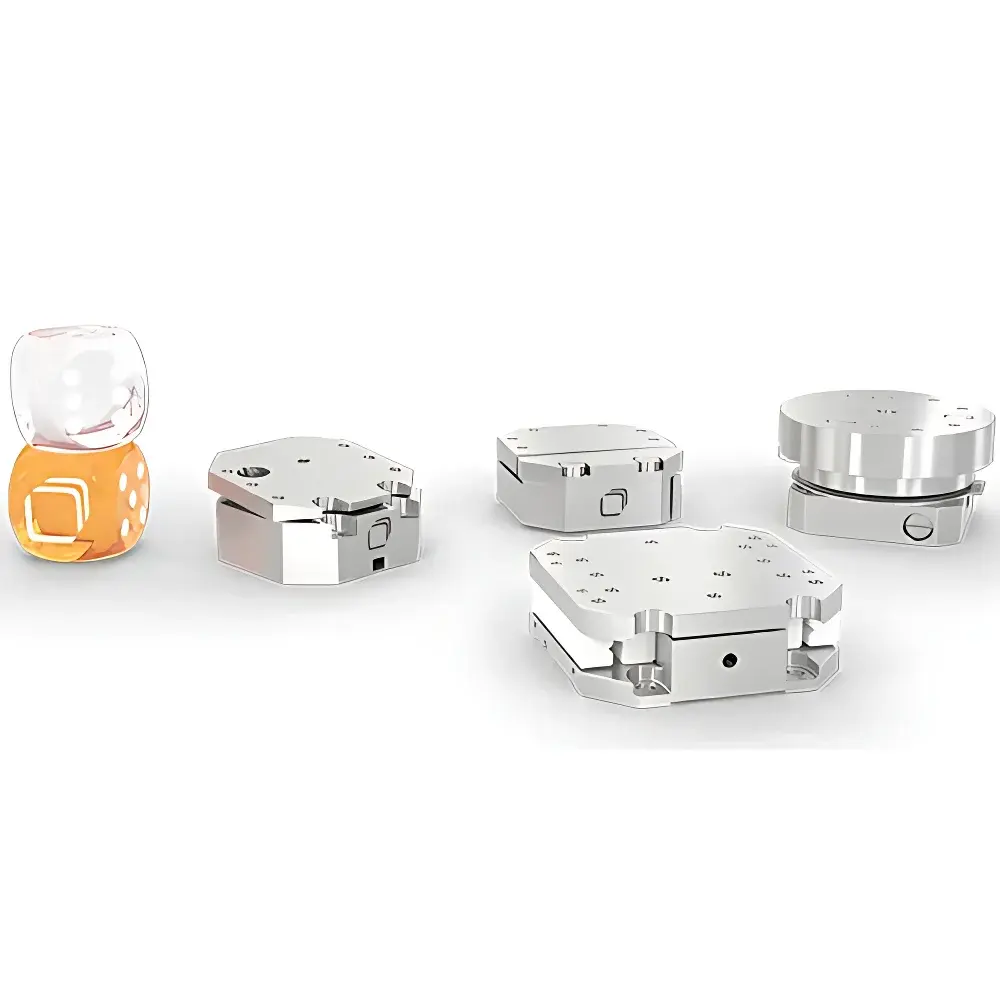
attocube ANP Series Cryogenic High-Magnetic-Field Nanopositioning Stages
| Brand | attocube Systems AG |
|---|---|
| Origin | Germany |
| Product Type | Motorized Translation Stage |
| Model | oPOSITIONING |
| Operating Temperature Range | 10 mK to 373 K |
| Magnetic Field Compatibility | Up to 31 T |
| Vacuum Compatibility | Down to 5×10⁻¹¹ mbar |
| Closed-Loop Positioning Resolution | 1 nm |
| Maximum Travel Range | 50 mm |
| Minimum Stage Footprint | 11 × 11 mm |
| Load Capacity | Up to 2 kg |
| Typical Step Size | 50 nm at 300 K, 10 nm at 4 K (linear actuators) |
| Control Options | Open-loop, RES (resistive sensor), or NUM (optical encoder) feedback |
Overview
The attocube ANP Series Cryogenic High-Magnetic-Field Nanopositioning Stages are engineered for ultra-precise motion control in extreme experimental environments. Based on piezoelectric inertial drive technology—specifically the patented “stick-slip” principle—the ANP stages deliver deterministic nanoscale displacement with zero holding voltage, eliminating thermal drift and electromagnetic interference associated with continuous bias operation. Unlike conventional stepper or servo-driven translation stages, ANP units operate without persistent electric fields across the actuator during static positioning, making them uniquely suited for low-noise quantum transport measurements, scanning probe microscopy (SPM), and dilution refrigerator–integrated optical spectroscopy. Designed and manufactured in Munich, Germany, each stage integrates monolithic ceramic actuation elements with integrated position sensing (RES or NUM variants), enabling traceable, repeatable, and hysteresis-compensated motion from millikelvin temperatures to ambient conditions—and under magnetic fields up to 31 Tesla. Their compact mechanical architecture supports direct mounting into cryostat cold-finger assemblies, UHV chambers, and superconducting magnet bores without compromising structural rigidity or thermal anchoring efficiency.
Key Features
- Zero-holding-voltage operation: Position is maintained passively after step completion, eliminating piezoelectric creep and EMI-induced positional instability.
- Low-drive-voltage design: Standard operation at ≤150 V enables compatibility with standard low-voltage cabling, feedthroughs, and commercial motion controllers—no high-voltage shielding required.
- Dual-role functionality: Each ANP stage serves simultaneously as coarse approach mechanism and fine scanning actuator, reducing system complexity and mechanical degrees of freedom.
- Multi-environment qualification: Validated performance across vacuum levels from atmospheric pressure to ultrahigh vacuum (5×10⁻¹¹ mbar), temperature ranges spanning 10 mK to 373 K, and static magnetic fields up to 31 T.
- Modular feedback integration: RES (resistive position sensor) and NUM (optical encoder) options provide closed-loop resolution of ≤1 nm with full traceability and long-term stability under thermal cycling.
- Compact form factor: Minimum footprint of 11 × 11 × 9.2 mm (ANPx51), optimized for space-constrained cryogenic and magnet-based setups.
Sample Compatibility & Compliance
ANP stages comply with internationally recognized standards for instrumentation used in fundamental physics research and regulated laboratory environments. Their mechanical and electrical design adheres to IEC 61000-6-3 (EMC emission limits) and IEC 61000-6-2 (immunity requirements), ensuring robust operation near sensitive SQUID magnetometers and RF detection circuits. All RES and NUM feedback variants support GLP-compliant audit trails when paired with attocube’s ASC500 controller firmware (v4.2+), including timestamped position logs, error codes, and calibration metadata. While not FDA-regulated, the stages meet functional safety expectations outlined in ISO/IEC 17025 for metrological traceability in accredited measurement laboratories. No hazardous substances are employed per RoHS Directive 2011/65/EU; all ceramics and stainless-steel components are vacuum-compatible and non-outgassing after bakeout.
Software & Data Management
attocube provides native drivers for LabVIEW, MATLAB, Python (via PyAttocube), and C/C++ APIs, enabling seamless integration into custom automation frameworks. The ASC500 control platform supports real-time position monitoring, multi-axis synchronization (up to 6 axes), and programmable motion profiles—including ramped acceleration, dwell timing, and conditional triggering based on external TTL signals. Closed-loop variants log position data at ≥1 kHz sampling rate with 24-bit resolution, exportable in HDF5 or ASCII formats for post-acquisition analysis. Firmware updates preserve backward compatibility and include enhanced thermal compensation algorithms for improved positional fidelity during cooldown cycles. All controller firmware versions undergo version-controlled release testing and are archived with SHA-256 checksums for audit readiness.
Applications
- Cryogenic scanning tunneling microscopy (STM) and atomic force microscopy (AFM) in dilution refrigerators and wet/dry magnets.
- Precision alignment of optical cavities, fiber couplers, and single-photon sources inside 3He/4He cryostats.
- In situ strain tuning of 2D materials (e.g., graphene, TMDCs) under simultaneous low-T and high-B conditions.
- Quantum device characterization: gate electrode positioning for gate-defined quantum dots, Josephson junction arrays, and topological superconductor platforms.
- Ultra-stable interferometric setups requiring sub-nanometer path-length control over extended thermal transients.
- Automated sample exchange and mapping in synchrotron beamlines operating under UHV and cryogenic constraints.
FAQ
What is the difference between open-loop and closed-loop ANP stages?
Open-loop stages rely on calibrated step-size models and do not provide real-time position verification; closed-loop variants (RES or NUM) incorporate integrated sensors to correct for hysteresis, thermal drift, and load-dependent nonlinearity—delivering guaranteed 1 nm repeatability.
Can ANP stages be operated in air or only in vacuum?
They are fully functional in ambient atmosphere, but long-term reliability and maximum performance (especially at <100 K) require operation in dry nitrogen or vacuum to prevent condensation and piezoceramic aging.
How is thermal contraction accommodated during cooldown from 300 K to 10 mK?
ANP stages feature matched-CTE mechanical designs and use Inconel or titanium alloy housings; users must apply stage-specific thermal offset tables (provided in ASC500 firmware) to maintain absolute coordinate accuracy across temperature sweeps.
Is remote operation supported over Ethernet or only via USB?
All ASC500 controllers support TCP/IP communication over Gigabit Ethernet, enabling rack-mounted deployment and integration into centralized lab infrastructure with firewall-safe port configuration.
Are replacement parts and recalibration services available outside Germany?
Yes—attocube maintains authorized service centers in the US, Japan, China, and the UK; NIST-traceable recalibration certificates are issued per ISO/IEC 17025 upon request.





