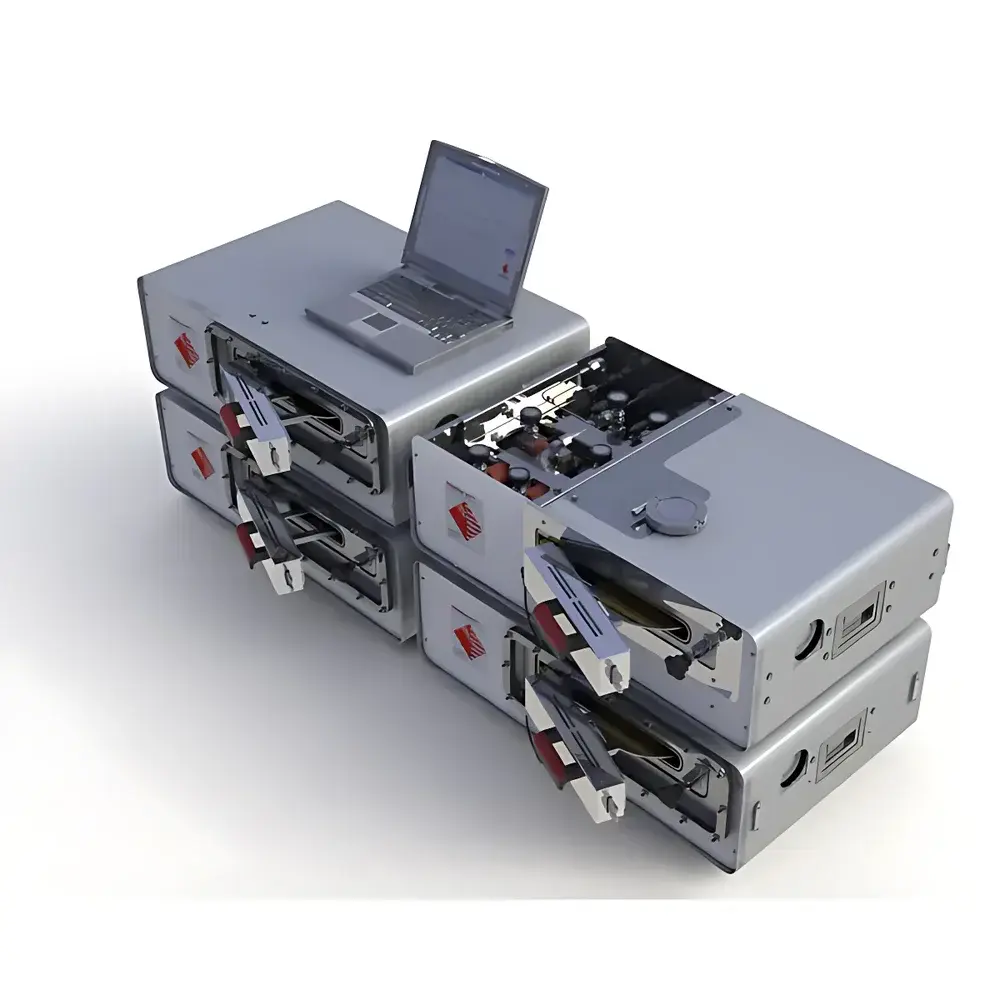
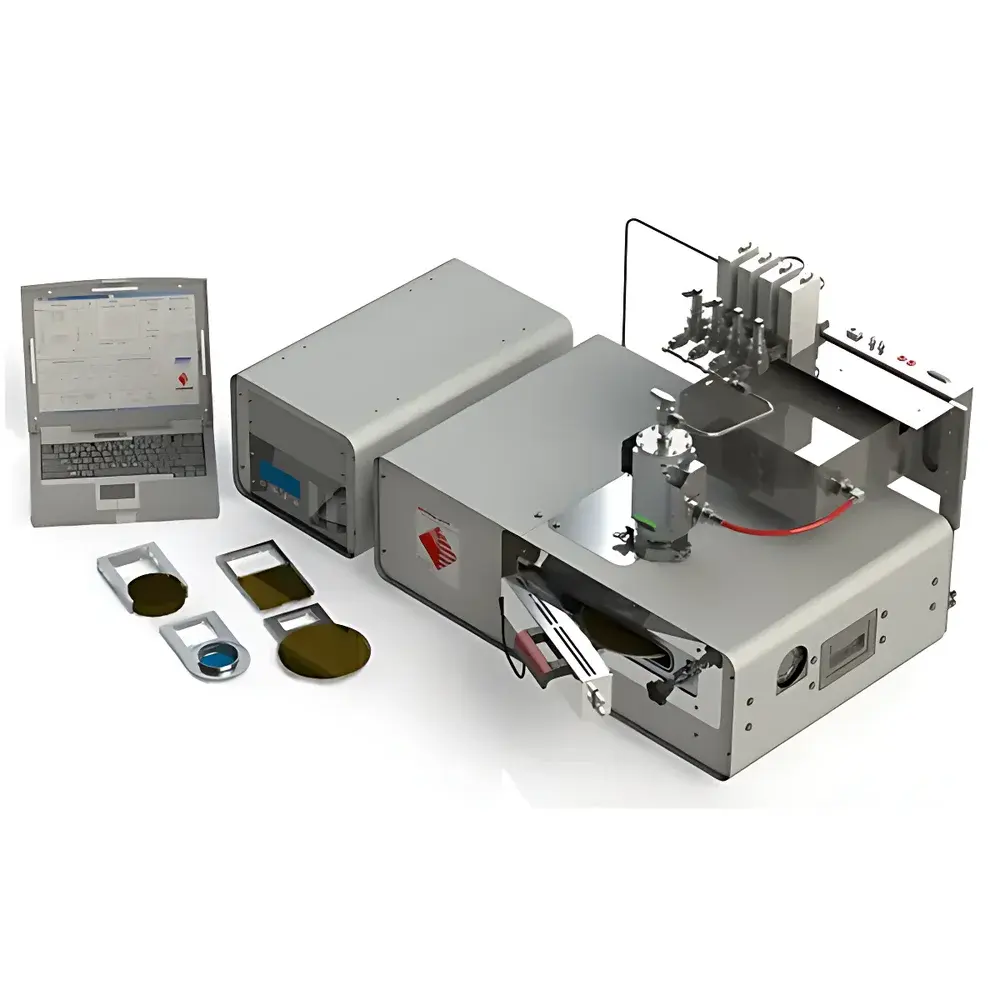
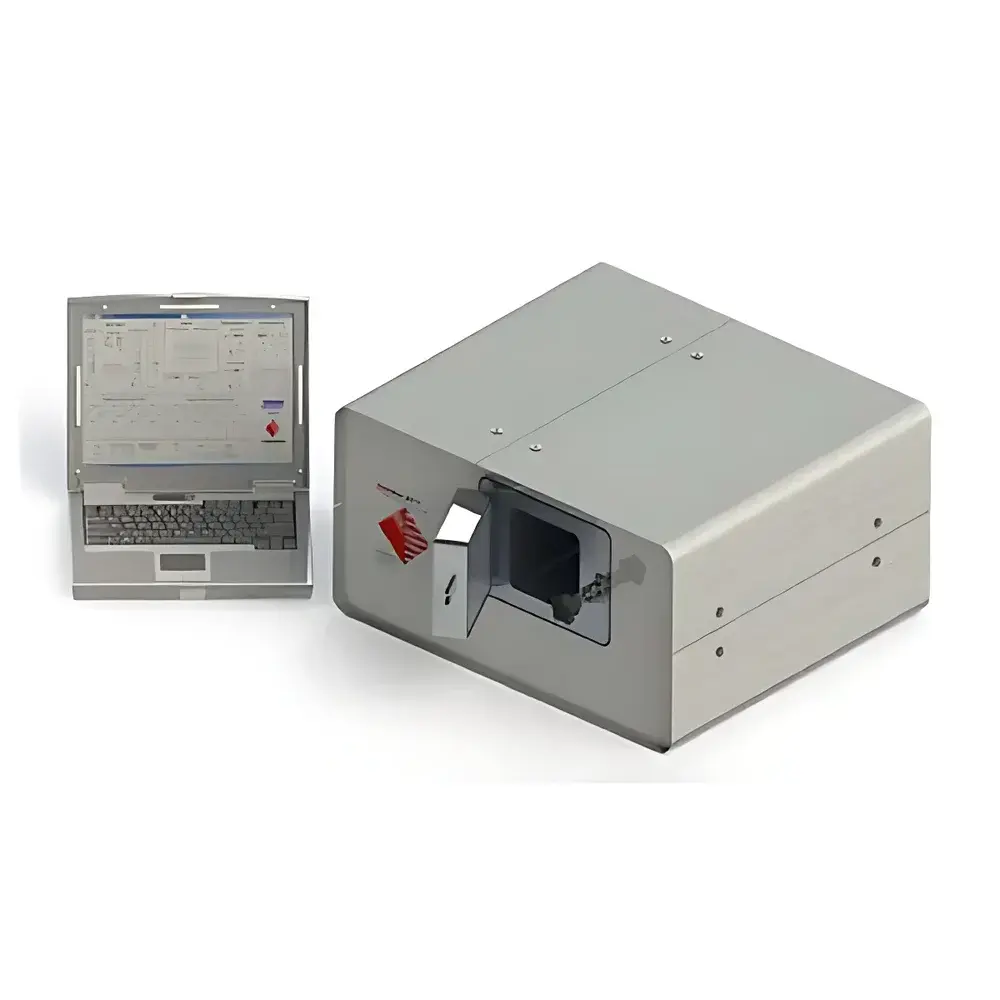
Arradiance GEMStar-8 XT Desktop Atomic Layer Deposition System
| Brand | Arradiance |
|---|---|
| Origin | USA |
| Model | GEMStar-8 XT |
| Substrate Size | Up to 200 mm (8-inch) wafers |
| Process Temperature | 300°C aluminum alloy hot-wall chamber with convective temperature control |
| Precursor Channels | 8 independent precursor lines with CF-40 vacuum flanges |
| Chamber Dimensions (W × H × D) | 78 × 56 × 28 cm |
| Thickness Uniformity | <1% across 200 mm substrate |
| Thermal Uniformity | 99.9% |
| Maximum Sample Thickness | 32 mm |
| Plasma Option | Integrated 13.56 MHz ICP plasma source (300 W, air-cooled) |
| Mass Flow Controllers | 4 MFCs (3 for plasma gases, 1 for carrier gas) |
| Compliance | CF-40 standard vacuum interface, glovebox-compatible side-mount configuration |
Overview
The Arradiance GEMStar-8 XT is a high-precision, benchtop atomic layer deposition (ALD) system engineered for reproducible, conformal thin-film synthesis on planar and three-dimensional substrates. ALD operates via self-limiting surface reactions—sequential, saturative chemisorption of gaseous precursors—enabling sub-nanometer thickness control and exceptional step coverage on high-aspect-ratio (HAR) structures. Unlike CVD or PVD, ALD delivers monolayer-by-monolayer growth with inherent digital thickness scaling, making it indispensable for advanced semiconductor device fabrication, MEMS packaging, battery electrode functionalization, and catalytic nanostructure engineering. The GEMStar-8 XT integrates a thermally symmetric hot-wall reactor architecture with dual-path precursor delivery, precision thermal management, and modular vacuum interfacing—designed to meet the stringent requirements of R&D laboratories and pilot-line process development.
Key Features
- Hot-wall reactor with 300°C aluminum alloy chamber and convective temperature regulation ensures minimal thermal gradients (<0.03% airflow-induced perturbation) and enables uniform film growth across full 200 mm substrates.
- Eight independently heated precursor lines (up to 200°C), each with dedicated CF-40 vacuum flanges, support complex multi-step chemistries including metal oxides (Al₂O₃, HfO₂), nitrides (TiN, TaN), sulfides (MoS₂), and noble metals (Pt, Pd).
- Integrated 13.56 MHz inductively coupled plasma (ICP) source (300 W, air-cooled) expands process window to low-temperature, plasma-enhanced ALD (PE-ALD) for thermally sensitive substrates and refractory compound synthesis.
- Benchtop footprint (78 × 56 × 28 cm) with side-mounted glovebox interface eliminates thermal cross-talk and preserves inert-atmosphere integrity—no bottom-entry heating impact on glovebox internal temperature stability.
- Modular expansion capability includes in-situ quartz crystal microbalance (QCM), ozone generator, load-lock vacuum transfer, heated sample stage (up to 500°C), powder rotation module, and 3D porous sample holder (NanoCUBE variant).
Sample Compatibility & Compliance
The GEMStar-8 XT accommodates substrates up to 200 mm in diameter and 32 mm in thickness—including wafers, foils, fibers, aerogels, microporous membranes, and nanopowders. Its lateral showerhead design and laminar gas flow profile ensure >99.9% thermal uniformity and <1% thickness non-uniformity (1σ) across 8-inch substrates, validated per SEM/EDS cross-sectional metrology. The system conforms to ISO 14644-1 Class 5 cleanroom-compatible vacuum practices and utilizes all-metal CF-40 sealing standards. Optional integration with gloveboxes satisfies ASTM E509-22 protocols for moisture- and oxygen-sensitive precursor handling. For regulated environments, optional audit-trail-enabled software supports GLP/GMP-aligned record retention and 21 CFR Part 11-compliant electronic signatures when paired with validated instrument control firmware.
Software & Data Management
GEMStar systems operate under Arradiance’s proprietary ALD Control Suite—a deterministic, event-driven platform supporting recipe-based process sequencing, real-time pressure/temperature/flow logging, and synchronized MFC ramping. All process parameters—including pulse durations, purge times, temperature ramps, and plasma ignition timing—are timestamped with microsecond resolution and stored in encrypted SQLite databases. Export formats include CSV, HDF5, and XML for traceable integration with LIMS or MES platforms. Remote monitoring via secure TLS-encrypted Ethernet connection enables off-site diagnostics without compromising data sovereignty. Software validation packages—including IQ/OQ documentation templates and test scripts—are available for laboratory accreditation workflows (ISO/IEC 17025, ISO 9001).
Applications
The GEMStar-8 XT serves as a foundational tool in academic and industrial research spanning multiple domains: atomic-scale passivation of silicon nanowires for photovoltaic efficiency enhancement; conformal Al₂O₃ encapsulation of Li-ion battery cathodes to suppress interfacial side reactions; site-selective Pt/Pd co-deposition on TiSi₂ nanonets for ORR electrocatalysis; hafnium oxide pore-lining in solid-state nanopore DNA sensing devices; and ultrathin TiN barrier layers in advanced Cu interconnect stacks. Published peer-reviewed applications include ALD-enabled selective area deposition on hybrid metal-dielectric patterns (J. Phys. Chem. C, 2014), PE-ALD of Pt nanoparticles on ZnO-passivated carbon for Li–O₂ batteries (Nanotechnology, 2015), and ALD-coated cellulose nanocrystal aerogels with enhanced thermal stability (MRS Proceedings, 2012).
FAQ
What substrate sizes does the GEMStar-8 XT support?
It accepts substrates up to 200 mm (8-inch) in diameter and up to 32 mm thick—including wafers, powders, fibers, and 3D porous monoliths.
Can the system be upgraded to plasma-enhanced ALD after purchase?
Yes—the GEMStar-6/8 XT and GEMStar-8 XT-P models share identical mechanical and vacuum architectures; plasma upgrade kits include ICP source, RF matching network, and MFC-integrated gas manifolds.
Is ozone generation supported natively?
An integrated ozone generator module is available as an add-on option, compatible with O₃-assisted ALD chemistries such as high-k oxide deposition at reduced temperatures.
How is temperature uniformity verified and maintained?
Chamber thermal symmetry is validated using embedded thermocouple arrays and infrared thermography during qualification; convective heating design minimizes radial and axial gradients, achieving 99.9% uniformity per ASTM F1531-20 Annex A1.
Does the system comply with regulatory data integrity standards?
With optional ALD Control Suite v4.2+ and validated firmware, the system supports 21 CFR Part 11-compliant audit trails, electronic signatures, and role-based access control for regulated QC/QA environments.