
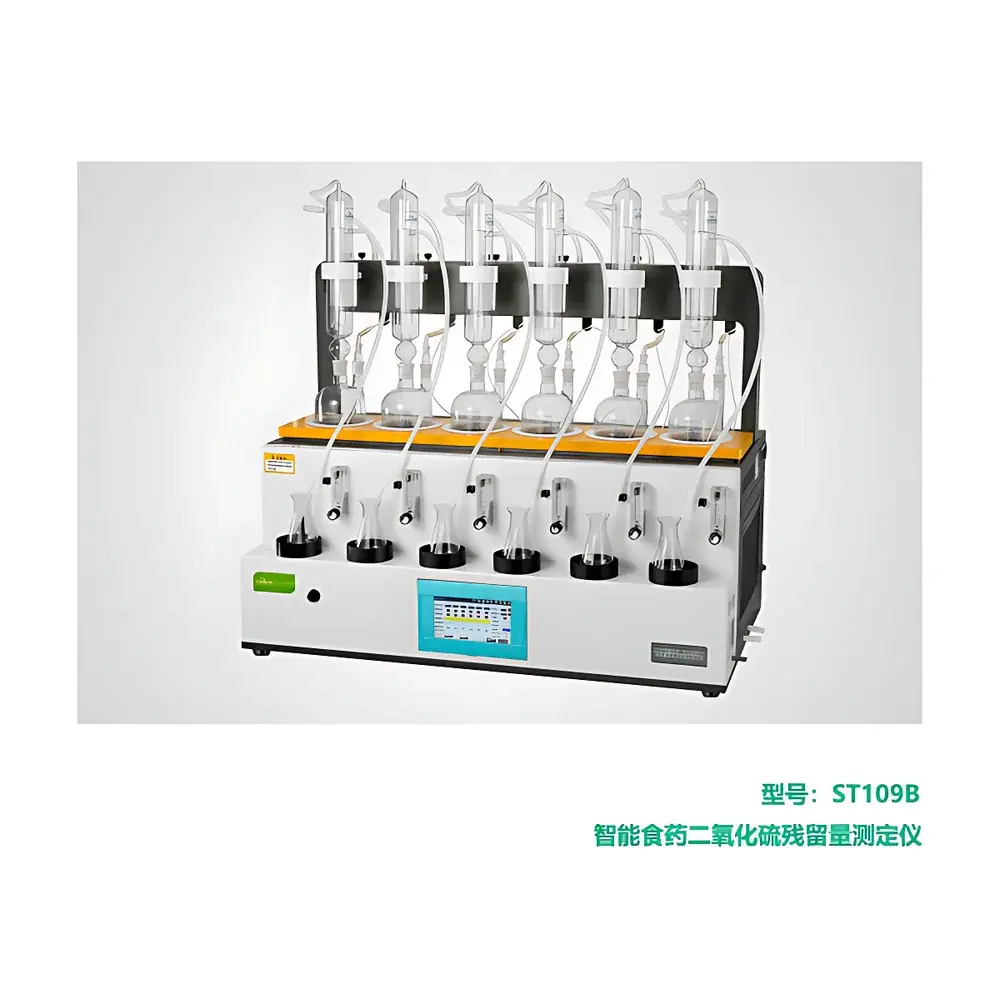
SENTE ST109B Intelligent Sulfur Dioxide Analyzer for Food and Pharmaceutical Applications
| Brand | SENTE |
|---|---|
| Origin | Shandong, China |
| Manufacturer Type | Direct Manufacturer |
| Product Category | Domestic |
| Model | ST109B |
| Price Range | USD 7,000–14,000 (FOB) |
| Type | Intelligent Automated Analyzer |
| Detection Limit | 1 mg/kg |
| Heating Method | Automatic Far-Infrared Ceramic Heating with Dry-Run Protection |
| Cooling System | Integrated Compressor-Based Closed-Loop Circulation |
| Condenser | Standard Reflux Condenser per GB 5009.34–2022 |
| Temperature Control | Programmable Dual-Mode Heating (Gentle Boil / Full Boil), Auto-Ramp |
| Timing Range | 0–999 min, Precise Digital Timer |
| Reagent Delivery | High-Accuracy Peristaltic Pump for Automated Reagent Addition |
| Nitrogen Flow Control | Rotameter-Controlled, Adjustable 200–2000 mL/min |
Overview
The SENTE ST109B Intelligent Sulfur Dioxide Analyzer is an automated, laboratory-grade analytical instrument engineered for precise and reproducible quantification of sulfur dioxide (SO₂) residues in food matrices and traditional Chinese medicinal materials. It implements the distillation–acidification–iodometric titration principle specified in GB 5009.34–2022 “Determination of Sulfur Dioxide in Foods” and aligned methodologies referenced in the Chinese Pharmacopoeia (ChP) for crude herbal drugs. Unlike manual or semi-automated SO₂ analyzers, the ST109B integrates thermal control, gas management, reagent delivery, and condensation into a single compact platform—eliminating inter-operator variability and ensuring method fidelity across batched analyses. Its design reflects rigorous adherence to analytical traceability requirements common in regulated pharmaceutical QC laboratories and food safety testing centers.
Key Features
- Far-infrared ceramic heating system with real-time temperature feedback and automatic dry-run protection—prevents sample tube overheating and ensures consistent distillation kinetics.
- Self-contained refrigeration module utilizing a hermetically sealed compressor and closed-loop coolant circulation—no external chiller required, reducing footprint and operational complexity.
- GB-compliant reflux condenser geometry optimized for efficient vapor condensation and minimal SO₂ loss during distillation.
- Dual-mode heating control (gentle boil and full boil) enables method-specific thermal ramping, supporting both volatile matrix stabilization and complete SO₂ liberation from bound sulfites.
- Precisely calibrated peristaltic pump delivers standardized volumes of phosphoric acid and iodine titrant—reducing manual pipetting errors and improving repeatability (RSD < 3.5% at 5 mg/kg level).
- Adjustable nitrogen purge flow (200–2000 mL/min via calibrated rotameter) facilitates controlled carrier gas introduction, enhancing recovery of liberated SO₂ while minimizing oxidation side reactions.
- Programmable digital timer (0–999 minutes) supports extended distillation protocols required for recalcitrant botanical samples such as dried rhizomes and resinous herbs.
Sample Compatibility & Compliance
The ST109B accommodates solid, semi-solid, and liquid samples—including dried fruits, wine musts, processed seafood, herbal slices (e.g., Paeonia lactiflora, Glycyrrhiza uralensis), and decoction pieces—within standard 500 mL round-bottom flasks. All wet chemistry steps conform to the procedural constraints defined in GB 5009.34–2022 and ChP General Chapter 2331. While not pre-certified for FDA 21 CFR Part 11, the instrument’s deterministic operation, audit-ready parameter logging (via optional RS232/USB data export), and user-accessible calibration records support GLP-compliant documentation practices. It is routinely deployed in ISO/IEC 17025-accredited food safety labs and GMP-aligned herbal quality control units across Asia.
Software & Data Management
The ST109B operates via an embedded microcontroller interface with intuitive tactile buttons and LED status indicators—no external PC required for routine operation. All method parameters (heating mode, timing, nitrogen flow setpoint) are stored in non-volatile memory and recallable per user-defined profiles. Optional data export (CSV format) enables integration with LIMS environments. Though lacking proprietary cloud analytics, its deterministic hardware-level control architecture ensures full traceability of every analytical run—critical for internal audit readiness and regulatory inspection preparation.
Applications
- Quantitative SO₂ residue analysis in sulfited food products (e.g., dried apricots, wine, shrimp paste) per GB 5009.34–2022 compliance reporting.
- Batch release testing of Chinese medicinal materials where SO₂ fumigation is historically practiced—supporting pharmacopeial compliance and stability assessment.
- Method validation studies evaluating recovery, linearity (1–100 mg/kg), and intermediate precision across multi-day runs.
- Reference laboratory use for inter-laboratory comparison exercises and proficiency testing schemes administered by CNAS or APAC.
- Research applications investigating SO₂ migration behavior during drying, storage, and extraction processes in functional food development.
FAQ
Does the ST109B comply with international pharmacopeial standards beyond the Chinese Pharmacopoeia?
It follows the same distillation–titration principle used in USP <231> and EP 2.2.32, though formal equivalence documentation requires lab-specific method verification per ICH Q2(R2).
Can the instrument be validated for GMP environments?
Yes—its fixed-parameter architecture, absence of firmware-upgradable logic, and mechanical reproducibility make it suitable for IQ/OQ/PQ protocols when paired with documented calibration standards and operator training records.
Is nitrogen gas purity critical for accurate results?
Use of ≥99.995% pure N₂ is recommended to avoid interference from ambient oxygen or moisture that may oxidize liberated SO₂ prior to titration.
What maintenance intervals are recommended for long-term reliability?
Condenser cleaning after every 20 runs; ceramic heater surface inspection quarterly; refrigerant pressure check annually by certified technician.
How does the ST109B compare to AOAC Official Method 990.28 instrumentation?
It implements identical distillation kinetics but replaces manual reagent addition and analog flow meters with automated, digitally stabilized subsystems—improving within-lab reproducibility without altering the core chemistry.





