
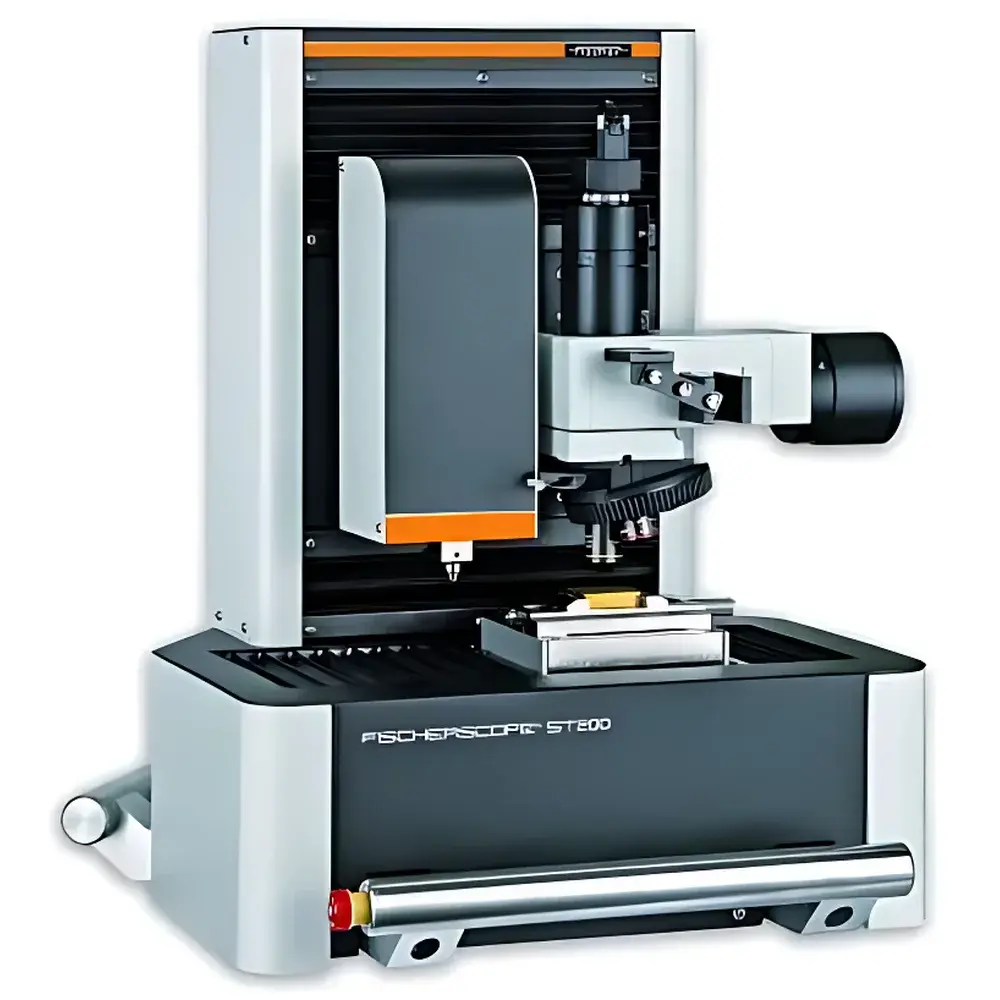
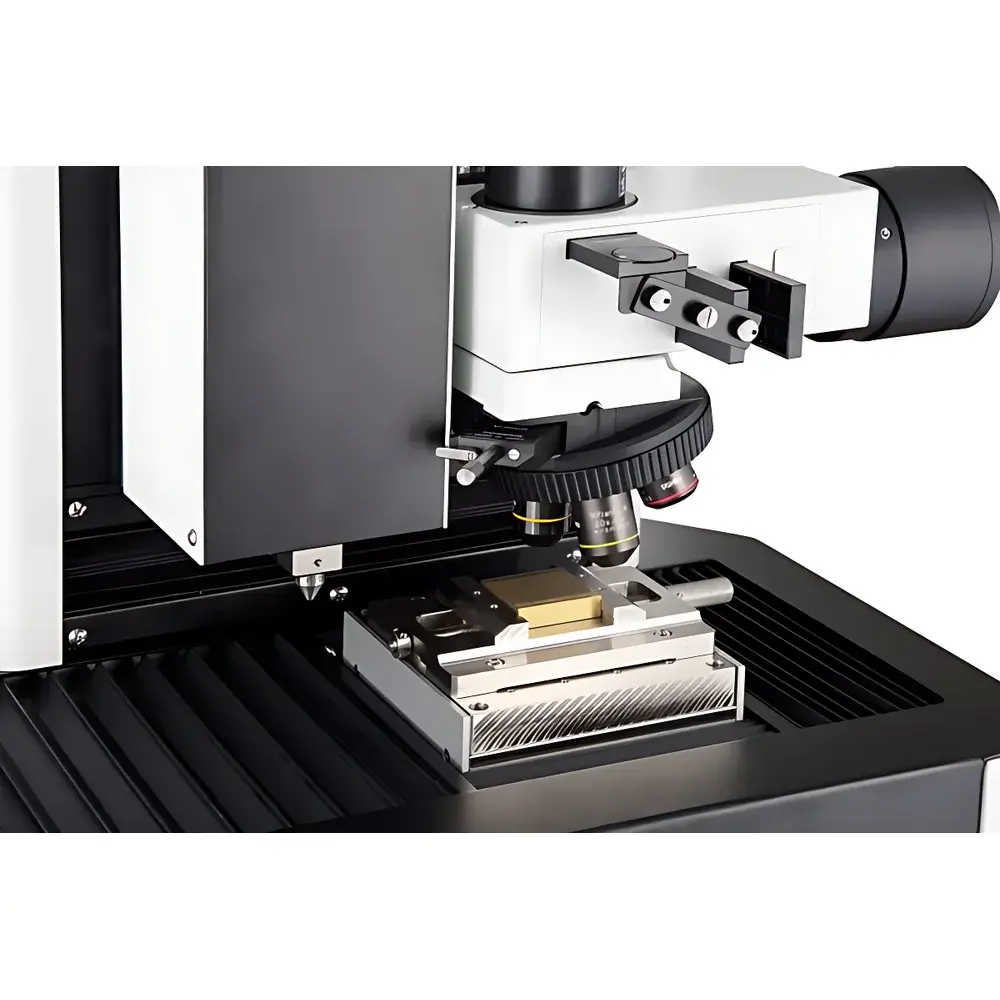
Fischer ST200 Progressive Load Scratch Tester
| Brand | Fischer |
|---|---|
| Origin | Germany |
| Model | ST200 |
| Instrument Type | Micro- and Nano-Scratch Tester |
| Maximum Indentation Depth | 1000 µm |
| Effective Normal Load Range | 0.1–200 N |
| Load Resolution | 3.3 µN |
| Displacement Range | 130 mm |
| Displacement Resolution | 0.01 nm |
| Maximum Friction Force | 200 N |
| Indenter Type | Natural Diamond Tip |
| Thermal Drift | ≤0.05 nm/s |
Overview
The Fischer ST200 Progressive Load Scratch Tester is a high-precision, motorized micro- and nano-scratch testing system engineered for quantitative evaluation of adhesion, interfacial cohesion, and mechanical failure behavior of thin films and coatings under controlled, monotonically increasing normal load. Based on the fundamental principle of progressive-load scratch testing—where a diamond indenter traverses a coated surface while normal force is linearly or stepwise increased—the ST200 enables direct identification of critical load thresholds (Lc1, Lc2, Lc3) corresponding to onset of cohesive cracking, interfacial delamination, and catastrophic spallation. Unlike conventional fixed-load scratch or cross-cut methods (e.g., ASTM D3359), which rely on subjective visual assessment and iterative trial-and-error, the ST200 delivers objective, repeatable, and traceable failure metrics within a single test run. Its design conforms to internationally recognized standards for coating mechanical characterization, including ISO 20502 (scratch testing of hard coatings), ASTM C1624 (critical load determination via acoustic emission), and VDI 3822 (adhesion testing of PVD/CVD layers).
Key Features
- Ultra-high-resolution force actuation: 3.3 µN load resolution across a 0.1–200 N dynamic range, enabling detection of sub-micron-scale interfacial debonding events.
- Sub-nanometer displacement sensing: 0.01 nm vertical resolution with thermal drift compensation ≤0.05 nm/s—essential for long-duration, low-load tests requiring dimensional stability.
- Integrated multimodal in situ monitoring: Synchronized acquisition of friction force, acoustic emission (AE), depth-of-penetration, and real-time video microscopy during scratching.
- Motorized XYZ stage with brushless DC drives: Delivers 4× higher torsional stiffness vs. standard stepper systems; supports programmable multi-scratch arrays, variable scan speeds (0.1–50 mm/s), and large-area mapping (130 mm travel range).
- Diamond indenter compatibility: Equipped with certified natural diamond tips (Rockwell C geometry, tip radius 2–5 µm) compliant with ISO 14577 and ASTM E2546 for standardized indentation and scratch geometry.
- Optimized optical subsystem: High-magnification telecentric lens with polarized illumination and interference contrast mode—enabling unambiguous differentiation between cohesive fracture, buckling, and interfacial peeling mechanisms.
Sample Compatibility & Compliance
The ST200 accommodates a broad spectrum of substrate materials—including metals (Al, Ti, stainless steel), alloys, semiconductors (Si, GaAs), ceramics (Al2O3, SiC), glasses, polymers, elastomers, and mineral-based composites—without requiring specialized fixturing. Coating thickness suitability spans from ≥1 µm (e.g., PVD TiN, DLC, CrN) to functional multilayers used in MEMS, biomedical implants, and optical filters. All measurement protocols support GLP/GMP documentation requirements, with full audit trail logging per FDA 21 CFR Part 11. Data export formats comply with ASTM E1447 (data exchange for mechanical testing) and are compatible with third-party statistical process control (SPC) platforms.
Software & Data Management
Fischer’s proprietary WinTest software provides intuitive workflow-driven test configuration, real-time parameter visualization (load vs. displacement, AE burst count, friction coefficient), and automated critical load identification using derivative-based algorithms (dFf/dL, dZ/dL). Raw data is stored in vendor-neutral HDF5 format with embedded metadata (operator ID, calibration timestamp, environmental conditions). Software modules include batch analysis for multi-sample comparison, ISO/ASTM-compliant report generation, and integration with LIMS via OPC UA. Calibration certificates are traceable to PTB (Physikalisch-Technische Bundesanstalt) and NIST standards.
Applications
- Hard coating R&D: Quantifying adhesion strength of cutting tool coatings (TiAlN, AlCrN) under simulated machining loads.
- Automotive powertrain: Evaluating thermal barrier coatings (TBCs) and low-friction DLC layers on piston rings and valve train components.
- Biomedical devices: Assessing osseointegration-supportive hydroxyapatite or diamond-like carbon (DLC) coatings on orthopedic and dental implants per ISO 13779-2.
- Decorative and functional plating: Validating adhesion of electroplated Au, Cr, or Ni-P layers on consumer electronics housings and watch components.
- Microelectronics: Characterizing passivation layer integrity (SiNx, SiO2) on wafer-level packaging under thermo-mechanical stress.
FAQ
What standards does the ST200 comply with for adhesion testing?
The system supports test execution and reporting per ISO 20502, ASTM C1624, VDI 3822, and DIN 50359, with optional validation packages available for ISO/IEC 17025-accredited laboratories.
Can the ST200 perform both scratch and nanoindentation measurements?
While primarily optimized for progressive-load scratch testing, the ST200 shares core transduction architecture with Fischer’s nanoindentation platforms; however, dedicated nanoindentation functionality requires separate calibration and module licensing.
Is thermal drift compensation active during extended-duration tests?
Yes—real-time thermal drift correction is continuously applied to displacement signals using integrated reference sensors, ensuring sub-nanometer positional fidelity over test durations exceeding 60 minutes.
How is acoustic emission data synchronized with mechanical signals?
AE waveforms are acquired at 10 MHz sampling rate and time-stamped with <100 ns jitter relative to load and displacement channels, enabling precise correlation of AE bursts with discrete failure events.
Does the system support automated multi-point testing on irregular surfaces?
The motorized Z-axis with closed-loop feedback and programmable focus tracking allows reliable scratch testing on curved or topographically complex samples, including cylindrical engine components and dental crowns.



