
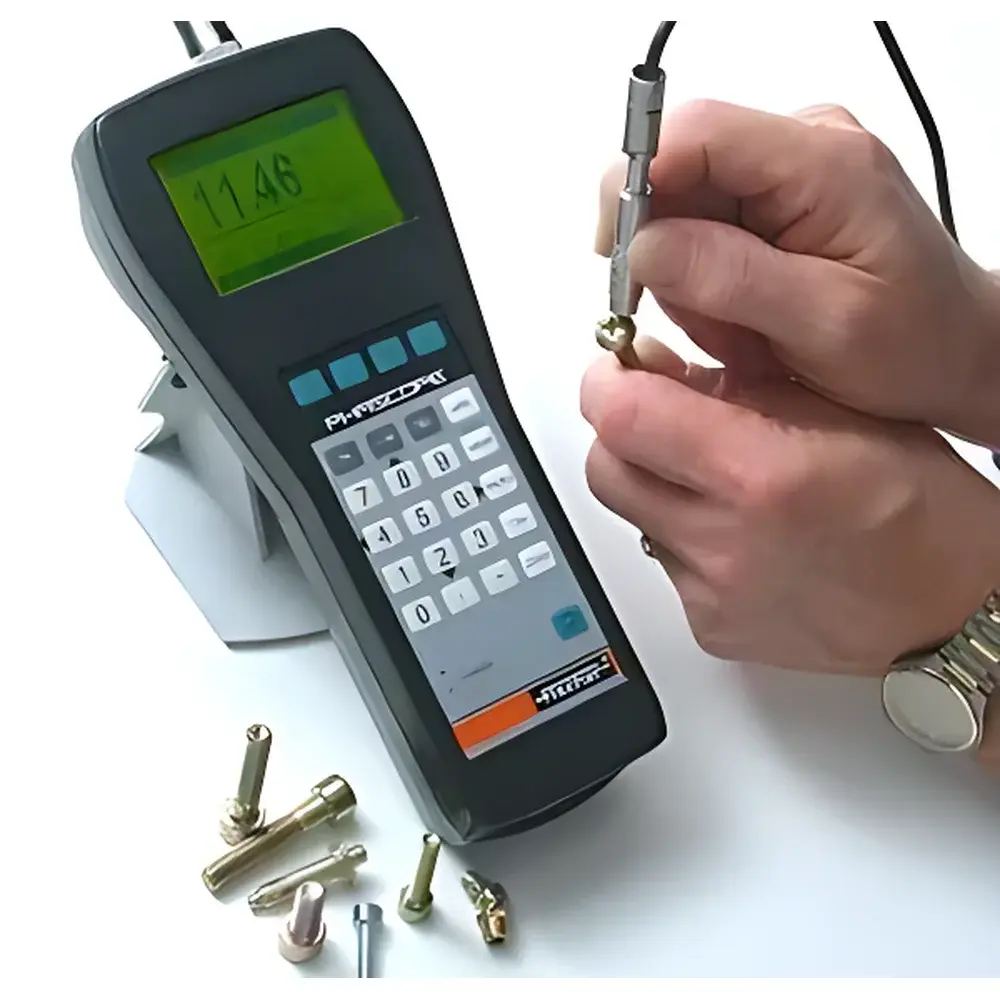
Fischer PHASCOPE PMP10 Electromagnetic Eddy Current Coating Thickness Gauge
| Brand | Fischer |
|---|---|
| Origin | Germany |
| Model | PMP10 |
| Measurement Principle | Phase-Sensitive Eddy Current |
| Operating Frequencies | 60 kHz / 240 kHz / 1.25 MHz |
| Probe Compatibility | ESD20Cu, ESD20Ni, ESD20Zn, ESD2.4, ESL080 |
| Max Data Storage | 20,000 measurements across 4,000 data groups |
| Applications | 100 user-defined programs |
| Display Resolution | 3-level precision |
| Measurement Modes | Automatic, Continuous, External Trigger |
| Analysis Modes | Scientific, Statistical, Limit (Hi/Lo), Analog Simulation |
| Security | Password protection & key lock |
| Power Management | Auto-off |
Overview
The Fischer PHASCOPE PMP10 is a handheld, phase-sensitive eddy current coating thickness gauge engineered for high-precision, non-destructive measurement of electrically conductive coatings on conductive or non-conductive substrates. Unlike amplitude-based eddy current instruments, the PMP10 relies on phase angle analysis of the induced eddy current field—enabling superior discrimination between coating and substrate conductivity, permeability, and geometry effects. This principle delivers enhanced accuracy on rough surfaces, small parts, and complex geometries—including printed circuit board (PCB) through-hole copper walls and thin zinc layers on miniature steel components—without requiring substrate-specific recalibration. Designed and manufactured in Germany, the instrument complies with the fundamental metrological requirements of ISO 2360 and ASTM B244 for non-magnetic coating thickness measurement on non-ferrous and ferrous substrates.
Key Features
- Triple-frequency operation (60 kHz, 240 kHz, 1.25 MHz) enables optimal excitation for diverse coating–substrate combinations—e.g., Cu on ISO (insulating) substrates, Ni on Fe, Zn on steel, or Al on plastic.
- Probe-flexible architecture supports application-specific sensors: ESD20Cu for PCB surface copper under solder mask; ESD2.4 for through-hole wall thickness; ESL080 for low-profile or recessed areas; ESD20Zn for thin galvanized layers on small fasteners.
- Phase-sensitive detection eliminates dependence on lift-off variation within defined probe–surface tolerances, reducing sensitivity to surface roughness and part curvature compared to conventional amplitude-based gauges.
- Onboard memory stores up to 100 independent measurement applications, each configurable with unique calibration curves, limits, units, and statistical parameters—fully traceable for GLP/GMP environments.
- Three measurement modes—automatic single-shot, continuous scanning, and external trigger via TTL input—support integration into inline QC stations or manual benchtop workflows.
- Four display modes (scientific, statistical summary, pass/fail limit check, analog bar graph) provide real-time feedback aligned with operator expertise level and process control requirements.
Sample Compatibility & Compliance
The PHASCOPE PMP10 measures conductive coatings—including Cu, Ni, Zn, Al, Sn, and Cr—on magnetic (Fe, steel), non-magnetic (Al, Cu, brass), and non-conductive (FR4, epoxy, plastic) substrates. It is validated for use on PCBs with solder mask, anodized aluminum, electroplated fasteners, and stamped metal components with surface roughness up to Ra 6.3 µm. The instrument meets the electromagnetic compatibility (EMC) requirements of EN 61326-1 and carries CE marking per EU Directive 2014/30/EU. Calibration traceability follows DIN EN ISO/IEC 17025 guidelines when performed using certified reference standards (e.g., Fischer-certified foil standards or step wedges). For regulated industries, audit trails—including operator ID, timestamp, probe ID, and calibration history—are retained with password-protected access control.
Software & Data Management
Raw measurement data (value, date/time stamp, probe ID, application ID, temperature) are stored internally with full metadata integrity. Export is supported via USB interface to Fischer’s FISCHER DataCenter software (Windows-compatible), enabling batch reporting, SPC charting (X̄–R, Cpk), CSV/Excel export, and PDF certificate generation. All data modifications—including deletion or editing—are logged with user ID and timestamp, satisfying FDA 21 CFR Part 11 requirements for electronic records when configured with digital signature and audit trail activation. Firmware updates are delivered via encrypted .bin files, preserving configuration integrity during version migration.
Applications
- Quality assurance of copper plating thickness on rigid and flexible PCBs—both surface traces and internal via walls—under solder resist or conformal coating.
- In-process verification of electroplated nickel thickness on automotive brake calipers or hydraulic valve bodies, where magnetic permeability variations demand phase-resolved discrimination.
- Final inspection of hot-dip or electrogalvanized steel components (e.g., brackets, clips, hinges), especially where geometric constraints preclude use of destructive cross-sectioning.
- R&D validation of thin-film deposition uniformity on prototype substrates, including multi-layer stacks where interfacial conductivity differences affect amplitude-only readings.
- Supplier qualification audits requiring documented repeatability (≤ ±3% RSD) and reproducibility across multiple operators and sites.
FAQ
What substrates and coatings can the PMP10 measure?
It measures non-ferrous conductive coatings (Cu, Ni, Zn, Al, Sn) on ferrous (steel, iron), non-ferrous (Al, Cu), and non-conductive (plastic, ceramic, FR4) substrates—provided the coating is electrically continuous and ≥0.1 µm thick.
Is calibration required before each use?
No. The instrument retains up to 100 calibrated applications with drift-compensated zero and span points. However, daily verification using certified reference standards is recommended per ISO 9001 and IATF 16949.
Can it measure through solder mask or conformal coating?
Yes—phase-sensitive eddy current detection allows accurate Cu thickness measurement beneath non-conductive layers up to 150 µm thick, provided the underlying copper remains unbroken and sufficiently conductive.
Does it support statistical process control (SPC) output?
Yes. Internal statistics (mean, std dev, min/max, Cp/Cpk) are displayed in real time and exported with full traceability for integration into enterprise MES or QMS platforms.
What is the typical measurement repeatability?
Under controlled lab conditions (23 °C, stable probe contact, ISO 2360-compliant standards), repeatability is ≤ ±1.5% of reading or ±0.1 µm—whichever is greater—for coatings >1 µm thick.



