
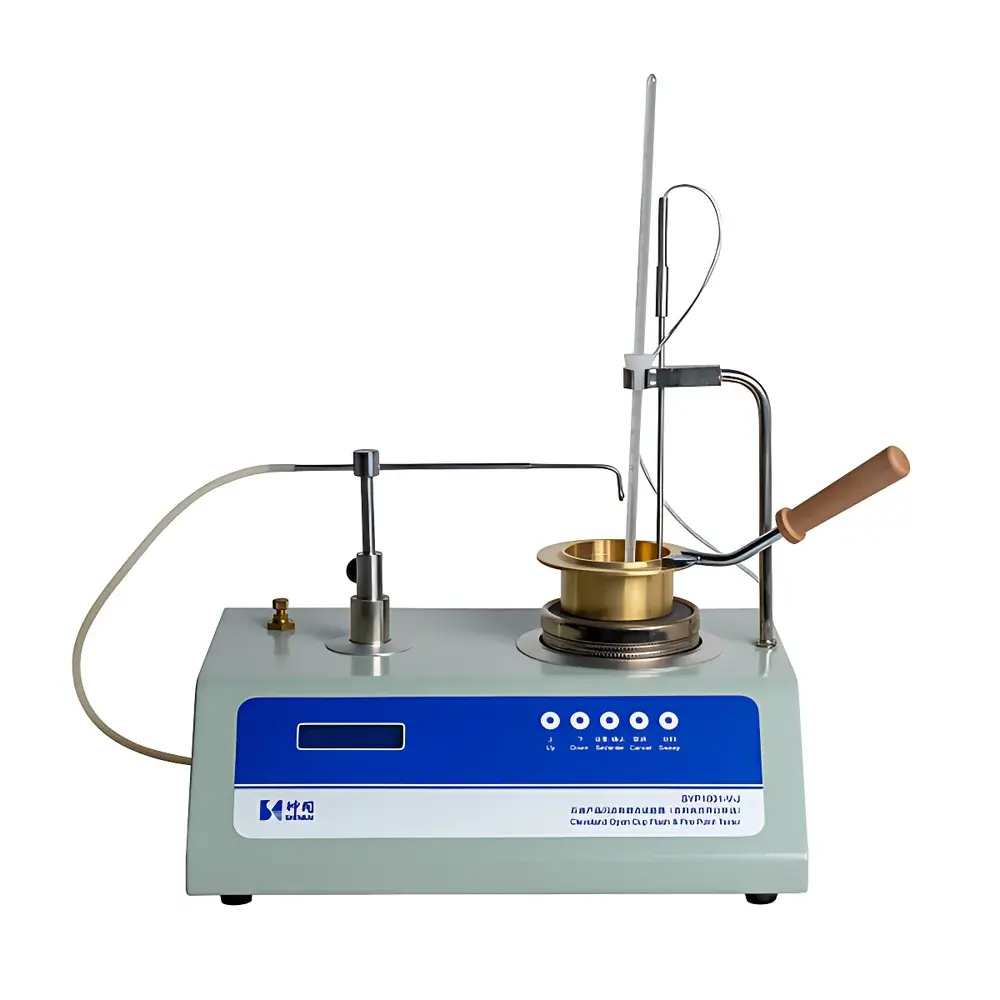
Shenkai SYP1001-V-J Cleveland Open Cup Flash Point and Fire Point Tester
| Brand | Shenkai |
|---|---|
| Origin | Shanghai, China |
| Model | SYP1001-V-J |
| Test Method | Cleveland Open Cup (COC) |
| Standards Compliance | GB/T 3536, ASTM D92, ISO 2592, SY/T 5645 |
| Cleveland Cup Material | H62 Brass |
| Cup Inner Diameter | Φ63.5 ± 0.5 mm |
| Ignition Source | Liquefied Petroleum Gas (LPG), Butane, or Town Gas |
| Igniter Orifice Diameter | 0.8 mm |
| Flame Sphere Diameter | φ4 mm |
| Heating Element Power | 400 W |
| Temperature Sensor | PT100, Range: 0–410 °C |
| Thermometer | GB/T 514 compliant, -6 to 400 °C, 2 °C graduation |
| Remote Control Distance | ≥10 m |
| Auto-Stop Conditions | 21 °C above expected flash point or sample temperature >400 °C |
| Voltage Compensation | Yes (maintains consistent heating rate under fluctuating line voltage) |
Overview
The Shenkai SYP1001-V-J Cleveland Open Cup Flash Point and Fire Point Tester is an engineered laboratory instrument designed for the precise determination of flash point and fire point of petroleum products—excluding fuel oils—having open-cup flash points above 79 °C. It operates in strict accordance with internationally recognized standard test methods, including ASTM D92, ISO 2592, and GB/T 3536, as well as the Chinese industry specification SY/T 5645. The instrument employs the Cleveland Open Cup (COC) method, a thermally controlled, manual-sweep ignition technique where a test flame is systematically traversed across the surface of a heated sample in a standardized brass cup. This method relies on visual detection of momentary vapor ignition (flash point) and sustained combustion (fire point), both governed by defined heating rates, cup geometry, and flame characteristics. Its robust architecture ensures thermal stability, repeatability, and operator safety during routine quality control and regulatory compliance testing in refinery laboratories, petrochemical R&D centers, and third-party testing facilities.
Key Features
- High-precision, sealed 400 W electric heating furnace with optimized thermal insulation—designed to extend service life and deliver consistent, controllable ramp rates per ASTM D92 (typically 5–6 °C/min up to 200 °C, then 3–4 °C/min thereafter)
- Integrated PT100 platinum resistance thermometer (0–410 °C range) coupled with digital LCD display for real-time, high-fidelity temperature monitoring and setpoint adjustment
- Intelligent remote-control ignition system (≥10 m operational range) enabling precise flame sweep timing and position synchronization with temperature progression
- Programmable pre-set flash point and fire point thresholds—activating automated flame sweep initiation and cessation logic to minimize operator intervention
- Self-diagnostic startup sequence verifying integrity of temperature sensor calibration, igniter actuation, and mechanical sweep alignment prior to each test cycle
- Dual auto-shutdown safeguards: termination triggered either 21 °C above user-defined anticipated flash point or upon reaching 400 °C—preventing thermal degradation and ensuring equipment longevity
- Voltage compensation circuitry maintains stable heating power output despite ±10% AC mains fluctuations, preserving measurement reproducibility in variable electrical environments
- Modular gas manifold with integrated tubing rack supporting interchangeable use of LPG, butane, or town gas—each regulated via precision needle valve for repeatable flame size (φ4 mm sphere) and ignition energy
Sample Compatibility & Compliance
The SYP1001-V-J is validated for use with lubricating oils, residual fuels, bitumens, biodiesel blends (B100–B20), and other non-volatile petroleum derivatives meeting the viscosity and volatility constraints of the Cleveland method. It excludes gasoline, jet fuels, and low-flash solvents (<79 °C), which require closed-cup methodologies (e.g., ASTM D56 or D93). Instrument construction complies with mechanical and dimensional requirements of ASTM D92: Cleveland cup fabricated from H62 brass (inner diameter Φ63.5 ± 0.5 mm), igniter orifice precisely machined to 0.8 mm, and flame geometry verified using traceable reference standards. Calibration traceability aligns with ISO/IEC 17025 requirements when paired with certified reference thermometers (GB/T 514 Class I) and documented verification procedures. Routine operation supports GLP documentation workflows, including electronic log entries for test parameters, observed events, and operator identity.
Software & Data Management
While the SYP1001-V-J operates as a stand-alone hardware platform without embedded PC software, its digital interface enables seamless integration into laboratory information management systems (LIMS) via RS-232 or optional USB-to-serial adapters. All temperature readings, setpoints, ignition timestamps, and auto-stop triggers are logged in non-volatile memory with UTC timestamping. Exported CSV files include test ID, sample ID, ambient conditions, observed flash/fire points, ramp rate verification flags, and diagnostic status codes. Audit trail functionality satisfies FDA 21 CFR Part 11 requirements when used with validated LIMS middleware that enforces electronic signatures, role-based access control, and immutable record retention. Firmware updates are performed via secure USB drive with version-locking and checksum validation.
Applications
- Quality assurance of base oils and finished lubricants per API RP 1529 and ISO 8217 specifications
- Regulatory submission testing for customs clearance and product registration under REACH and China’s GB standards
- Stability assessment of oxidized or thermally stressed hydrocarbon streams in refinery process monitoring
- Fire safety classification of industrial fluids under UN GHS and NFPA 30 hazard communication frameworks
- Research-grade evaluation of additive package effects on thermal ignition behavior in synthetic ester formulations
- Third-party certification testing for ISO 9001:2015 and CNAS-accredited laboratories
FAQ
What standards does the SYP1001-V-J fully support?
ASTM D92, ISO 2592, GB/T 3536, and SY/T 5645—all verified through factory calibration reports and dimensional inspection certificates.
Can this instrument be used for diesel or kerosene testing?
No. Diesel and kerosene have flash points below 79 °C and must be tested using closed-cup methods (e.g., ASTM D93 or D56); the Cleveland method is unsuitable and non-compliant for such materials.
Is external gas supply mandatory?
Yes. The instrument requires an external regulated supply of LPG, butane, or town gas; no internal gas storage or generation is provided.
How is temperature accuracy verified during routine use?
Users perform periodic verification using a NIST-traceable liquid-in-glass thermometer (GB/T 514 Class I) immersed in the oil bath alongside the PT100 sensor, comparing readings at three points: 100 °C, 250 °C, and 370 °C.
Does the unit support GLP-compliant electronic records?
Yes—when connected to a validated LIMS or ELN system with 21 CFR Part 11-compliant audit trail, signature, and data integrity controls.





