
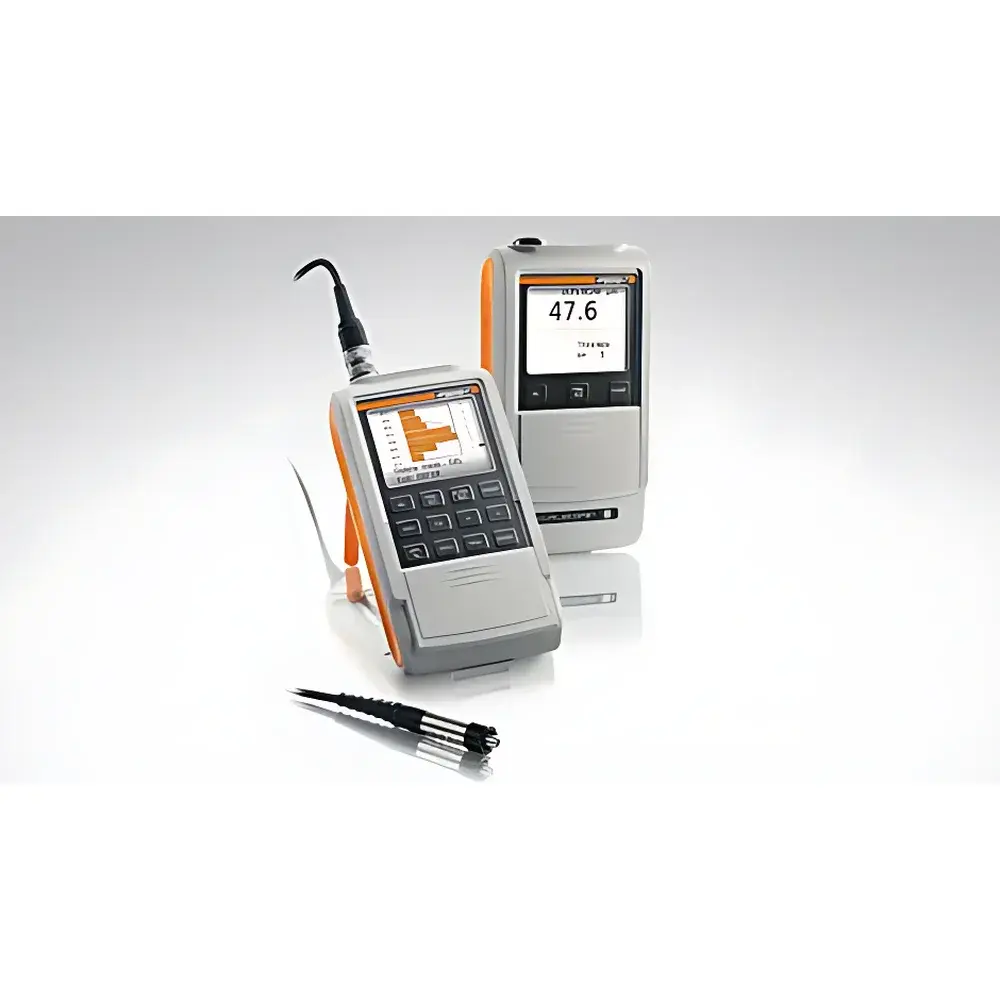
Fischer FMP10–FMP40 Series Handheld Coating Thickness Gauge
| Brand | Fischer |
|---|---|
| Origin | Germany |
| Model | FMP10–FMP40 |
| Measurement Principles | Magnetic Induction (for ferrous substrates) & Eddy Current (for non-ferrous conductive substrates) |
| Compliance Modes | IMO PSPC, SSPC-PA2, QUALANOD, QUALICOAT |
| Memory Capacity | Thousands of measurement records |
| Probe Interface | Interchangeable probe system |
| Operating Principle | Dual-method substrate-agnostic thickness quantification via calibrated electromagnetic field perturbation analysis |
Overview
The Fischer FMP10–FMP40 series represents a modular family of handheld coating thickness gauges engineered for high-precision, field-deployable metrology in industrial quality control and maintenance environments. These instruments operate on two complementary electromagnetic principles: magnetic induction for coatings applied to ferromagnetic substrates (e.g., steel, iron), and eddy current measurement for non-ferromagnetic conductive substrates (e.g., aluminum, copper, stainless steel). The DUALSCOPE® variant integrates both technologies into a single platform with automatic substrate recognition—eliminating manual mode selection and reducing operator-induced error. Unlike single-principle gauges, the FMP series delivers traceable, repeatable measurements across heterogeneous production lines where substrate composition varies unpredictably. Each unit is factory-calibrated against NIST-traceable reference standards and conforms to ISO 2178 (magnetic induction), ISO 2360 (eddy current), and ASTM B244/B499 for coating thickness verification.
Key Features
- Modular probe architecture supporting over 20 interchangeable probes—including flat, curved, miniaturized, and high-resolution variants—enabling adaptation to complex geometries (e.g., pipe interiors, fastener heads, narrow gaps).
- Real-time substrate identification logic that automatically selects the appropriate measurement method (magnetic or eddy current) and applies optimized calibration curves without user intervention.
- On-device statistical engine supporting mean, standard deviation, min/max, histogram visualization, and pass/fail evaluation per user-defined tolerance bands.
- Built-in compliance templates aligned with industry-critical protocols: IMO PSPC (Protective Coating Performance Standard for Ships), SSPC-PA2 (Procedure for Determining Conformance to Dry Film Coating Thickness Requirements), QUALANOD (anodized aluminum architectural finishes), and QUALICOAT (organic coatings on aluminum).
- Rugged IP54-rated enclosure with rubberized grip and scratch-resistant sapphire window for operation in harsh workshop, shipyard, or outdoor conditions.
- USB-C and Bluetooth 5.0 connectivity for secure data export, remote firmware updates, and integration with enterprise LIMS or SAP QA modules.
Sample Compatibility & Compliance
The FMP10–FMP40 series accommodates a broad spectrum of coated systems encountered in aerospace, automotive, marine, and architectural manufacturing. It measures non-conductive coatings (e.g., paint, epoxy, powder coat, enamel, plastic) on conductive metallic substrates—including ferrous alloys (steel, cast iron) and non-ferrous metals (aluminum, zinc, titanium, brass). For dual-layer systems—such as zinc underpaint on steel—the instrument resolves individual layer thicknesses when paired with appropriate multi-frequency probes (optional). All measurement algorithms are validated per ISO/IEC 17025-accredited procedures, and audit trails comply with FDA 21 CFR Part 11 requirements when used with Fischer’s optional GMP-compliant software suite. Calibration certificates include uncertainty budgets referenced to PTB (Physikalisch-Technische Bundesanstalt) standards.
Software & Data Management
Fischer’s FISCHER DataCenter software provides full lifecycle data governance: from probe-specific calibration management and multi-instrument fleet configuration to automated report generation compliant with EN ISO 14644-1 (cleanroom coatings) or ISO 12944-6 (corrosion protection). Raw measurement files retain timestamp, GPS coordinates (when enabled), operator ID, probe serial number, and environmental metadata (temperature, humidity). Export formats include CSV, PDF (with embedded signature fields), XML (for ERP ingestion), and proprietary .fcd format supporting GLP/GMP audit trail reconstruction. Role-based access control ensures segregation of duties between operators, calibrators, and QA reviewers.
Applications
- Verification of blast-cleaned surface profile prior to coating application in shipbuilding per IMO PSPC Clause 3.2.2.
- In-line quality assurance of coil-coated aluminum sheets in architectural cladding production, meeting QUALICOAT Class 1 performance criteria.
- Maintenance inspection of thermal barrier coatings on gas turbine casings using high-temperature rated probes (up to 150 °C continuous duty).
- Validation of zinc-rich primer thickness on offshore wind tower sections per ISO 12944-5 C5-M corrosion category requirements.
- Process capability studies (Cp/Cpk) during automotive OEM body shop audits, leveraging built-in SPC charting tools.
FAQ
Can the FMP40 measure coatings on stainless steel?
Yes—stainless steel substrates are evaluated via eddy current mode; however, austenitic grades (e.g., 304, 316) require probe-specific calibration due to variable magnetic permeability. A dedicated “SS-Mode” is available in firmware v3.2+.
Is probe calibration required before each use?
No—factory calibration remains valid for 12 months under normal operating conditions. However, daily zero-checks on certified reference standards (e.g., Fischer Foil Set FS-100) are recommended per ISO 2178 Annex B.
Does the device support multi-point averaging across curved surfaces?
Yes—curved-surface compensation algorithms correct for radius-induced field distortion; supported radii range from 3 mm (mini-probe) to ∞ (flat).
Can measurement data be exported directly to Excel?
Yes—CSV exports preserve all metadata and statistical parameters; column headers conform to ASTM E1300 tabular reporting conventions.
What is the typical measurement repeatability for 50 µm epoxy on mild steel?
±0.5 µm at 95% confidence (k=2), based on 20 repeated measurements per ISO 5725-2 precision testing protocol.



