
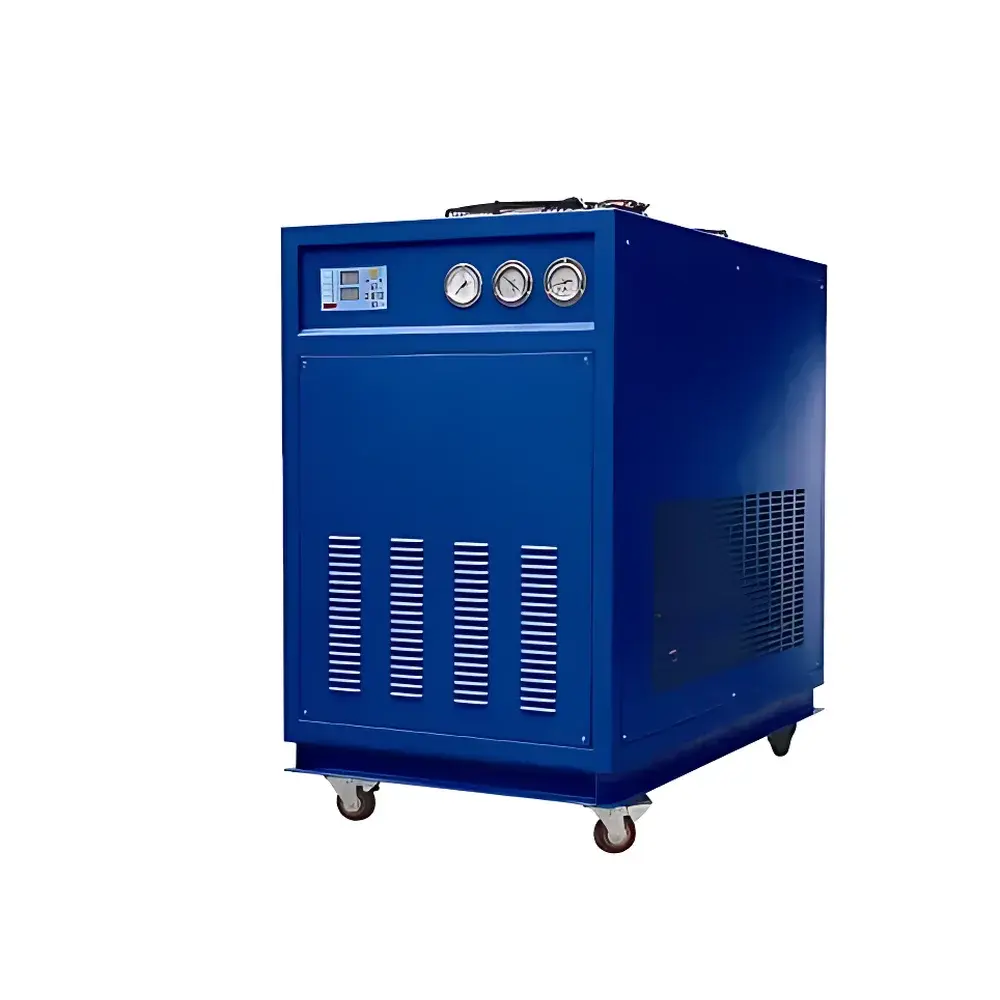
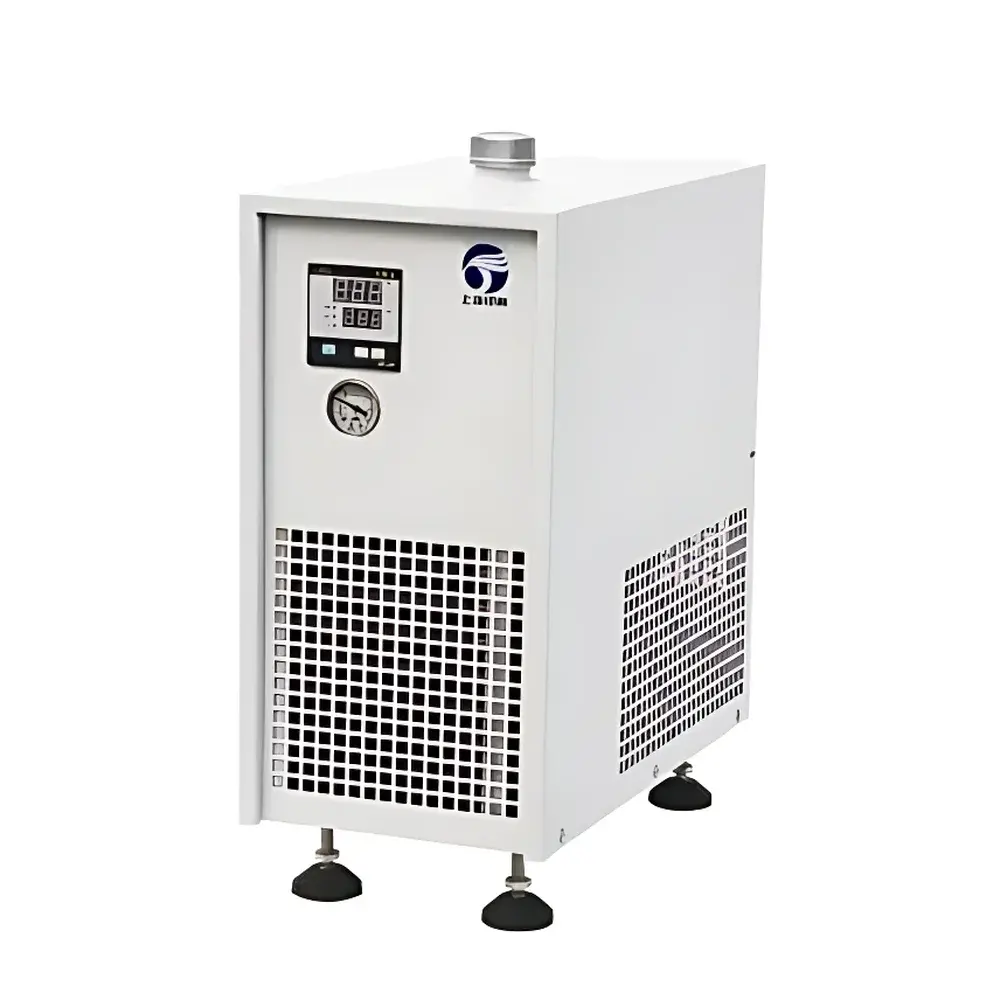
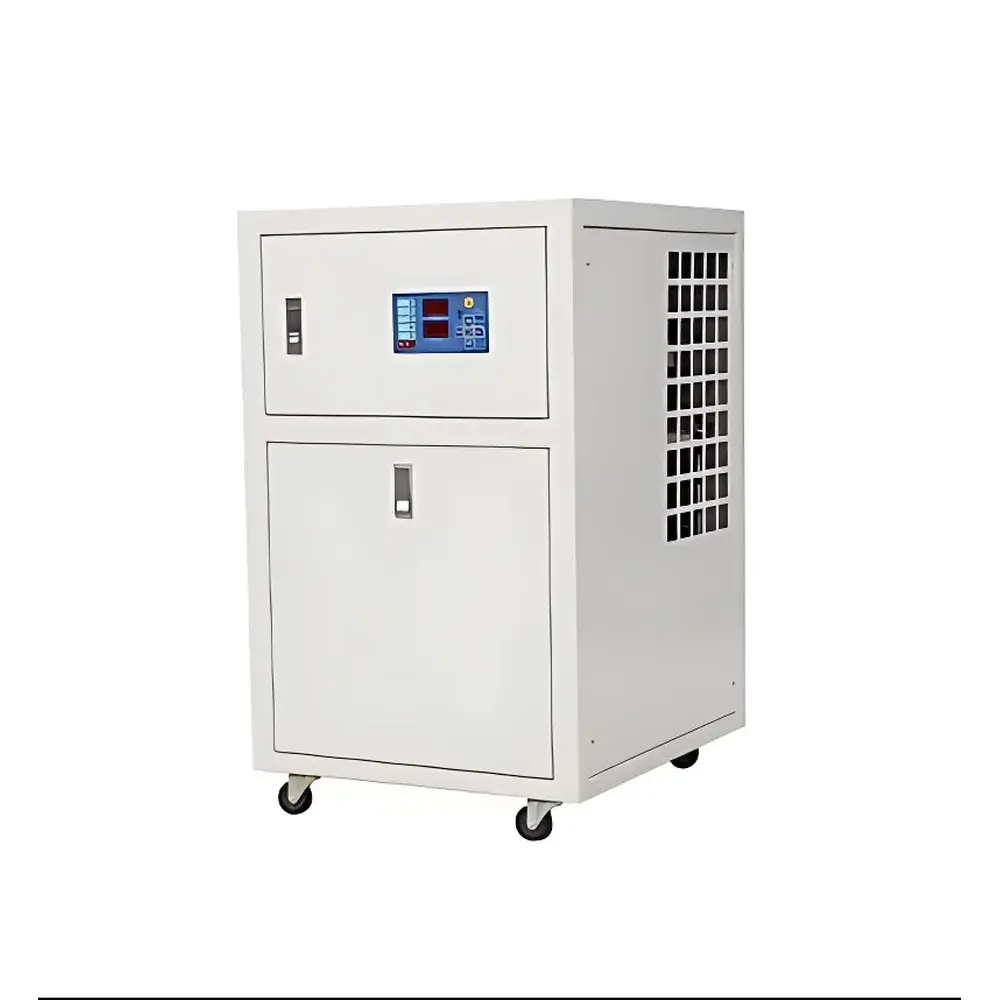
Tianfeng LS-4HP Air-Cooled Low-Temperature Circulating Chiller
| Brand | Tianfeng |
|---|---|
| Origin | Shanghai, China |
| Manufacturer Type | Direct Manufacturer |
| Equipment Type | Integrated Unit |
| Cooling Method | Air-Cooled |
| Temperature Control Range | 0–10 °C |
| Temperature Stability | ±0.1 °C |
| Refrigeration Capacity | 4 kW (3,440 kcal/h) |
| Circulating Pump Pressure | 2.0 bar |
| Circulating Flow Rate | 2 L/min |
| Reservoir Volume | 200 L |
| Operating Mode | Continuous Duty |
| Compressor Type | Scroll Compressor |
| Safety Protections | High/Low Pressure Switch, Overheat Protection, Overcurrent Protection, Overtemperature Alarm |
| Power Supply | 220 V, 50 Hz |
| Dimensions (L×W×H) | 800 × 600 × 1065 mm |
| Net Weight | Approx. 125 kg |
| Construction | Stainless Steel Reservoir & Pump |
| Controller | Digital PID Temperature Controller (Optional RKC Japan) |
Overview
The Tianfeng LS-4HP Air-Cooled Low-Temperature Circulating Chiller is an integrated precision temperature control system engineered for continuous-duty laboratory and industrial applications requiring stable, low-temperature coolant delivery. Unlike water-cooled chillers, this unit employs a high-efficiency air-cooled condenser—eliminating dependency on external cooling towers or facility water loops—making it ideal for standalone deployment in labs, cleanrooms, and compact production environments. Its core thermal management architecture utilizes a scroll compressor, thermostatic expansion valve (TEV), and copper-aluminum finned evaporator to achieve precise refrigerant cycle control. The chiller maintains setpoint temperatures between 0 °C and 10 °C with a stability of ±0.1 °C under dynamic load conditions, meeting the stringent thermal consistency requirements of analytical instrumentation such as graphite furnace atomic absorption spectrometers (GFAAS), inductively coupled plasma optical emission spectrometers (ICP-OES), X-ray diffractometers (XRD), and scanning electron microscopes (SEM). Designed for ISO/IEC 17025-compliant laboratories, it supports traceable calibration and long-term operational reliability without performance drift.
Key Features
- Integrated air-cooled design with no external water infrastructure required—reduces installation complexity and site dependency
- Stainless steel reservoir (200 L) and circulation pump resistant to corrosion and microbial growth—ensures fluid purity for sensitive instrumentation
- Digital PID temperature controller with real-time display and programmable setpoint adjustment (0.1 °C resolution)
- Scroll compressor with low-vibration operation and extended service life—provides consistent refrigeration output across ambient temperatures up to 40 °C
- Multi-layer safety architecture: high/low refrigerant pressure monitoring, compressor overheat detection, motor overcurrent protection, and outlet temperature over-limit alarm
- Adjustable flow rate (0–2 L/min) and pressure (0–2.0 bar) via calibrated bypass valve—enables optimization for varying heat load profiles
- Continuous-duty rated motor and sealed refrigerant circuit—validated for 24/7 operation in GMP-aligned QC labs and pilot-scale manufacturing
- Compliance-ready construction: CE-marked electrical components (Siemens, Schneider, Omron), certified expansion valves (Italy/Germany), and optional FDA 21 CFR Part 11–compatible controller upgrade path
Sample Compatibility & Compliance
The LS-4HP is compatible with all standard laboratory coolant circuits utilizing deionized water or 30% ethylene glycol/water mixtures (pH 6.5–8.5). It interfaces seamlessly with OEM cooling ports on major analytical platforms—including PerkinElmer, Thermo Fisher, Shimadzu, and Bruker instruments—via standard 1/2″ NPT or G1/2″ BSP fittings. From a regulatory standpoint, the unit conforms to IEC 61000-6-3 (EMC emissions), IEC 61000-6-2 (immunity), and UL 61010-1 (safety for lab equipment). Its stainless-steel wetted parts meet ASTM A240 Type 304 specifications, supporting GLP audit trails when paired with validated loggers. While not inherently classified as medical device hardware, its thermal stability profile satisfies USP criteria for analytical instrument qualification (AIQ) when deployed in pharmaceutical QC workflows.
Software & Data Management
The base configuration includes local digital interface only; however, optional RS485 Modbus RTU or Ethernet TCP/IP communication modules enable integration into centralized lab infrastructure management systems (LIMS) or building automation platforms. When equipped with the RKC PG32A controller (optional), the chiller supports full audit trail functionality—including user login history, parameter change logs, alarm timestamps, and event-driven data export—meeting FDA 21 CFR Part 11 requirements for electronic records and signatures. All firmware updates are performed via secure USB interface with version-controlled binaries. Data retention is maintained for ≥90 days onboard, with configurable remote logging to SQL or CSV-compatible servers. No cloud dependency or proprietary SaaS layer is introduced—ensuring full data sovereignty and network segmentation compatibility.
Applications
- Analytical Instrument Cooling: Thermal stabilization of plasma sources (ICP-MS), X-ray tubes (XRF/XRD), laser diodes (LIBS), and detector arrays (FTIR, Raman) to minimize signal noise and wavelength drift
- Materials Characterization: Controlled cooling during DSC, TGA, and rheometry sample preparation to preserve metastable phases and prevent premature crystallization
- Electron Microscopy: Heat extraction from SEM/TEM column components and specimen stages to reduce thermal drift during high-resolution imaging
- Pharmaceutical Process Support: Jacketed reactor temperature control during lyophilization cycle development and API crystallization studies
- Industrial OEM Integration: Compact cooling for CNC spindles, laser cutting heads, vacuum diffusion pumps, and semiconductor wafer probers where footprint and air-cooling are mandatory
FAQ
What is the maximum allowable inlet water temperature for safe operation?
The unit is designed for continuous operation with coolant return temperatures ≤35 °C. Sustained return temperatures above 40 °C may trigger high-pressure cutout and reduce compressor lifespan—consistent with AHRI Standard 550/590 guidelines.
Can the chiller operate at sub-zero setpoints?
No. The LS-4HP is optimized for 0–10 °C range. Sub-zero operation requires glycol concentration adjustment and specialized low-temperature compressors—not supported by this model.
Is remote monitoring supported out-of-the-box?
Standard units include local display only. Remote monitoring requires optional communication module installation and configuration per site network policy.
How often does the refrigerant circuit require maintenance?
Under normal operating conditions and ambient dust levels, the sealed R410A circuit requires no scheduled refrigerant servicing for ≥8 years. Annual inspection of condenser coil cleanliness and electrical terminations is recommended.
Does the unit comply with energy efficiency regulations?
Yes. It meets China’s GB 19576-2019 Energy Efficiency Labeling standard (Level 2) and EU Ecodesign Directive 2016/2281 for liquid chillers (≤15 kW).
Related Products



