
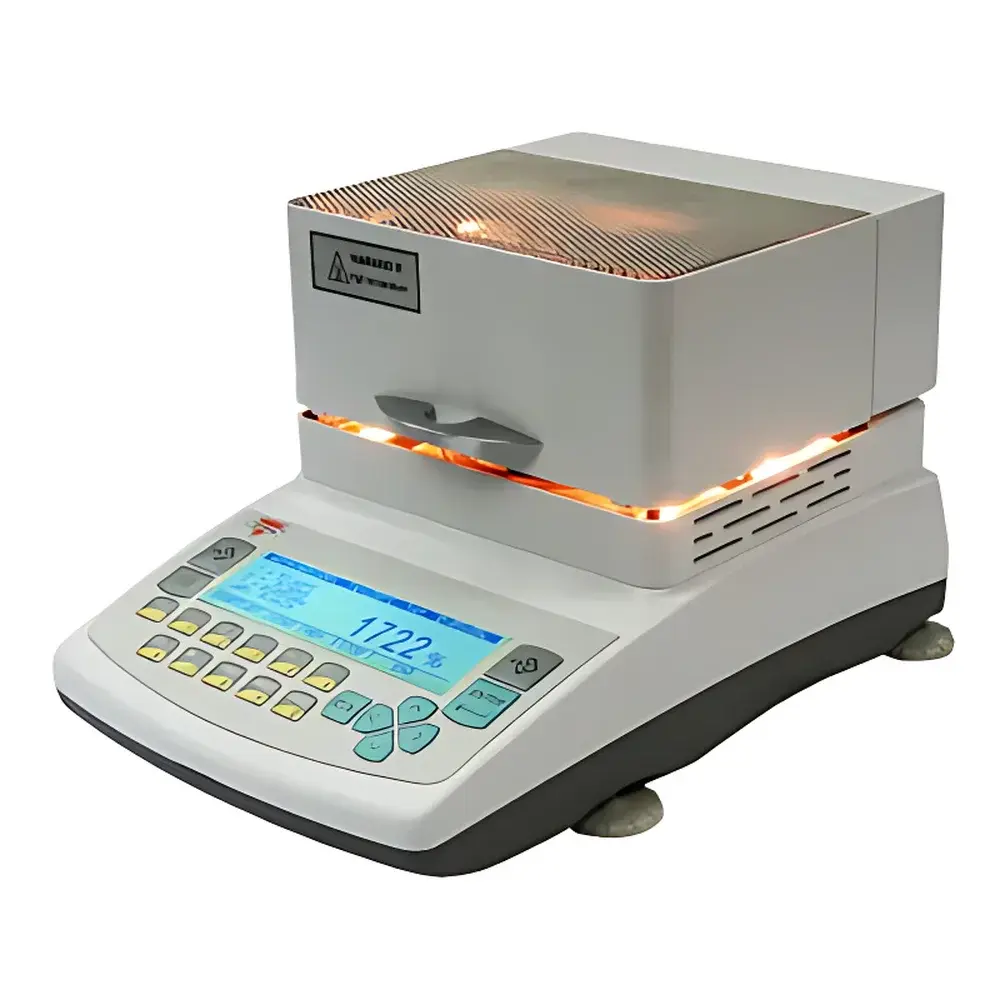
SI Torbal AGS PRO Series Precision Infrared Moisture Analyzer
| Brand | Scientific Industries |
|---|---|
| Origin | USA |
| Model | AGS60 250C PRO, AGS120 250C PRO |
| Heating Method | Halogen Lamp |
| Max Capacity | 60 g / 120 g |
| Tare Range | –60 g / –120 g |
| Readability | 0.001 g |
| Repeatability | 0.001 g |
| Linearity | ±0.002 g |
| Accuracy Class | II |
| Resolution | 0.01% moisture |
| Moisture Repeatability | ±0.3% (2 g sample), ±0.06% (5 g sample) |
| Interface | USB, RS232C, PS2 |
| Max Drying Temperature | 250 °C |
| Drying Time Range | 1–180 s per step, up to 10 hr total |
| Drying Power | 250 W |
| Preheat Time | ~30 s |
| Pan Diameter | 90 mm |
| Chamber Dimensions | 108 × 20 mm |
| External Dimensions | 215 × 345 × 200 mm |
Overview
The SI Torbal AGS PRO Series Precision Infrared Moisture Analyzer is an integrated thermogravimetric instrument engineered for rapid, reproducible moisture content determination in solid and semi-solid samples across pharmaceutical, food, polymer, chemical, and quality control laboratories. Utilizing halogen lamp infrared heating combined with high-resolution electromagnetic force compensation (EMFC) weighing technology, the system measures moisture loss as mass change during controlled thermal drying. Unlike traditional oven-drying methods requiring hours, the AGS PRO delivers validated results in minutes—without compromising traceability, linearity, or regulatory compliance. Its dual-sensor architecture decouples thermal and mass measurement subsystems, minimizing thermal drift and ensuring stability under dynamic heating conditions. Designed and assembled in the United States by Scientific Industries, the analyzer conforms to fundamental principles outlined in ASTM D4457 (for polymer moisture), ISO 15512 (plastics), and USP & Ph. Eur. general chapters on loss on drying (LOD), supporting method validation under GLP and GMP frameworks.
Key Features
- Electromagnetic force compensation (EMFC) load cell delivering 0.001 g readability and ±0.002 g linearity across full capacity range—certified to OIML R76 and NIST-traceable standards.
- 250 W halogen infrared heating system with precise external temperature control (up to 250 °C), enabling rapid, uniform sample desiccation while minimizing charring or decomposition of heat-sensitive matrices.
- Backlit graphical LCD display with intuitive menu navigation, real-time drying curve visualization, and on-screen statistical summary (mean, SD, CV%) for multi-run analysis.
- Onboard memory storing up to 20 user-defined drying methods—including ramp-hold profiles, endpoint criteria (e.g., Δm/Δt < 0.1 mg/min), and auto-shutdown logic.
- Rugged aluminum alloy housing with optimized airflow design and a 90 mm diameter stainless-steel weighing pan, facilitating easy cleaning and cross-contamination mitigation.
- Comprehensive I/O interface suite: isolated RS232C (for legacy LIMS integration), USB 2.0 (mass storage and HID emulation), and PS2 port (optional keyboard support for extended method entry).
Sample Compatibility & Compliance
The AGS PRO accommodates diverse sample types—including powders, granules, films, pellets, pastes, and lyophilized solids—with no requirement for pre-grinding or homogenization beyond standard lab practice. Its compact drying chamber (108 × 20 mm) ensures efficient radiant energy transfer while maintaining inert atmosphere compatibility (optional nitrogen purge kit available). All models meet ISO/IEC 17025 calibration requirements when serviced per manufacturer-recommended intervals. The instrument supports audit-ready data integrity through timestamped, non-editable result logs; optional software enables 21 CFR Part 11-compliant electronic signatures, role-based access control, and full audit trail generation for regulated environments.
Software & Data Management
The AGS PRO operates autonomously but integrates seamlessly with SI’s optional Torbal MoistureLink™ PC software (Windows 10/11 compatible). This application provides advanced method development tools, comparative drying curve overlay, statistical process control (SPC) charting, and automated report export to PDF, CSV, or XML formats. Raw mass-vs.-time datasets are preserved in native binary format with embedded metadata (operator ID, method name, environmental temp/humidity if logged via external sensor). Data encryption, password-protected configuration files, and configurable auto-backup ensure continuity in multi-shift operations and long-term archival compliance.
Applications
- Pharmaceutical raw material release testing (excipients, APIs, tablet granules) per USP & EP monographs.
- Food ingredient QC—monitoring moisture in flour, dairy powders, coffee beans, spices, and pet food to prevent microbial growth and ensure shelf-life stability.
- Polymer processing control—verifying resin dryness prior to extrusion or injection molding to avoid hydrolysis-induced molecular weight degradation.
- Chemical catalyst and desiccant validation—quantifying residual solvent or hydration water in zeolites, silica gels, and metal-organic frameworks (MOFs).
- Academic research in materials science—correlating moisture content with dielectric properties, thermal conductivity, or mechanical performance.
FAQ
What calibration standards are recommended for routine verification?
NIST-traceable stainless-steel weights (10 g and 50 g) and certified moisture reference standards (e.g., sodium tartrate dihydrate, ~15.66% H₂O) are advised for daily performance checks.
Can the AGS PRO be used for volatile organic compound (VOC) quantification?
No—it measures total volatile loss as moisture-equivalent mass reduction; dedicated GC or headspace analysis is required for VOC speciation.
Is method transfer between AGS60 and AGS120 models straightforward?
Yes—identical firmware, identical drying algorithms, and shared method libraries ensure seamless scalability from R&D to production-scale testing.
Does the instrument support automatic sample identification?
Not natively; however, barcode scanning integration is achievable via third-party serial-to-USB adapters and custom scripting in MoistureLink™.
What maintenance intervals are specified for halogen lamp replacement?
Lamp life exceeds 5,000 hours under typical usage; replacement is recommended only upon observed deviation in drying kinetics or temperature uniformity validation failure.
Related Products






