
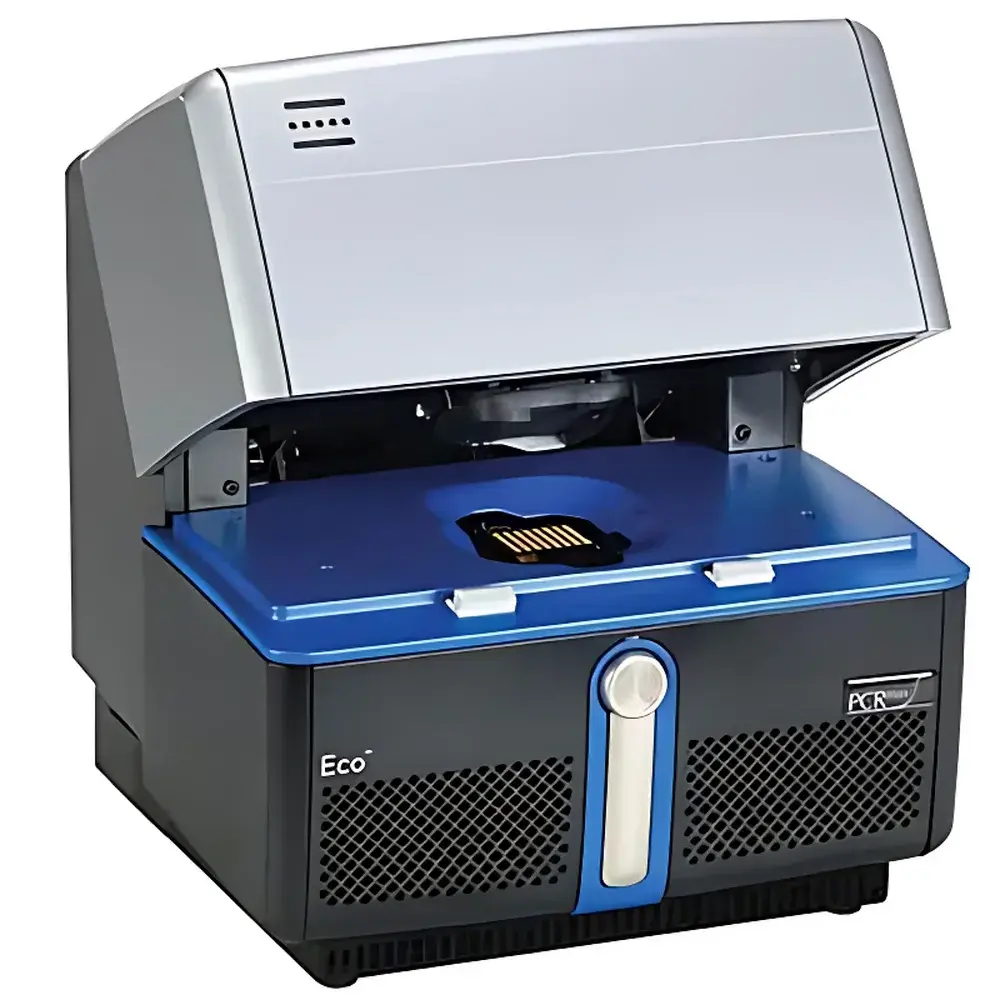
PCRmax ECO 48 Real-Time Fluorescence Quantitative PCR System
| Brand | PCRmax |
|---|---|
| Origin | United Kingdom |
| Model | ECO 48 |
| Instrument Type | Real-Time Fluorescence Quantitative PCR System |
| Sample Throughput | 48-well |
| Heating/Cooling Rate | 5.5 °C/sec |
| Temperature Accuracy | ±0.1 °C |
| Well-to-Well Temperature Uniformity | ±0.1 °C (at 95 °C) |
| Dynamic Range | >9 logs |
| Detection Sensitivity | 1 copy |
| Optical Channels | 4 (excitation: 452–486 nm & 542–582 nm |
| emission filters | 505–545 nm, 562–596 nm, 604–644 nm, 665–705 nm) |
| Supported Dyes | SYBR®, FAM™, HEX™, VIC™, ROX™, Cy®5 |
| HRM Capability | Standard |
| Block Material | Hollow silver-plated aluminum block with internal liquid thermal conduction medium |
| Reaction Volume | 5–20 µL |
| Software | EcoControl & EcoStudy (included, multi-user, post-run reanalysis enabled) |
| Dimensions (W×D×H, closed) | 34.5 × 31 × 32 cm |
| Weight | 13.6 kg |
Overview
The PCRmax ECO 48 is a compact, high-performance real-time fluorescence quantitative PCR system engineered for precision, reproducibility, and compliance in molecular diagnostics, academic research, and quality-controlled bioprocessing environments. It operates on the principle of sequence-specific DNA amplification coupled with real-time fluorescent signal detection during each thermal cycle. The system employs a hollow silver-plated aluminum thermal block filled with a thermally conductive liquid medium—enabling rapid heat transfer and exceptional temperature homogeneity across all 48 wells. With a certified temperature accuracy of ±0.1 °C and well-to-well uniformity of ±0.1 °C at 95 °C, the ECO 48 meets stringent requirements for MIQE (Minimum Information for Publication of Quantitative Real-Time PCR Experiments) compliance. Its dual 48-position LED excitation arrays (452–486 nm and 542–582 nm) and four precisely calibrated emission filter channels support multiplexed detection without spectral crosstalk, while its CCD-based optical architecture ensures low-noise, high-fidelity signal acquisition from as few as one target DNA copy.
Key Features
- MIQE-compliant platform with built-in validation protocols for assay transparency and publication readiness
- Integrated high-resolution melting (HRM) analysis as standard functionality—capable of discriminating Class IV SNPs with ≥99.9% classification accuracy under optimized conditions
- Four-channel fluorescence detection supporting SYBR®, FAM™, HEX™, VIC™, ROX™, and Cy®5 dyes; pre-calibrated for all listed dyes—no user calibration required
- Thermal cycling performance: 40 cycles completed in <40 minutes (standard mode) or <20 minutes (fast mode), enabled by 5.5 °C/sec average ramp rate and low thermal mass block design
- Passive reference dye support (e.g., ROX) for inter-run normalization and fluorescence baseline correction
- Plug-and-play installation—no external calibration or service engineer intervention required for routine deployment
- Compact footprint (34.5 × 31 cm) optimized for space-constrained laboratories, including biosafety cabinets and shared core facilities
Sample Compatibility & Compliance
The ECO 48 accepts standard 48-well qPCR plates with transparent adhesive seals, accommodating reaction volumes from 5 to 20 µL. Its open-platform architecture supports all commercially available master mixes, probe chemistries (hydrolysis, hybridization, molecular beacon), and intercalating dyes—including third-party and custom formulations. Regulatory compliance is embedded in system design: data integrity safeguards include audit-trail-enabled software (EcoControl and EcoStudy), timestamped run logs, user-access controls, and exportable raw fluorescence and melt curve datasets compliant with GLP/GMP documentation standards. While not FDA 510(k)-cleared, the instrument’s architecture aligns with ISO/IEC 17025 laboratory accreditation requirements for method validation and equipment qualification. All thermal and optical calibrations are factory-performed and traceable to NPL (National Physical Laboratory, UK) standards.
Software & Data Management
The bundled EcoControl (acquisition) and EcoStudy (analysis) software suite provides a unified, multi-user interface compatible with Windows OS. Acquisition parameters—including cycle number, temperature profile, fluorescence read points, and melt ramp rate—are fully configurable pre-run. Critically, quantitative and qualitative analysis parameters—including Ct threshold setting, baseline correction, and HRM clustering algorithms—can be modified post-acquisition without re-running samples. Raw fluorescence data (Rn values), normalized reporter signals (ΔRn), and continuous melt curve derivatives are stored in vendor-neutral CSV and XML formats. Exported datasets meet FAIR (Findable, Accessible, Interoperable, Reusable) principles and integrate with LIMS platforms via ODBC or API-compatible middleware. Software updates are delivered via secure HTTPS channel with version-controlled release notes.
Applications
- Absolute and relative quantification of mRNA, miRNA, and viral nucleic acids in clinical and translational research
- Genotyping and allelic discrimination assays—including SNP detection, methylation-specific PCR, and copy number variation (CNV) analysis
- High-resolution melting (HRM) for mutation scanning, pathogen strain differentiation, and amplicon species identification
- QC testing of biologics, cell therapies, and gene therapy vectors (e.g., residual plasmid DNA, vector genome titer)
- Environmental monitoring and food safety testing (e.g., pathogen load quantification in agricultural samples)
- Teaching laboratories requiring robust, low-maintenance instrumentation with pedagogical software interfaces
FAQ
Does the ECO 48 require routine optical recalibration?
No. All excitation LEDs and emission filters are factory-aligned and thermally stabilized; no user-performed optical recalibration is necessary.
Can I perform multiplex qPCR with more than two targets simultaneously?
Yes—the four-channel optical system enables simultaneous detection of up to four distinct fluorophores per well, provided their spectra are resolvable within the configured filter bands.
Is the software compatible with networked laboratory environments?
Yes. EcoControl and EcoStudy support domain-authenticated login, role-based permissions, and centralized configuration management across local area networks.
What validation documentation is supplied with the instrument?
Each unit ships with a Certificate of Conformance, Factory Calibration Report (thermal and optical), and IQ/OQ protocol templates aligned with ISO 13485 and GAMP5 guidelines.
Can HRM analysis be performed without prior qPCR amplification on the same instrument?
No. HRM is executed immediately following amplification within the same run; it requires a completed qPCR step to generate the double-stranded DNA substrate for melting analysis.





