
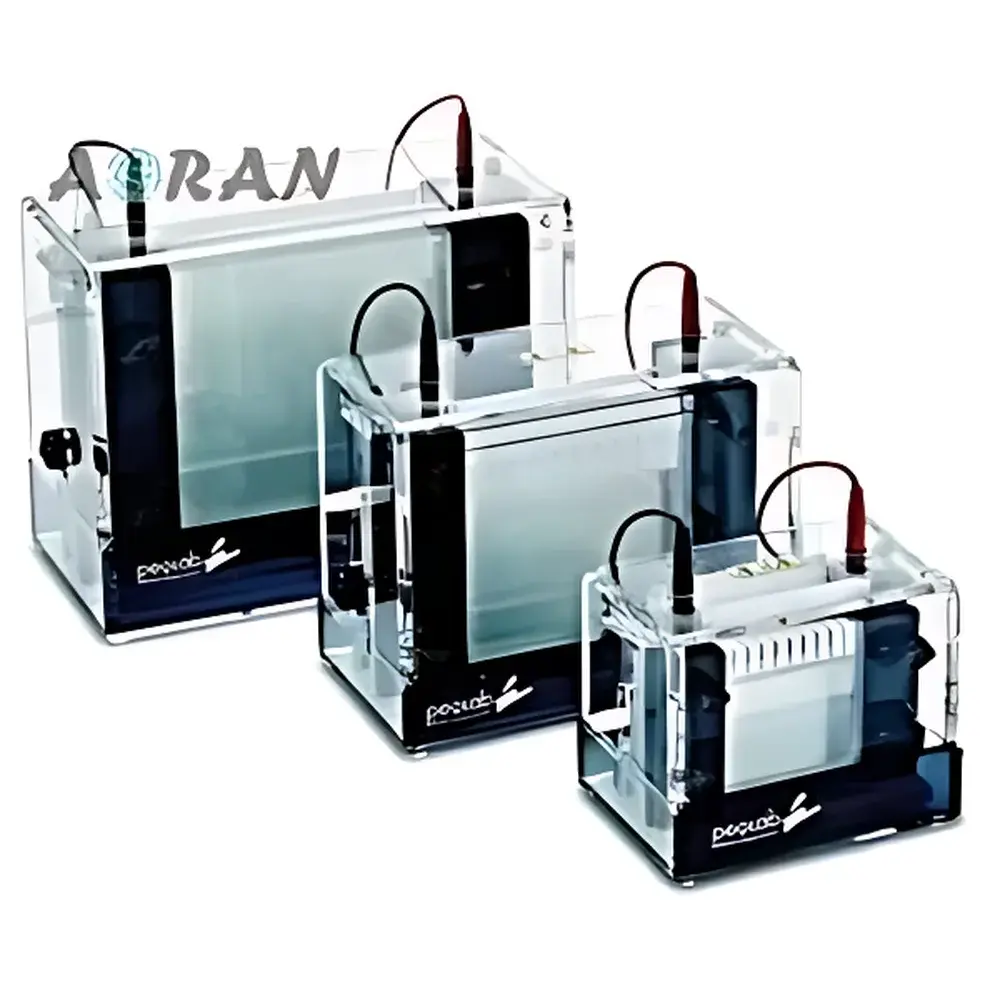
peQLab Perfect Blue Vertical Electrophoresis Tank
| Brand | peQLab |
|---|---|
| Origin | Germany |
| Model Range | Twin S, Twin M, Twin L, Twin ExW S |
| Gel Dimensions (W×L) | 10×10 cm, 16×14 cm, 20×20 cm, 20×10 cm |
| Max Sample Capacity | 24–72 wells |
| Comb Options | 10-, 15-, or 20-tooth combs (0.8 mm or 1.5 mm thickness) |
| Dual-Gel Capability | Yes |
| Cooling System | Aluminum oxide ceramic central cooling chamber |
| Electrode Design | Asymmetric anode/cathode connectors |
| Construction Material | Acrylic resin (leak-proof, chemically resistant) |
| Included Accessories | 2 glass plate sets, 2 comb sets, 2 pressure bar sets, Easy-to-use casting stand |
| Warranty | 3 years |
Overview
The peQLab Perfect Blue Vertical Electrophoresis Tank is a high-precision, dual-gel vertical electrophoresis system engineered for reproducible protein and nucleic acid separation under denaturing (SDS-PAGE) and native conditions—including isoelectric focusing (IEF) applications. Designed and manufactured in Germany, the system operates on standard constant-voltage or constant-current power supplies and leverages a robust Cu–Ni electrode configuration with a proprietary triple-cathode architecture to ensure uniform electric field distribution across the entire gel matrix. This design mitigates edge effects and band distortion—critical for high-resolution analytical separations where lane integrity and molecular weight accuracy are essential. The tank’s integrated thermal management relies on a central cooling chamber fabricated from aluminum oxide ceramic, enabling stable buffer temperature control during high-power runs (up to 500 V / 100 mA), thereby minimizing Joule heating-induced gel deformation or band smearing.
Key Features
- Triple-cathode electrode configuration: Ensures homogeneous current density across the gel surface, reducing lateral migration artifacts and improving inter-gel reproducibility.
- Leak-proof acrylic resin construction: Chemically inert, impact-resistant housing rated for long-term exposure to SDS, acrylamide, and organic solvents commonly used in gel preparation and running buffers.
- Single-chamber gel casting & electrophoresis: Eliminates transfer steps between casting trays and running tanks—reducing contamination risk and operator handling time while preserving gel integrity.
- Ceramic-core active cooling: Aluminum oxide ceramic offers superior thermal conductivity and electrical insulation; maintains buffer temperature within ±0.5 °C at sustained 400 V operation.
- Asymmetric electrode connectors: Physically keyed anode and cathode plugs prevent misconnection—a critical safeguard against reversed polarity and irreversible gel damage.
- Dual-gel parallel operation: Each tank accommodates two independent gels simultaneously, doubling throughput without compromising resolution or run consistency.
- Modular accessory ecosystem: Includes precision-machined Easy-to-use casting stands, calibrated glass plates (1.0 mm and 1.5 mm spacers), interchangeable combs (10/15/20 teeth), and stainless-steel pressure bars with silicone gaskets.
Sample Compatibility & Compliance
The Perfect Blue system supports standard polyacrylamide gel electrophoresis (PAGE), SDS-PAGE, 2D-PAGE (first-dimension IEF strips compatible with IPGphor or Multiphor systems), and native PAGE protocols. It is routinely validated for use with Tris-Glycine, Tris-Tricine, and Bis-Tris-MES buffer systems. All materials comply with EU Directive 2011/65/EU (RoHS) and are free of SVHC substances per REACH Annex XIV. The design conforms to IEC 61010-1:2010 safety standards for laboratory electrical equipment. While not a regulated medical device, its performance characteristics align with ISO/IEC 17025 requirements for method validation in accredited QC/QA laboratories performing protein purity assessment per USP and EP 2.2.44.
Software & Data Management
The Perfect Blue tank is hardware-independent and fully compatible with third-party imaging and analysis platforms including Bio-Rad Quantity One, TotalLab TL120, and Alpha Innotech FluoroChem Q. No proprietary firmware or embedded software is required—operation is controlled exclusively via external power supply units (e.g., peQLab PowerBase series or equivalent). All accessories are serialized and traceable; documentation packages include CE Declaration of Conformity, RoHS compliance certificates, and full dimensional schematics for GLP audit readiness. Raw gel images acquired post-run may be annotated with batch identifiers, operator ID, and instrument serial number to support 21 CFR Part 11-compliant electronic record retention when paired with validated LIMS or ELN systems.
Applications
- High-throughput SDS-PAGE for recombinant protein purity verification in biopharmaceutical process development
- Native PAGE analysis of multi-subunit complexes and enzyme activity profiling
- First-dimension IEF separation in 2D electrophoresis workflows targeting phosphoproteome or glycoproteome mapping
- Quality control of oligonucleotide synthesis products and CRISPR guide RNA preparations
- Academic research in structural biology requiring consistent, low-background gel matrices for subsequent Western blotting or mass spectrometry sample excision
FAQ
Is the Perfect Blue system compatible with precast gels?
Yes—standard thickness (1.0 mm and 1.5 mm) commercial precast gels from Bio-Rad, Thermo Fisher, and Lonza fit securely within the Twin S, Twin M, and Twin L configurations.
What buffer volumes are required for each model?
Twin S: 350 mL anode + 350 mL cathode; Twin M: 600 mL per chamber; Twin L: 900 mL per chamber; Twin ExW S: 700 mL per chamber.
Can the cooling chamber be connected to an external recirculating chiller?
No—the ceramic chamber is passively coupled to ambient air via integrated heat sinks; active chilling is unnecessary under standard operating conditions up to 500 V.
Are replacement parts available separately?
Yes—glass plates, combs, gaskets, pressure bars, and electrode assemblies are stocked globally with lead times under 5 business days.
Does peQLab provide application support for method optimization?
Yes—technical documentation includes protocol appendices for common electrophoretic systems (e.g., Laemmli, Schägger, and Anderson buffers), and application scientists offer remote troubleshooting aligned with ISO/IEC 17025 traceability requirements.




