
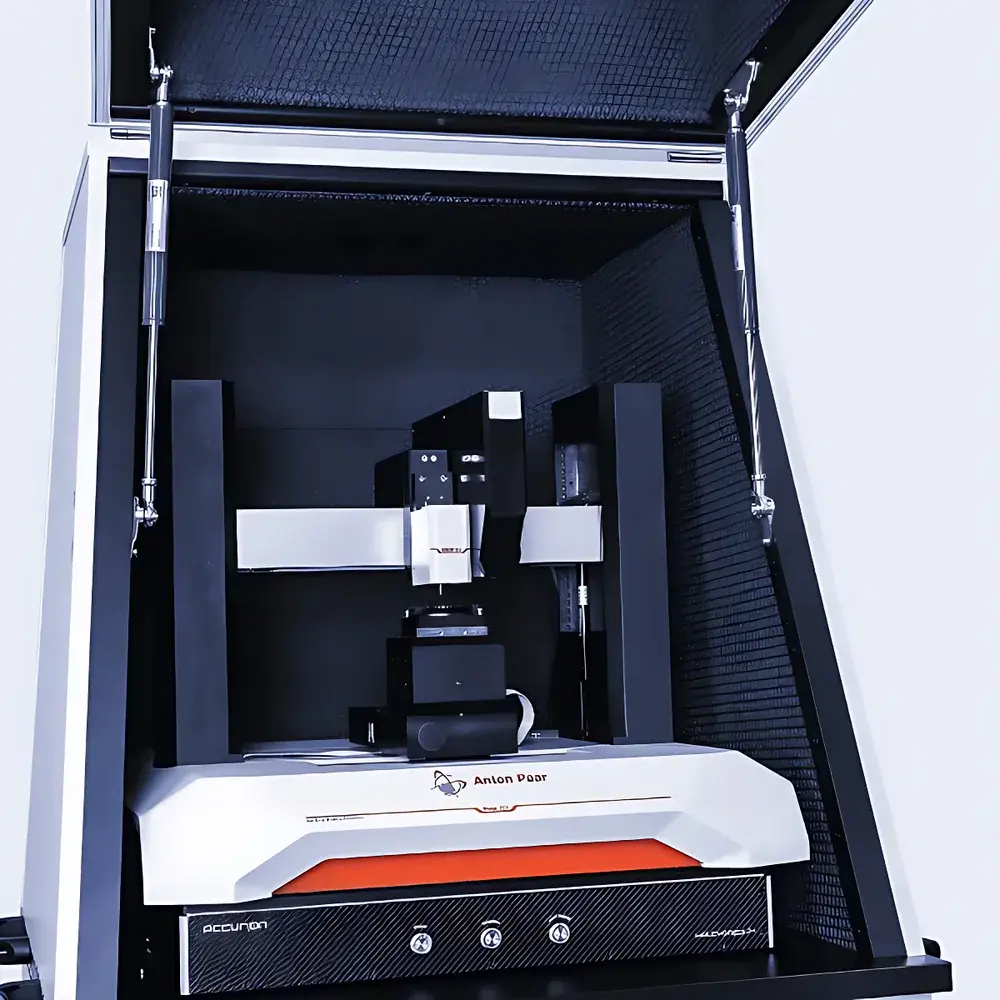
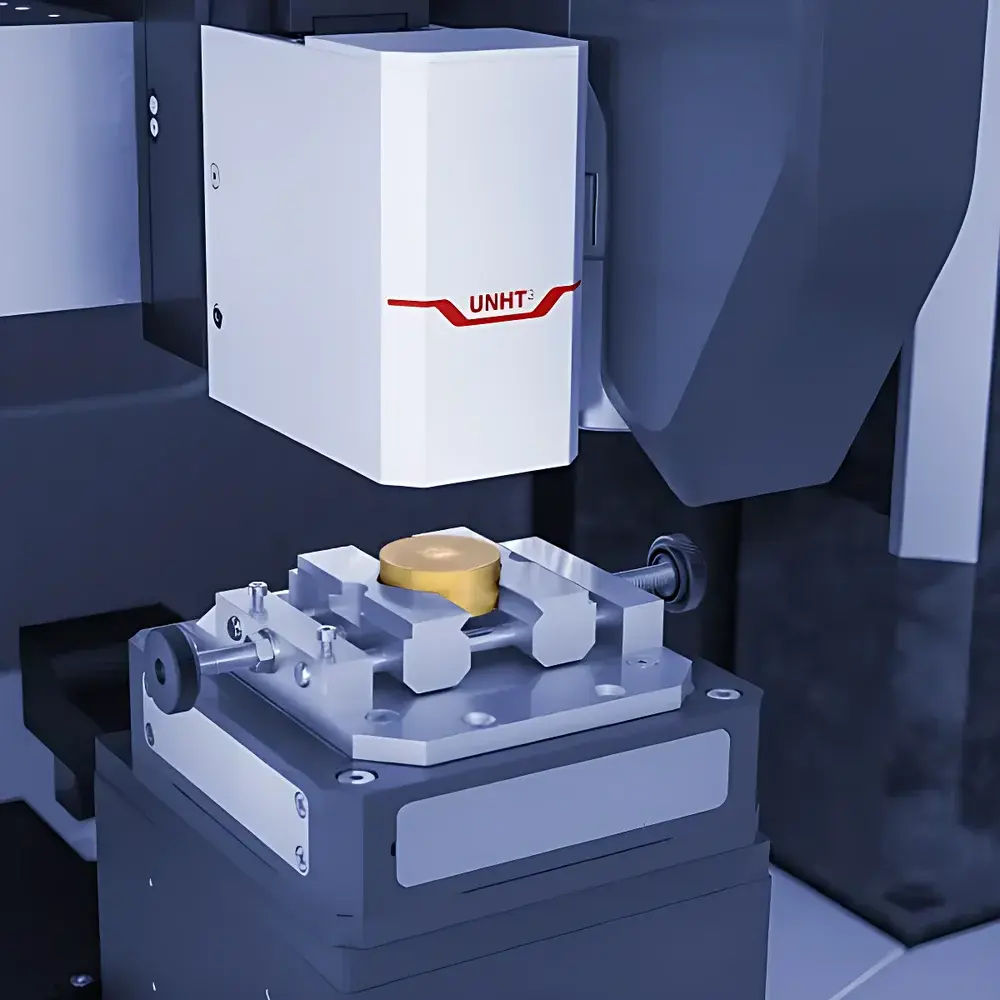
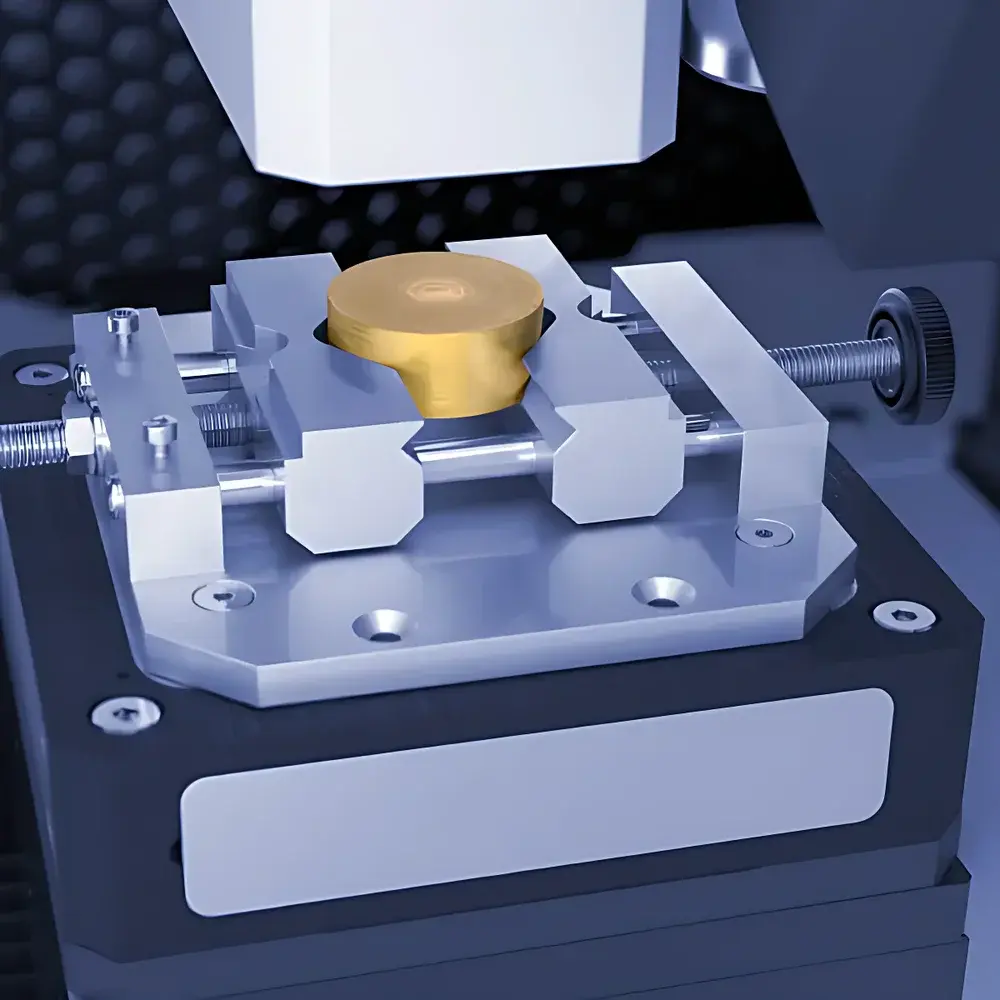
Anton Paar High-Resolution Piezo Sample Stage (100 μm × 100 μm) for UNHT³ Nanoindentation Systems
| Brand | Anton Paar |
|---|---|
| Origin | Austria |
| Manufacturer Type | Original Equipment Manufacturer (OEM) |
| Product Category | Imported Instrument |
| Model | Piezo Sample Stage 100 μm × 100 μm |
| Pricing | Upon Request |
Overview
The Anton Paar High-Resolution Piezo Sample Stage (100 μm × 100 μm) is a precision motion module engineered specifically for integration with the UNHT³ ultra-nanohardness tester and other high-sensitivity nanoindentation platforms. It operates on closed-loop piezoelectric actuation principles, enabling sub-nanometer positional control and deterministic repositioning across a defined 100 μm × 100 μm scanning field. This stage is not a standalone instrument but a critical subsystem that directly governs spatial fidelity in depth-sensing indentation experiments—where measurement repeatability, site-specific mechanical mapping, and cross-scale correlation (e.g., linking nanoindentation data to SEM/FIB coordinates) depend fundamentally on XY positioning accuracy. Its design prioritizes thermal stability, mechanical rigidity, and electromagnetic compatibility within vacuum-compatible or inert-gas environmental chambers typical of advanced materials characterization labs.
Key Features
- Closed-loop piezoelectric positioning with real-time capacitive feedback for traceable displacement control
- 10 nm repositioning accuracy—verified per ISO 14577-1 Annex C protocols—ensuring consistent indentation site registration across repeated load-unload cycles
- 100 μm × 100 μm travel range optimized for high-resolution mechanical property mapping of heterogeneous microstructures (e.g., grain boundaries, phase interfaces, thin-film multilayers)
- 0.2 nm minimum step resolution enables precise rastering for grid-based modulus/hardness tomography and local strain-field analysis
- Compact footprint (100 mm × 100 mm × 20 mm) with standardized kinematic mounting interface compatible with UNHT³ base plates and third-party nanoindenter frames
- Low hysteresis (<0.1% F.S.) and minimal creep (<0.05% over 60 s), supporting long-duration creep or relaxation tests requiring stable probe positioning
Sample Compatibility & Compliance
The stage supports rigidly mounted specimens up to 50 mm in diameter and 20 mm in thickness, including polished metal alloys, ceramic composites, polymer blends, and coated substrates. It maintains positional integrity under dynamic loading conditions (up to 100 mN maximum force during UNHT³ operation) without measurable stage-induced drift. All motion control electronics comply with IEC 61000-6-3 (EMC emission standards) and operate within ambient temperature ranges of 20–25 °C ± 0.5 °C—conditions aligned with ASTM E2546 and ISO 14577-1 recommendations for nanomechanical testing reproducibility. When used in conjunction with UNHT³’s integrated environmental chamber, the stage remains functional under controlled humidity (10–60% RH) and inert gas (N₂ or Ar) atmospheres, satisfying requirements for oxide-sensitive or hygroscopic material evaluation.
Software & Data Management
Fully integrated via Anton Paar’s iNano software suite (v5.3+), the piezo stage enables synchronized coordinate referencing between indentation sites and optical microscope images, AFM topographs, or EBSD maps. Positional metadata—including absolute XY coordinates, timestamp, thermal drift compensation values, and closed-loop error residuals—is embedded in each .ind file per ASTM E2546 Annex A3 guidelines. Audit trails comply with FDA 21 CFR Part 11 when configured with electronic signatures and user access controls. Export formats include CSV (for MATLAB/Python post-processing), XML (for LIMS integration), and native .nif for direct import into Thermo Scientific Avizo or Bruker NanoScope Analysis.
Applications
- Quantitative hardness and elastic modulus mapping across multiphase alloys (e.g., Ti-6Al-4V α/β lamellae, Al-Si cast microstructures)
- Depth-resolved mechanical profiling at coating-substrate interfaces (e.g., DLC, CrN, thermal barrier coatings)
- Thermally induced property gradients in laser-annealed or ion-irradiated surfaces
- Statistical nanoindentation for stochastic modeling of local yield behavior in amorphous metals
- Correlative metrology workflows combining nanoindentation with SEM-EDS, TEM-DIC, or synchrotron XRD
FAQ
Is this stage compatible with non-Anton Paar nanoindenters?
Yes—mechanical and electrical interface specifications (including pinout diagrams and communication protocol documentation) are available under NDA for OEM integration projects.
Does the stage require recalibration after thermal cycling?
No routine recalibration is needed; built-in capacitive sensors provide continuous position verification, and thermal drift compensation algorithms are automatically applied during measurement sequences.
Can it be used in vacuum environments?
Yes—the stage is rated for operation down to 10⁻⁶ mbar and features UHV-compatible materials (stainless steel 316L, ceramic insulators) and bake-out tolerant cabling.
What is the maximum allowable specimen weight?
The stage supports static loads up to 500 g with ≤0.5 nm deflection under gravitational loading, verified via interferometric calibration.
How is positional accuracy validated during installation?
Anton Paar provides traceable calibration reports using NIST-traceable laser interferometry (ISO/IEC 17025 accredited lab), delivered with each unit.



