
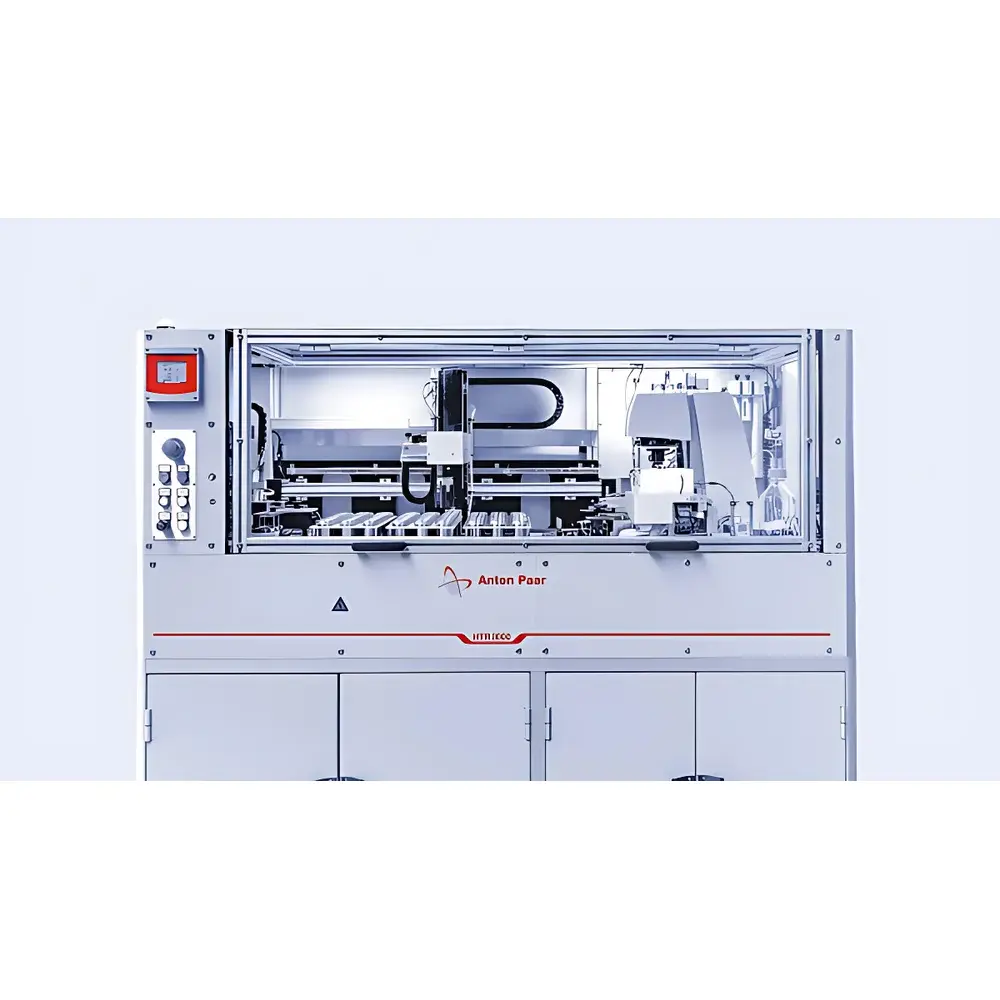
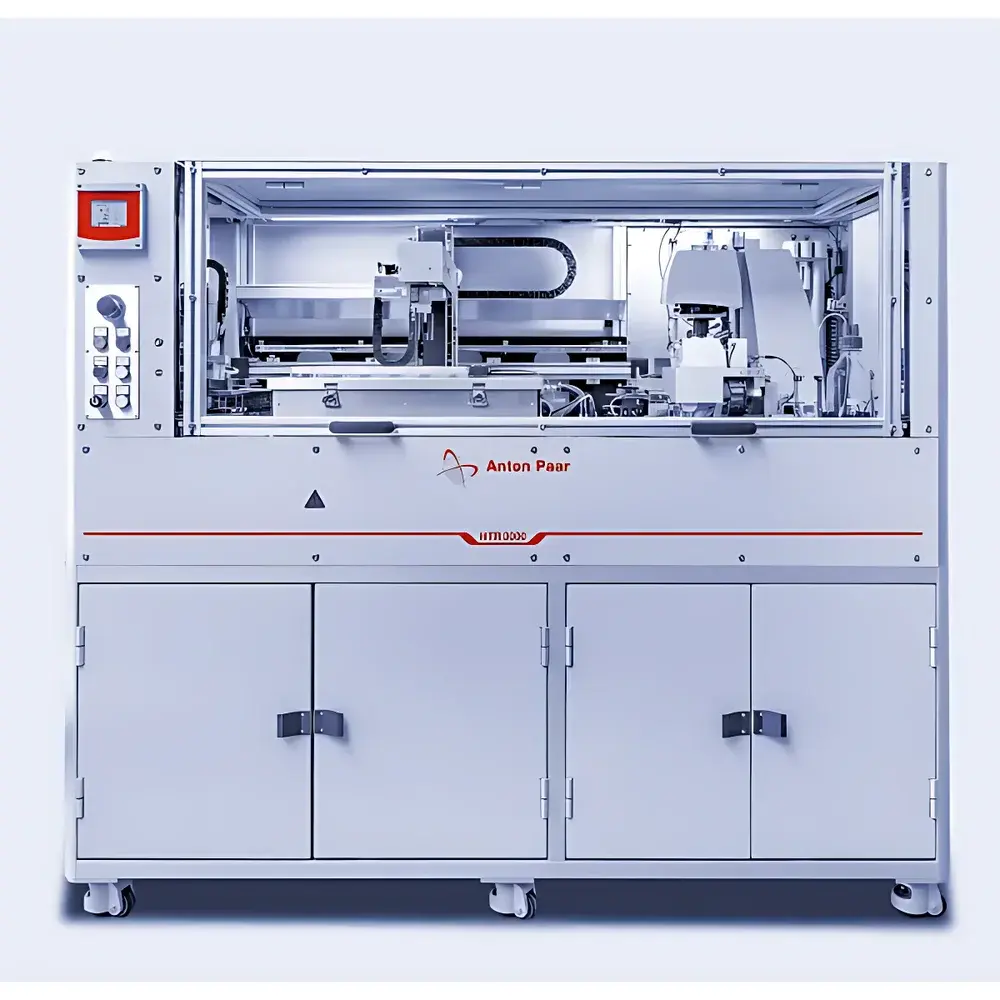
Anton Paar HTR 3000 Desktop Fully Automated Rheometer
| Brand | Anton Paar |
|---|---|
| Origin | Austria |
| Manufacturer | Anton Paar GmbH |
| Product Type | Rotational Rheometer |
| Sample Viscosity Range | High-Viscosity Liquids |
| Temperature Range | –160 °C to +1000 °C |
| Frequency Range | 0.001–628 rad/s |
| Maximum Rotational Speed | 2100 rpm |
| Bearing System | Precision Multi-Pore Carbon Air Bearing |
| Sample Capacity | Up to 54 Samples |
| Automation Level | Fully Automated, Barcode-Enabled, Integrated Cleaning & Temperature Control |
| Compliance | Designed for GLP/GMP environments |
Overview
The Anton Paar HTR 3000 Desktop Fully Automated Rheometer is an integrated sample-handling platform engineered to automate routine and high-throughput rheological characterization using Anton Paar’s MCR 102e or MCR 302e rotational rheometers. It operates on the principle of controlled-stress and controlled-strain rotational rheometry—leveraging precision air-bearing motor technology and high-fidelity torque transduction—to deliver reproducible viscoelastic data across complex fluid systems. Designed specifically for laboratories requiring unattended operation, traceable workflows, and rigorous compliance with quality assurance frameworks, the HTR 3000 enables continuous 24/7 measurement cycles without manual intervention. Its architecture eliminates five sequential manual steps per sample—including loading, geometry alignment, temperature equilibration, measurement execution, and post-run cleaning—thereby reducing operator dependency, minimizing inter-operator variability, and enhancing experimental robustness.
Key Features
- Fully automated sample handling for up to 54 vials in a single run, supporting barcoded identification and sequence-driven scheduling
- Integrated temperature control module enabling precise thermal conditioning from –160 °C to +1000 °C—compatible with cryogenic, ambient, and high-temperature rheological protocols
- Precision multi-pore carbon air bearing system ensuring minimal friction, zero wear, and long-term torque stability over extended operational cycles
- Automated cleaning station with programmable solvent delivery, waste aspiration, and rinse validation—reducing cross-contamination risk and eliminating manual cleaning labor
- Modular safety subsystems including interlocked access doors, real-time ventilation monitoring, and optional explosion-proof configurations for hazardous material testing
- Seamless integration with RheoCompass™ software for method scripting, remote supervision, and automated report generation with embedded metadata and digital signatures
Sample Compatibility & Compliance
The HTR 3000 accommodates liquid-phase samples exhibiting high viscosity (e.g., polymer melts, asphalt binders, ceramic slurries, food gels, and pharmaceutical suspensions), with compatibility extending to non-Newtonian, thixotropic, and thermorheologically complex systems. All sample contact surfaces are chemically inert and autoclavable where applicable. The system adheres to ISO 6721 (plastics — determination of dynamic mechanical properties), ASTM D4440 (standard test method for dynamic shear rheometry of asphalt binders), and USP (rheological analysis of semisolid dosage forms). When configured with RheoCompass™ in audit-trail mode, it satisfies FDA 21 CFR Part 11 requirements for electronic records and signatures, supporting full traceability from sample ID to final exportable dataset—including timestamps, user credentials, instrument calibration status, and environmental logs.
Software & Data Management
RheoCompass™ serves as the unified control and analysis environment for the HTR 3000–MCR ecosystem. It provides script-based automation for multi-step rheological protocols (e.g., temperature ramps, frequency sweeps, oscillatory time sweeps, and yield stress determination), with built-in validation checks at each stage. Raw data is stored in vendor-neutral HDF5 format, preserving hierarchical metadata and enabling direct ingestion into LIMS, ELN, or AI training pipelines. Export options include CSV, Excel, and XML formats compliant with ASTM E1489–22 (standard practice for electronic data exchange in materials testing). Audit trail functionality captures every user action, parameter change, and system event with immutable timestamps—essential for regulatory submissions and internal quality audits.
Applications
- Quality control of thermoplastic polymers and elastomers under processing-relevant shear and thermal conditions
- Rheokinetic profiling of curing resins and adhesives during crosslinking reactions
- Stability assessment of concentrated colloidal dispersions and nanoparticle suspensions
- Texture and mouthfeel modeling in dairy, confectionery, and plant-based formulations
- High-temperature rheology of molten metals, glasses, and refractory slags in metallurgical R&D
- Regulatory-compliant viscosity and viscoelasticity testing for injectables, ointments, and topical gels per ICH Q5C and Q5E guidelines
FAQ
Can the HTR 3000 operate independently without an MCR rheometer?
No—the HTR 3000 is a dedicated automation platform and requires integration with an Anton Paar MCR 102e or MCR 302e rheometer to perform measurements.
What sample geometries are supported?
Standard configurations include parallel-plate, cone-and-plate, and concentric cylinder systems compatible with MCR series instruments; custom geometries may be accommodated upon request.
Is remote monitoring supported?
Yes—RheoCompass™ includes web-based dashboard access, email alerting for run completion or error states, and secure VPN-compatible remote desktop control.
How is calibration traceability maintained?
All torque and temperature calibrations are performed using NIST-traceable reference standards; calibration certificates and verification reports are automatically archived with each dataset.
Does the system support method transfer between labs?
Yes—RheoCompass™ method files include embedded instrument configuration, environmental settings, and procedural logic, enabling consistent replication across globally distributed MCR–HTR installations.
Related Products



