
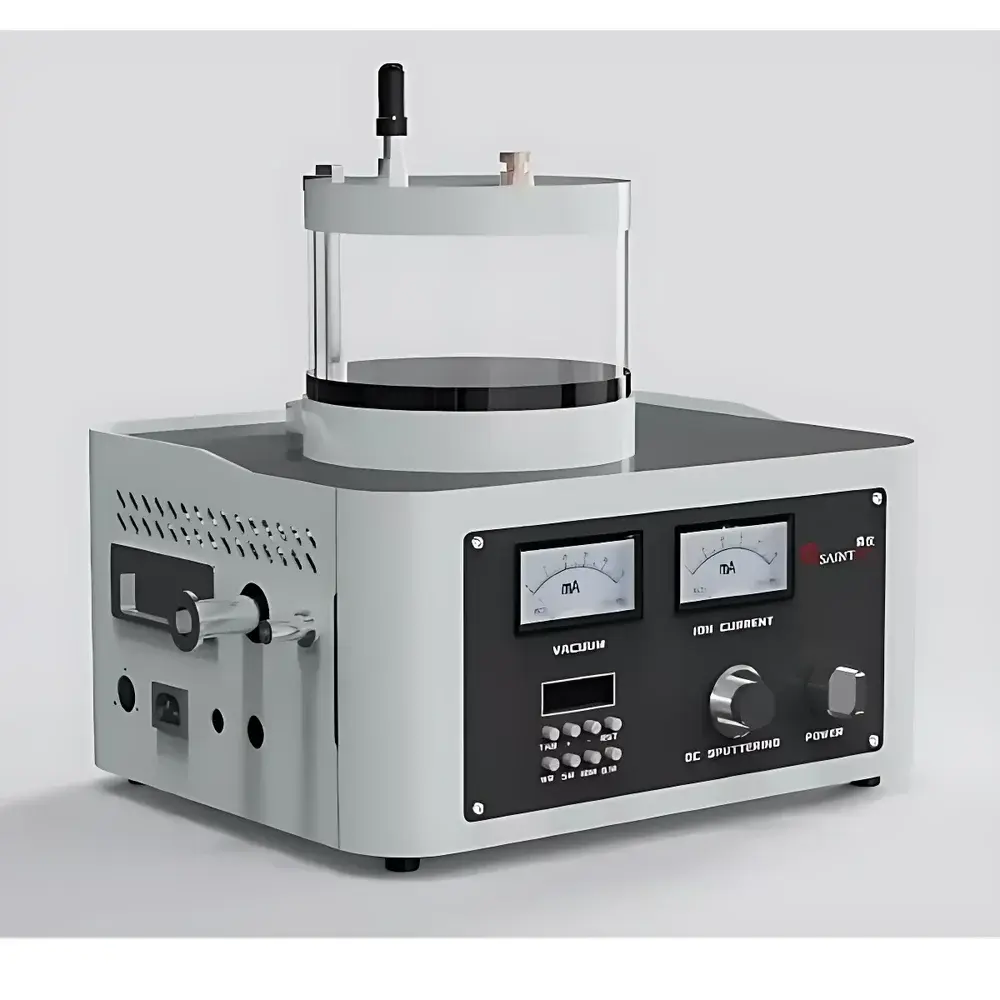
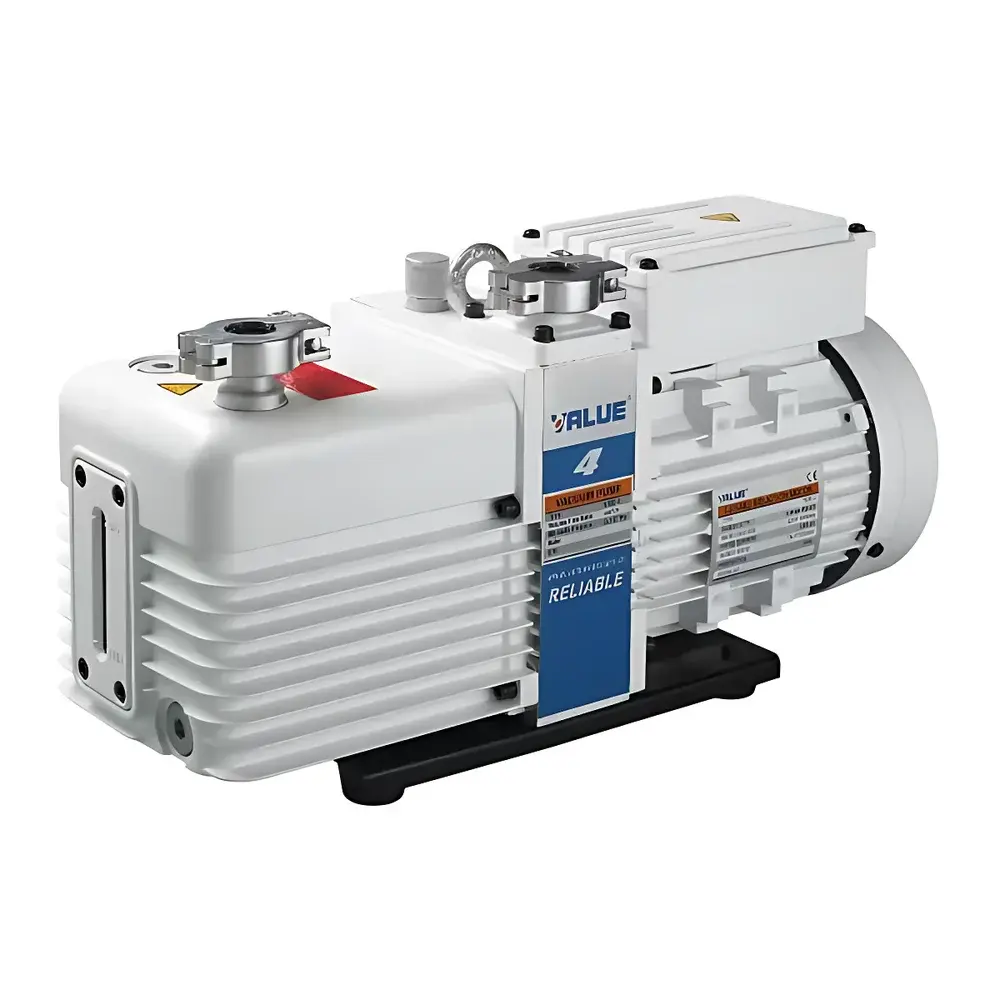
Saintins JS-1600M Benchtop DC Magnetron Sputter Coater
| Brand | Saintins |
|---|---|
| Origin | Jiangsu, China |
| Manufacturer Type | Direct Manufacturer |
| Country of Origin | China |
| Model | JS-1600M |
| Target Material | Gold (99.999% purity) |
| Target Diameter | Ø50 mm |
| Control Mode | Manual |
| Chamber Dimensions | Ø160 mm × 120 mm (H) |
| Sample Stage Diameter | Ø50 mm |
| Sputtering Gases | Air, Argon |
| Cooling | Water-cooled magnetron cathode (6×4 mm quick-connect fittings) |
| Operating Vacuum Range | 2×10⁻¹ – 6×10⁻² mbar |
| Sputtering Voltage | −1600 V DC |
| Ion Current Range | 0–100 mA |
| Timer | Adjustable preset duration |
| Vacuum Pump | VRD-4 rotary vane pump (1.1 L/s) |
| Power Supply | Integrated DC high-voltage source |
Overview
The Saintins JS-1600M is a compact, manually operated DC magnetron sputter coater engineered for high-reproducibility conductive coating of non-conductive specimens prior to scanning electron microscopy (SEM) analysis. It operates on the principle of cold plasma sputtering—where energetic argon (or air) ions, accelerated by a −1600 V DC potential across a magnetically confined cathode, physically dislodge atoms from a metallic target (e.g., Au, Pt, Ag). The resulting neutral metal atoms travel ballistically and condense as a uniform, nanoscale conductive film on substrates placed on the grounded sample stage. Unlike thermal evaporation, magnetron sputtering minimizes substrate heating—critical for temperature-sensitive biological, polymeric, or low-melting-point samples. The JS-1600M features a water-cooled magnetron cathode to sustain stable discharge at higher currents, suppress target arcing, and extend target lifetime. Its Ø160 mm × 120 mm cylindrical vacuum chamber accommodates larger or irregularly shaped specimens than standard desktop units, supporting both routine SEM preparation and exploratory thin-film electrode fabrication in materials science labs.
Key Features
- Water-cooled Ø50 mm magnetron cathode with integrated rare-earth permanent magnets for enhanced plasma confinement and ionization efficiency
- Manually adjustable needle valve for precise control of sputtering gas inflow (Ar or ambient air), enabling fine-tuning of pressure between 2×10⁻¹ and 6×10⁻² mbar
- Dedicated high-stability −1600 V DC power supply with real-time analog ion current monitoring (0–100 mA range)
- Integrated mechanical timer for repeatable, user-defined deposition durations—essential for inter-laboratory protocol consistency
- Robust aluminum alloy chamber with Viton O-ring sealing and front-loading hinged lid for rapid sample exchange
- Standard inclusion of a 99.999% pure gold target (Ø50 mm × 0.1 mm thick), optimized for high-resolution SEM imaging and low-noise secondary electron emission
- Compact footprint (360 × 300 × 380 mm) and plug-and-play compatibility with standard lab-grade vacuum infrastructure
Sample Compatibility & Compliance
The JS-1600M accommodates a wide range of non-conductive substrates—including ceramic cross-sections, polymer films, biological tissue sections, geological thin sections, and fragile nanomaterials—without requiring pre-baking or conductive adhesive optimization. Its low-heat deposition process preserves native morphology and avoids carbon migration artifacts common in carbon-coating workflows. While the system itself does not carry CE or UL certification out-of-the-box, its design adheres to fundamental safety principles outlined in IEC 61010-1 for laboratory electrical equipment. Vacuum operation complies with ISO 27427:2015 guidelines for vacuum-assisted surface preparation. When used with certified argon gas (≥99.998% purity), the resulting Au coatings meet ASTM E1558–22 requirements for SEM specimen conductivity verification. For GLP/GMP-regulated environments, manual operation necessitates documented procedural SOPs and operator training records—but the system supports full traceability via handwritten logbooks or external digital lab notebooks.
Software & Data Management
The JS-1600M operates exclusively via analog controls—no embedded firmware, no proprietary software, and no network interface. This architecture eliminates cybersecurity vulnerabilities, ensures long-term operational continuity without vendor-dependent updates, and simplifies validation in regulated settings where software qualification would otherwise be required. All process parameters—gas pressure (measured via analog Pirani gauge), sputtering time, current draw, and voltage—are directly observable and manually recorded. Users may integrate external data loggers (e.g., USB-connected pressure/temperature sensors) or document runs in ELN platforms such as LabArchives or Benchling using standardized templates aligned with ISO/IEC 17025 clause 7.7 on result reporting. No FDA 21 CFR Part 11 electronic signature capability is provided—consistent with its classification as a Class I general-purpose lab instrument under US FDA guidance.
Applications
- Routine SEM sample metallization for high-resolution topographic and compositional imaging
- Fabrication of microelectrodes on insulating substrates (e.g., SiO₂/Si wafers, glass slides) for electrochemical sensor development
- Deposition of reference layers in thin-film optical characterization (e.g., ellipsometry calibration standards)
- Preparation of TEM grid coatings for charge dissipation during low-dose imaging
- Prototyping of transparent conductive oxide (TCO) seed layers using alternative targets (Pt, Ag) under inert atmosphere
- Teaching laboratories: hands-on demonstration of plasma physics, thin-film growth kinetics, and vacuum technology fundamentals
FAQ
What vacuum level is required before initiating sputtering?
A base pressure of ≤6×10⁻² mbar is recommended; residual moisture or hydrocarbons above this threshold increase arcing risk and reduce film adhesion.
Can I use targets other than gold?
Yes—the JS-1600M accepts any electrically conductive target material compatible with DC sputtering, including platinum, silver, copper, chromium, and nickel. Insulating targets (e.g., Al₂O₃, SiO₂) require RF power supplies and are not supported.
Is argon gas mandatory?
No—ambient air may be used for basic conductive coating, though argon yields denser, lower-resistivity films with fewer oxide inclusions.
How often should the vacuum pump oil be changed?
With typical usage (≤2 hours/day), VRD-4 pump oil should be replaced every 500 operating hours or semiannually—whichever occurs first—to maintain optimal pumping speed and ultimate vacuum.
Does the system include a vacuum gauge?
Yes—a calibrated analog Pirani gauge is integrated into the main panel for continuous pressure readout during pump-down and sputtering.



