
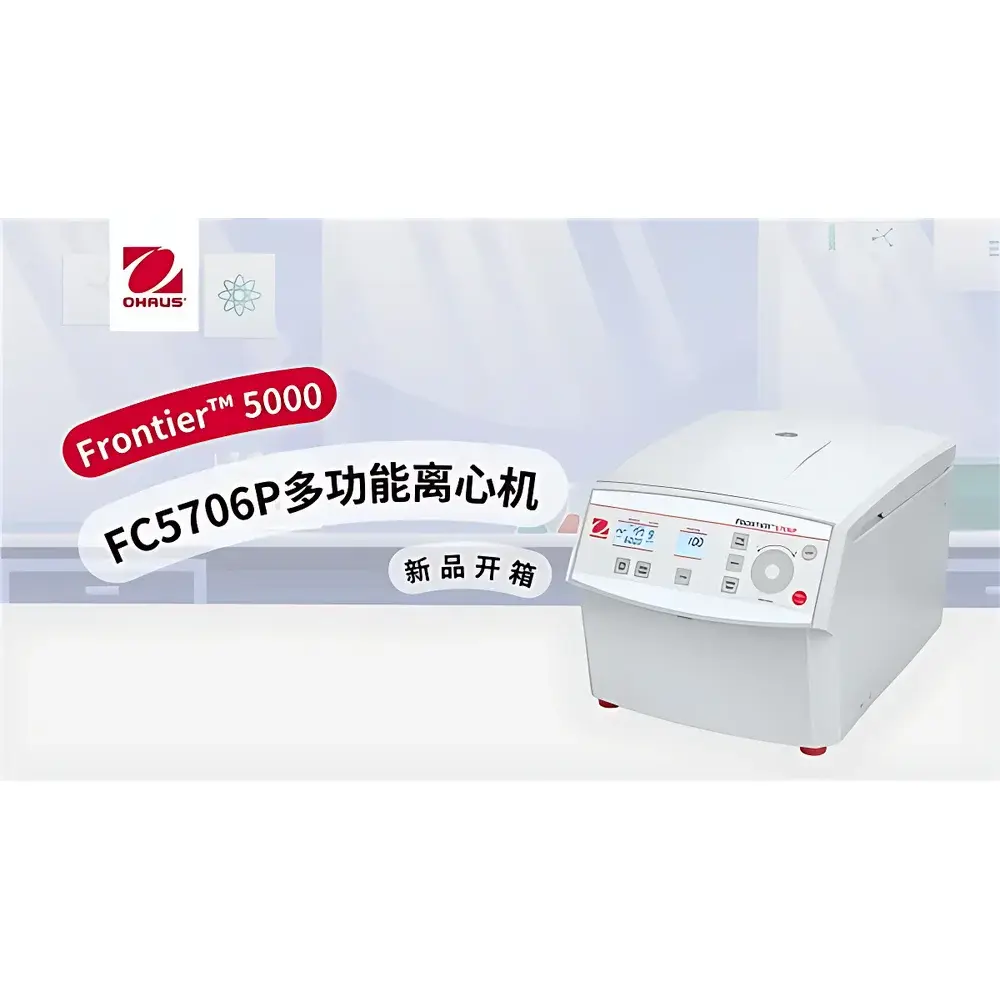
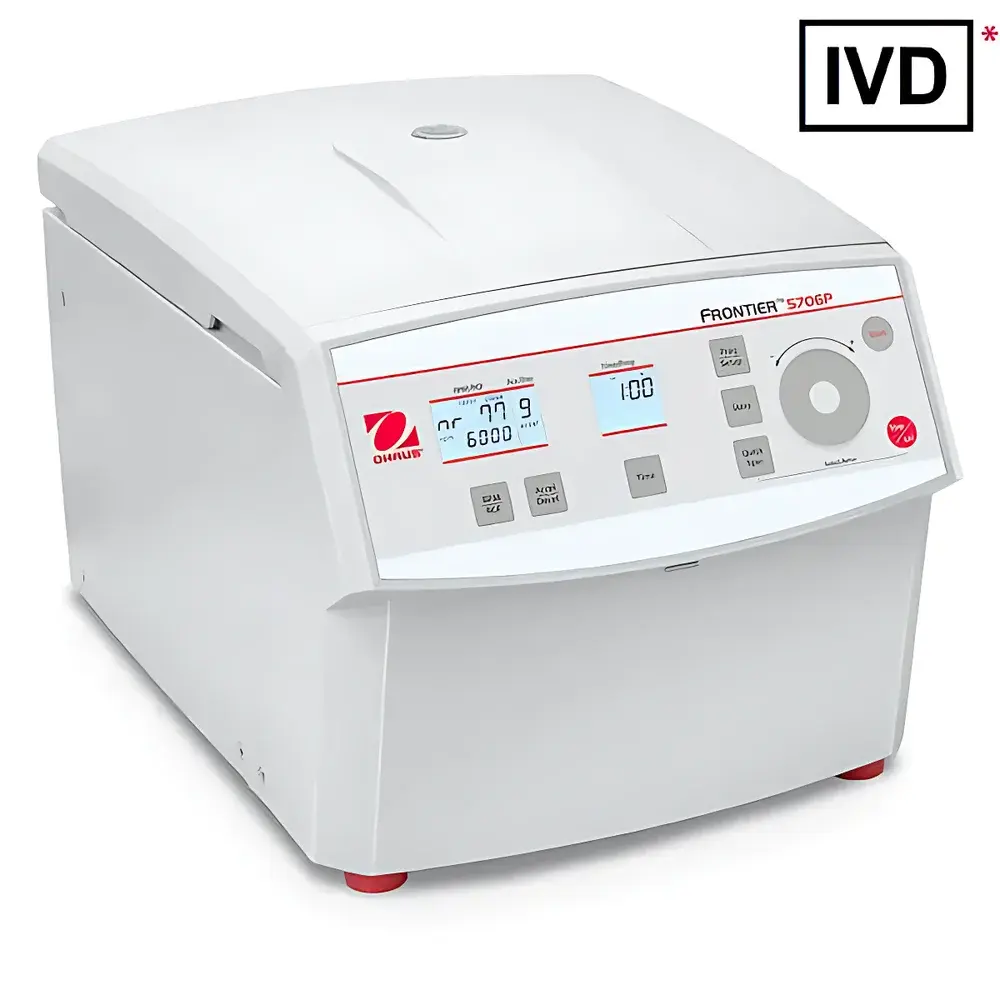
OHAUS Frontier™ 5000 Series Multi-Function Medical Centrifuge FC5706P
| Brand | OHAUS |
|---|---|
| Origin | Jiangsu, China |
| Manufacturer Type | Manufacturer |
| Product Category | Domestic |
| Model | FC5706P (Medical Centrifuge) |
| Instrument Type | Benchtop Centrifuge |
| Speed Range | 200 – 6,000 rpm |
| Maximum RCF | 4,427 × g |
| Maximum Capacity | 6 × 50 mL |
| Dimensions (L×H×W) | 540 mm × 365 mm × 323 mm |
| Net Weight | 14.2 kg |
| Motor | Brushless DC |
| Display | Backlit LCD, dual-line |
| Operating Environment | 5°C – 35°C, ≤80% RH (non-condensing) |
| Noise Level | ≤56 ± 2 dB(A) |
| Acceleration/Deceleration Steps | 10 |
| Timer Range | 10 sec – 99 min 59 sec |
| Rotor Recognition | Manual |
| Safety Certification | CE |
| Power Input | AC mains (included) |
| Power Consumption | 70 W |
| Rotor Options | Angle rotor (6 × 50 mL RB/FA), angle rotor (12 × 15 mL RB/FA), angle rotor (18 × 1.5/2.0 mL), swing-out rotor (4 × 10 mL), swing-out rotor (6 × 5 mL) |
Overview
The OHAUS Frontier™ 5000 Series Multi-Function Medical Centrifuge FC5706P is a benchtop, low-speed centrifuge engineered for precision and reliability in clinical and routine laboratory settings. Designed around the principles of sedimentation-based separation—where differential particle migration under controlled gravitational force enables isolation of cellular components, precipitates, or suspended solids—the FC5706P delivers consistent performance across diagnostic workflows involving blood, urine, and other biological fluids. Its brushless DC motor ensures stable rotational dynamics with minimal thermal drift and acoustic emission, supporting reproducible pelleting of erythrocytes, leukocytes, platelets, and bacterial cells without compromising sample integrity. The unit operates within a defined RCF range up to 4,427 × g and accommodates standard medical tube formats—including conical-bottom and round-bottom tubes—without requiring custom adapters for most common 5–50 mL specimen containers.
Key Features
- Intuitive dual-line backlit LCD interface with real-time display of rpm, RCF, time remaining, and acceleration/deceleration status
- Compact footprint (540 × 365 × 323 mm) optimized for space-constrained clinical laboratories and point-of-care environments
- Mechanical lid lock with tactile feedback and automatic rotor imbalance detection for operator safety compliance
- Programmable timer with flexible operation modes: continuous run, soft-spin (instant stop), and precise interval timing from 10 seconds to 99 minutes 59 seconds
- 10-step acceleration and deceleration control to minimize sample resuspension during braking—critical for fragile cell pellets and serum separation
- Noise-optimized architecture achieving ≤56 ± 2 dB(A) at maximum speed, enabling quiet operation in shared diagnostic workspaces
- CE-certified design meeting essential health and safety requirements for medical device deployment in EU-regulated facilities
Sample Compatibility & Compliance
The FC5706P supports standardized clinical sample containers including Vacutainer®-compatible tubes, polypropylene conical centrifuge tubes (15 mL and 50 mL), microcentrifuge tubes (1.5/2.0 mL), and narrow-diameter urine collection vials. Its manually identified rotor system allows rapid configuration changes between five interchangeable rotors—covering angular and swing-out geometries—without firmware recalibration. While not refrigerated, the unit maintains thermal stability within ambient operating conditions (5°C–35°C, ≤80% RH non-condensing), aligning with ISO 15189 pre-analytical requirements for specimen processing consistency. All rotor configurations are validated per IEC 61010-2-020 for centrifugal equipment safety, and the mechanical interlock mechanism satisfies EN 61000-6-2 electromagnetic compatibility standards applicable to medical electrical equipment.
Software & Data Management
This centrifuge operates as a standalone instrument with no embedded software or network connectivity. All operational parameters are set and monitored locally via the front-panel interface, eliminating data security concerns associated with cloud-linked devices. The absence of digital data logging or electronic audit trails means it is inherently compliant with laboratories that maintain strict air-gapped instrumentation policies—particularly those adhering to GLP or internal QA protocols where manual recordkeeping is mandated. For institutions requiring traceability, users may document run parameters (speed, time, rotor ID, date/time) in paper-based logbooks or LIMS-integrated manual entry forms. No FDA 21 CFR Part 11 electronic signature capability is provided, nor is remote diagnostics supported—consistent with its classification as a Class I general-purpose medical device under regulatory frameworks governing low-risk in vitro diagnostic support equipment.
Applications
- Routine serum and plasma separation from whole blood specimens using standard 10–15 mL collection tubes
- Urine sediment concentration prior to microscopic analysis in urinalysis workflows
- Bacterial pellet harvesting for Gram staining, culture inoculation, or nucleic acid extraction preparation
- Cell washing and resuspension steps in basic immunohematology procedures
- Clarification of reagent solutions and buffer preparations in clinical chemistry labs
- Processing of coagulation studies where gentle, repeatable RCF application prevents platelet activation
FAQ
Is the FC5706P suitable for use with infectious or biohazardous samples?
Yes—when used with sealed, leak-proof tubes and appropriate biosafety containment practices (e.g., BSL-2 cabinets for high-risk specimens), the FC5706P meets standard biosafety guidelines for low-speed centrifugation. Its enclosed rotor chamber and mechanical lid lock reduce aerosol generation risk.
Does this model support temperature-controlled runs?
No—the FC5706P is a non-refrigerated centrifuge. It is intended for ambient-temperature applications only and must be operated within the specified environmental limits (5°C–35°C).
Can rotor imbalance errors be overridden manually?
No. The built-in imbalance detection system halts operation automatically if asymmetrical loading exceeds tolerance thresholds. This safeguard cannot be bypassed, ensuring compliance with IEC 61010-2-020 safety directives.
What maintenance is required for long-term reliability?
Routine cleaning of the rotor chamber and lid gasket with 70% ethanol; periodic inspection of rotor threads and locking mechanisms; annual verification of speed accuracy using an external tachometer per ISO 8573-1 calibration recommendations.
Are replacement rotors traceable to lot-specific validation reports?
Yes—each rotor carries a unique serial number and is supplied with a manufacturer’s certificate of conformance indicating maximum rated speed, RCF, and material certification per ASTM F899 stainless steel specifications.



