
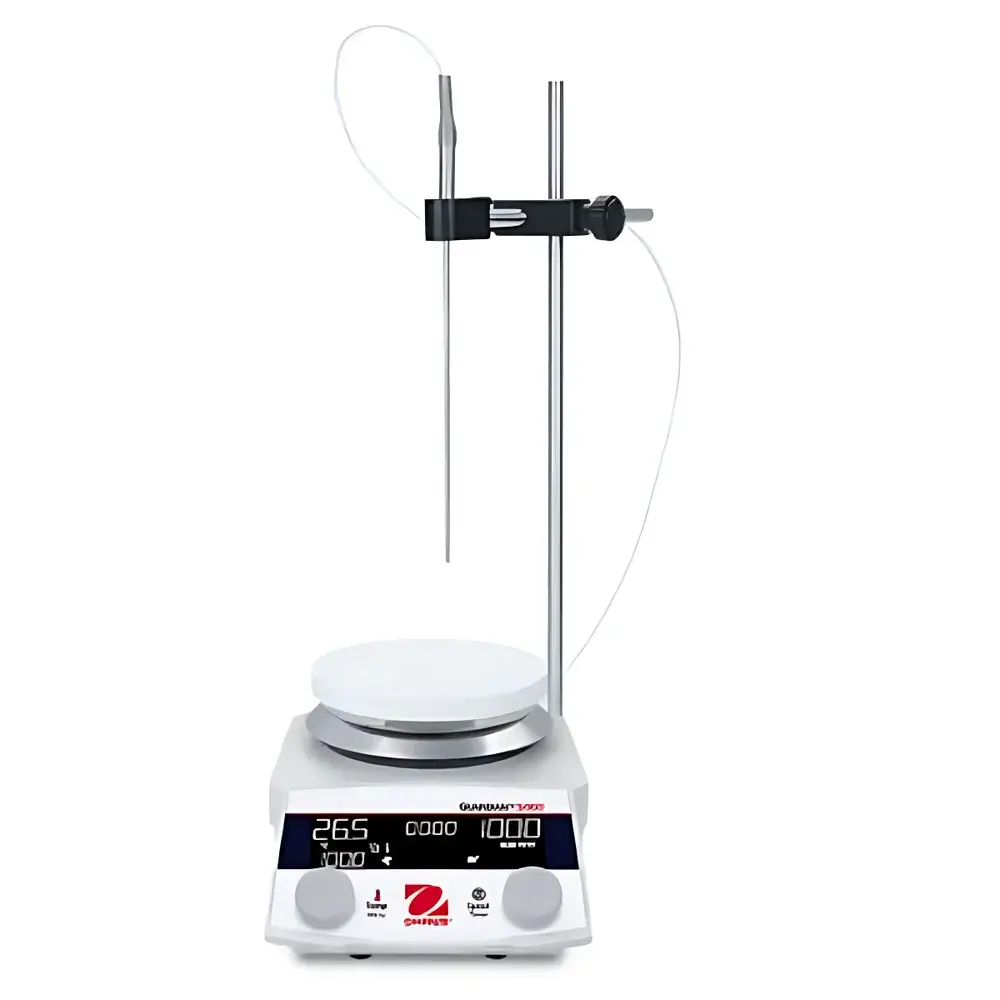
OHAUS GUARDIAN™5000 Advanced Heating Magnetic Stirrer
| Brand | OHAUS |
|---|---|
| Origin | Jiangsu, China |
| Manufacturer Type | Manufacturer |
| Product Category | Domestic |
| Model | e-G52HSRDA K1 |
| Instrument Type | Magnetic Stirrer |
| Maximum Stirring Volume | 20 L |
| Speed Range | 50 rpm – 1,800 rpm |
| Temperature Control Range | 5 °C – 360 °C |
| Heating Plate Material | Ceramic-coated aluminum |
| Plate Dimensions | 13.5 cm (square equivalent) |
| Temperature Accuracy | ±1 °C (heating plate, <100 °C) |
| Speed Stability | ±2% |
| Timer Range | 1 min – 99 h 59 min |
| Power Supply | 220–240 V~, 4 A, 50/60 Hz |
| Safety Certifications | CE, TÜV |
| Enclosure | Full-metal housing |
| Display | High-contrast backlit LCD |
| Interface | Rotary encoder + RS232 port |
| Operating Environment | 5–40 °C, ≤80% RH (non-condensing) |
| Net Weight | 2.6 kg |
| Dimensions (L×H×W) | 259 mm × 175 mm × 108 mm |
Overview
The OHAUS GUARDIAN™5000 Advanced Heating Magnetic Stirrer is an engineered platform for precise thermal and mechanical control of liquid-phase reactions and sample preparation in regulated laboratory environments. It operates on the principle of magnetic coupling—using a high-performance samarium-cobalt (SmCo) drive magnet beneath a thermally robust ceramic-coated aluminum heating plate to rotate a PTFE- or glass-coated stir bar within the vessel. This non-contact stirring mechanism eliminates shaft seals and mechanical wear, ensuring long-term reliability and contamination-free operation. The integrated Peltier-assisted or resistive heating system enables rapid thermal ramping and stable setpoint maintenance across a wide operational envelope—from sub-ambient offset (≥5 °C above ambient) up to 360 °C—making it suitable for applications requiring both gentle warming and high-temperature synthesis support. Designed for compliance-critical workflows, the unit meets CE and TÜV safety standards and supports audit-ready documentation via its RS232 interface.
Key Features
- Full-metal enclosure with reinforced structural integrity for durability in high-traffic lab settings
- Ceramic-coated aluminum heating plate (13.5 cm square footprint) offering uniform heat distribution and chemical resistance
- High-torque SmCo drive magnet enabling consistent agitation of viscous or dense solutions up to 20 L volume
- Digital rotary encoder control with intuitive tactile feedback for precise speed (50–1800 rpm) and temperature (5–360 °C) adjustment
- Backlit high-contrast LCD display showing real-time speed, temperature, timer status, and system alerts—including amber over-temperature warning
- Triple-point temperature calibration capability for both heating plate surface and external Pt1000 probe (±0.5 °C accuracy below 100 °C)
- Programmable timer supporting durations from 1 minute to 99 hours and 59 minutes, with auto-shutdown functionality
- RS232 serial port enabling remote command execution, data logging, and integration into centralized lab management systems
Sample Compatibility & Compliance
The GUARDIAN™5000 accommodates standard borosilicate glass, stainless steel, and polypropylene vessels ranging from small vials to 20 L carboys—provided magnetic coupling remains effective (i.e., stir bar size and geometry match vessel dimensions and fluid viscosity). Its temperature stability (±1 % of setpoint, heating plate; ±0.5 % with Pt1000 probe) and speed reproducibility (±2 %) align with routine QC/QA requirements under ISO/IEC 17025-accredited laboratories. While not intrinsically rated for hazardous area use, the unit’s CE and TÜV certifications verify conformance with EN 61010-1 (Safety Requirements for Electrical Equipment for Measurement, Control, and Laboratory Use) and EN 61326-1 (EMC for Laboratory Instruments). Its design supports GLP-compliant recordkeeping when paired with validated third-party data acquisition software.
Software & Data Management
No proprietary software is bundled; however, the RS232 interface complies with standard ASCII command protocols (e.g., SCPI-like syntax), allowing interoperability with common serial communication tools such as LabVIEW, Python (pySerial), MATLAB, or custom-built LIMS interfaces. Users may log timestamped speed, temperature, and timer values at user-defined intervals. For FDA-regulated environments, the device supports 21 CFR Part 11–compliant audit trails when integrated with validated middleware that enforces electronic signatures, role-based access, and immutable data storage—though native electronic signature functionality is not embedded.
Applications
- pH adjustment and buffer equilibration under controlled thermal conditions
- Media preparation for microbiology and cell culture, including autoclave-alternative sterilization protocols
- Thermal denaturation studies of proteins and nucleic acids
- Synthesis of metal-organic frameworks (MOFs) and nanoparticle dispersions requiring extended reflux
- Dissolution testing of pharmaceutical excipients and active ingredients
- Accelerated aging studies involving elevated temperature exposure
- Exothermic reaction quenching via rapid cooling-integrated workflows (when used with external chillers)
- Standardized sample homogenization prior to ICP-MS, HPLC, or titration analysis
FAQ
Can the GUARDIAN™5000 be used with temperature probes other than the supplied Pt1000?
Yes—any industry-standard 2-wire or 3-wire Pt1000 sensor with compatible physical mounting and resistance-temperature characteristics may be substituted, though calibration must be repeated.
Is the heating plate surface resistant to strong acids or alkalis?
The ceramic coating provides excellent resistance to dilute mineral acids (e.g., HCl, HNO₃) and bases (e.g., NaOH up to 1 M), but prolonged exposure to HF, hot concentrated H₂SO₄, or molten alkali hydroxides is not recommended.
Does the unit support simultaneous independent control of bath temperature and stir speed?
Yes—speed and temperature are fully decoupled parameters; changes to one do not affect the setpoint or stability of the other.
What is the maximum allowable ambient temperature for continuous operation?
The specified operating range is 5–40 °C at ≤80 % relative humidity (non-condensing); sustained use above 35 °C may reduce thermal efficiency and accelerate component aging.
How frequently should temperature calibration be performed?
OHAUS recommends annual verification under ISO/IEC 17025 guidelines—or after any event that may compromise thermal sensor integrity (e.g., mechanical shock, thermal overload, or cleaning with abrasive agents).



