
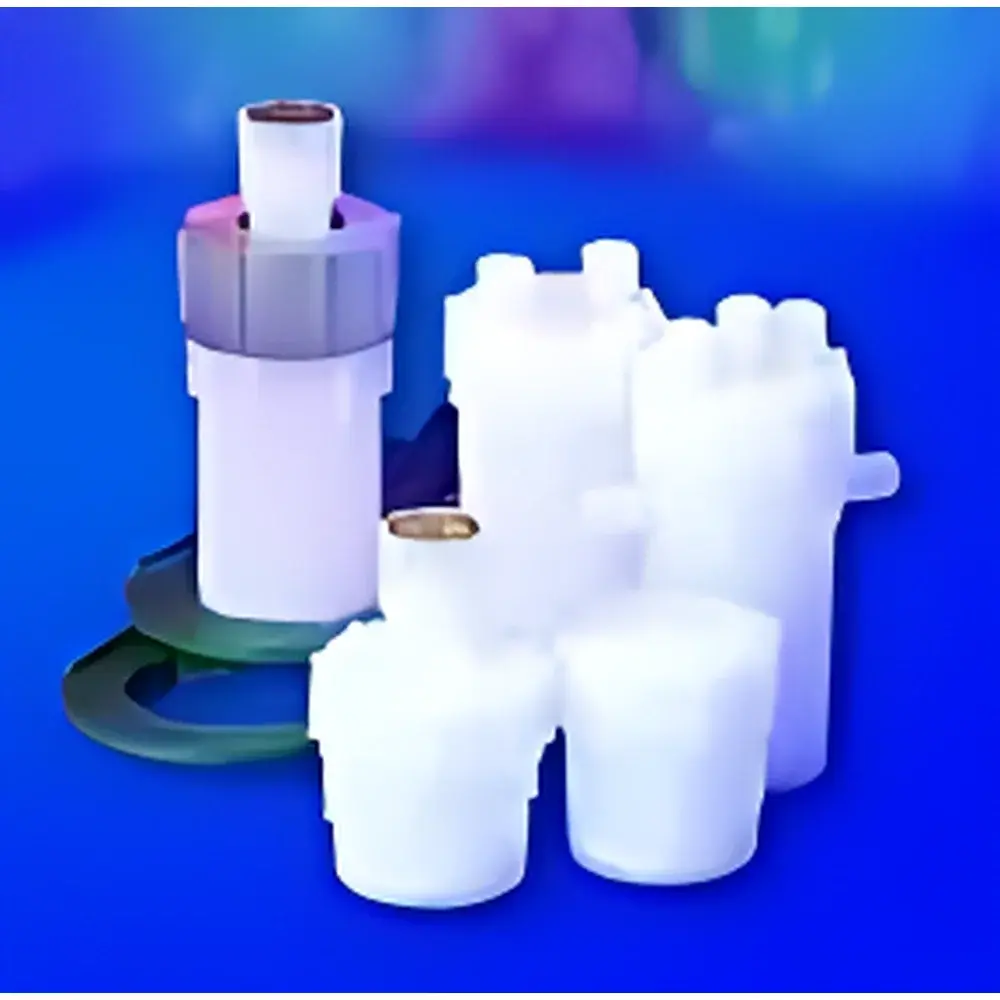
Savillex Digestion Vessels (PFA) for Microwave-Assisted Acid Digestion
| Brand | Savillex |
|---|---|
| Origin | USA |
| Product Type | Microwave Digestion Vessels |
| Material | High-Purity PFA (Perfluoroalkoxy) |
| Compatibility | Fully compatible with all microwave digestion systems (e.g., CEM MARS, Anton Paar Multiwave, Milestone ETHOS) |
| Thermal Stability | Continuous use up to 260 °C, short-term peak tolerance ≥300 °C |
| Pressure Rating | Designed for sealed-vessel high-pressure microwave digestion (up to 100 bar typical operational limit) |
| Surface Finish | Electro-polished inner surface, ultra-low extractables (<1 pg/mL metal leaching per ASTM D5127) |
| Regulatory Compliance | Meets ASTM E2918 (Standard Practice for Handling and Storage of Trace Metal Samples), USP <232>/<233> elemental impurities requirements, and ISO/IEC 17025 traceability standards |
| Packaging | Individually clean-room packaged (Class 100 / ISO 5), certified for trace-metal analysis |
Overview
Savillex Digestion Vessels are precision-engineered, high-purity PFA (perfluoroalkoxy) sample containment systems designed specifically for microwave-assisted acid digestion in trace-element and ultra-trace analytical workflows. These vessels operate on the principle of closed-vessel, high-temperature/pressure acid decomposition—enabling rapid, complete mineralization of organic and inorganic matrices under controlled, reproducible conditions. Unlike conventional glass or quartzware, PFA offers exceptional chemical inertness across the full spectrum of strong acids (including HF, HNO₃, HCl, H₂O₂, and aqua regia) and resistance to thermal shock, making them indispensable for ICP-MS, ICP-OES, and GF-AAS applications where contamination control is non-negotiable. Each vessel is manufactured in a certified Class 100 cleanroom environment and undergoes rigorous batch-certified testing for metal extractables per ASTM D5127, ensuring baseline integrity for sub-ppt level quantification.
Key Features
- Ultra-high purity PFA construction with ≤1 pg/mL background leaching for Al, Cr, Cu, Fe, Ni, Pb, Zn, and rare earth elements
- Seamless, electro-polished interior surface minimizing adsorption and residue retention
- Full compatibility with major commercial microwave digestion platforms—including CEM MARS 6, Anton Paar Multiwave PRO, Milestone ETHOS UP, and PerkinElmer Titan MPS
- Rated for sustained operation at 260 °C and transient pressure excursions up to 100 bar—supporting aggressive digestion protocols for refractory materials (e.g., geological silicates, polymer composites, biological tissues)
- Flat-bottom geometry enables direct placement on hot plates or block heaters for open-vessel pre-digestion or post-digestion evaporation without transfer
- Autoclavable and reusable after thorough cleaning with trace-metal-grade reagents (e.g., 10% v/v HNO₃, 60 °C, 2 h), validated per EPA Method 3052
Sample Compatibility & Compliance
Savillex Digestion Vessels accommodate solid, semi-solid, and liquid samples ranging from 0.1 g to 1.5 g (depending on matrix density and acid volume). They are routinely deployed in regulatory-compliant laboratories performing analyses under EPA Methods 3050B, 3051A, 3052, and ASTM D5127. The vessels meet ISO/IEC 17025 requirements for measurement traceability and are fully compatible with GLP/GMP documentation workflows. Their material certification supports compliance with USP and for elemental impurities testing in pharmaceuticals and biologics. All lots include a Certificate of Analysis (CoA) listing measured blank values for ≥25 elements, verified via quadrupole ICP-MS.
Software & Data Management
While the vessels themselves are passive hardware components, they integrate seamlessly into instrument-specific method libraries and LIMS environments through standardized barcode labeling (optional upon request). When used with microwave systems featuring audit-trail-enabled software (e.g., CEM’s iWave or Anton Paar’s Multiwave Navigator), vessel usage history—including run ID, temperature/pressure profiles, acid composition, and operator metadata—can be logged and exported in CSV or PDF formats compliant with FDA 21 CFR Part 11 requirements. Savillex provides digital CoA archives accessible via secure customer portal with version-controlled revision history.
Applications
- Environmental analysis: Soil, sediment, sludge, and airborne particulate matter digestion prior to multi-element ICP-MS quantification
- Clinical and forensic toxicology: Hair, tissue, and blood digestions for As, Cd, Hg, Pb, and U monitoring
- Geochemical exploration: Silicate rock and ore digestion using HF-HNO₃ mixtures under pressurized microwave conditions
- Food safety and agricultural testing: Digestion of fortified cereals, infant formula, and plant-based proteins for nutritional element profiling
- Materials science: Decomposition of catalysts, battery cathode materials (NMC, LFP), and ceramic precursors for stoichiometric validation
FAQ
Are Savillex PFA digestion vessels suitable for hydrofluoric acid (HF) digestion?
Yes—PFA is one of only two fluoropolymer materials (alongside PTFE) rated for full-concentration HF exposure at elevated temperatures. Savillex vessels are routinely used in EPA Method 3052 HF-containing protocols.
Can these vessels be reused, and what is the recommended cleaning protocol?
Yes, provided cleaning follows EPA Method 3052 Section 7.3: soak in 10% ultrapure HNO₃ at 60 °C for 2 hours, rinse three times with 18.2 MΩ·cm water, and dry in Class 100 laminar flow hood.
Do Savillex vessels require special torque tools or sealing mechanisms?
No—they are designed for direct integration with OEM microwave rotor assemblies and utilize standard compression-seal caps supplied by the instrument manufacturer.
Is there lot-to-lot variability in blank levels?
No—each production lot undergoes mandatory ICP-MS blank verification; CoAs report actual measured values—not specifications—and are available upon request.
How do Savillex vessels support ISO/IEC 17025 accreditation?
Through documented traceability (NIST-traceable calibration of reference materials used in blank testing), uncertainty budgeting for leachate measurements, and full retention of raw data files and CoAs for ≥5 years.



