
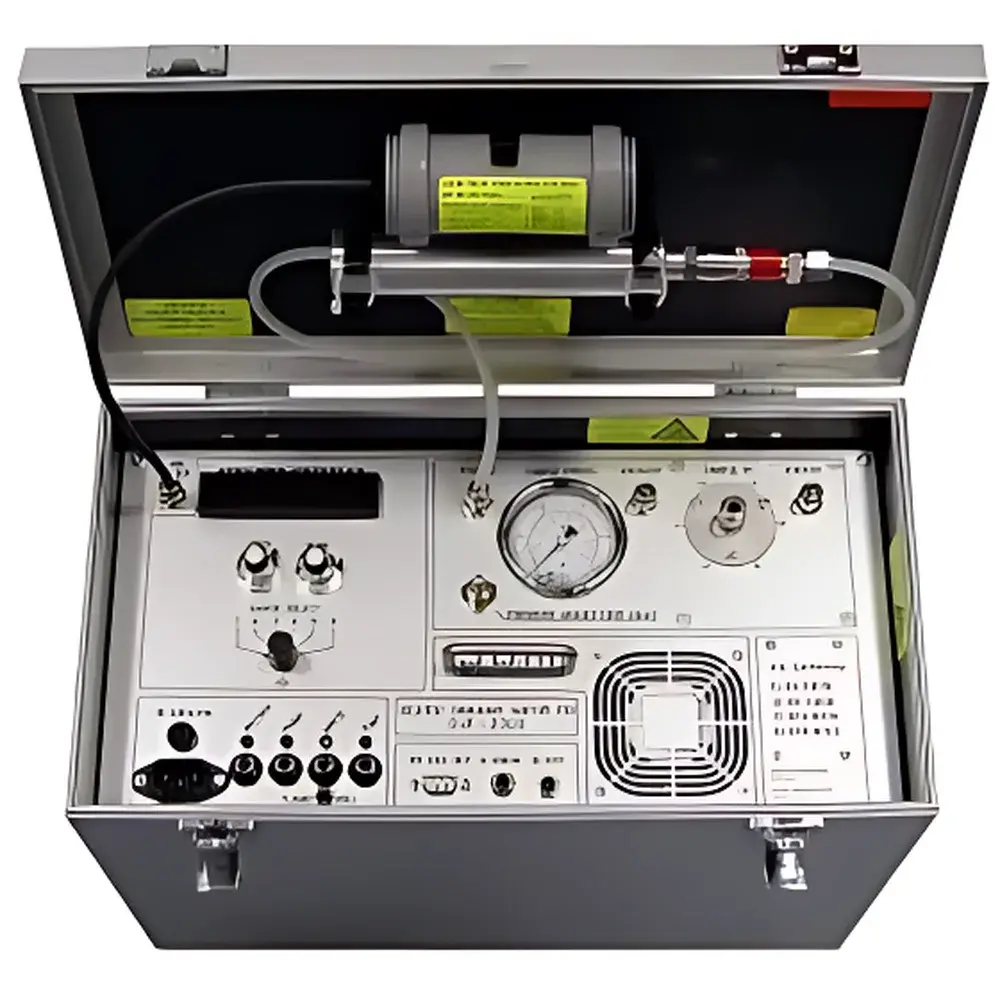
J.U.M. OVF3000 Portable Total Hydrocarbon Analyzer
| Brand | J.U.M. |
|---|---|
| Origin | Germany |
| Model | OVF3000 |
| Detection Principle | Flame Ionization Detection (FID) |
| Operating Temperature | 180 °C (heated sample path & detector) |
| Fuel System | Low-pressure solid-state metal hydride hydrogen storage |
| Fuel Runtime | 40–50 h continuous operation |
| Max Fill Pressure | 30 bar (430 PSI) |
| Response Time | ≤ 0.2 s |
| Sample Filter | Front-panel accessible, tool-free heated filter |
| Combustion Air | Integrated zero-air generator |
| Safety Features | Flame-out detection with automatic gas shutoff |
| Compliance | Designed for EPA Method 25A, ASTM D6348, ISO 8573-5, and EU EN 15267-3 applicable environments |
Overview
The J.U.M. OVF3000 Portable Total Hydrocarbon Analyzer is a field-deployable, high-temperature flame ionization detector (FID) system engineered for accurate, real-time quantification of total hydrocarbons (THC) across a wide dynamic range—from sub-ppb to percent-level concentrations. Unlike ambient-temperature FID analyzers susceptible to condensation and heavy hydrocarbon adsorption, the OVF3000 maintains its entire sample pathway—including sampling pump, particulate filter, flow control valves, and FID detector—at a precisely regulated 180 °C. This fully heated architecture prevents loss of C₆₊ compounds (e.g., n-hexane, toluene, xylene), ensuring representative measurement of both methane and non-methane hydrocarbons (NMHC) in complex emission streams. Its compact, back-packable form factor enables rapid deployment at stack outlets, mobile source testing sites, fugitive emission surveys, and industrial process monitoring points—without reliance on external power or auxiliary gas supplies.
Key Features
- Fully integrated 180 °C heated sample train: eliminates cold spots and minimizes adsorption/desorption artifacts in high-boiling-point hydrocarbons
- Low-pressure solid-state metal hydride hydrogen storage: stores fuel safely at ≤30 bar; refilled via standard H₂ cylinder without high-pressure handling risks
- Self-contained zero-air generation: built-in air compressor and catalytic purifier eliminate need for bottled zero-grade air or nitrogen–oxygen blends
- Front-access heated particulate filter: replaceable without tools in under 30 seconds, minimizing downtime during field campaigns
- Microprocessor-controlled ignition and flame stability monitoring: automatic re-ignition after transient flame-outs; real-time flame status feedback
- Sub-0.2-second response time: optimized gas dynamics and low-volume detector chamber support rapid transient profiling (e.g., vehicle exhaust plume tracking)
- Integrated sample pump with pressure-compensated flow control: maintains consistent residence time across varying backpressure conditions (e.g., stack draft fluctuations)
Sample Compatibility & Compliance
The OVF3000 is validated for direct analysis of undiluted flue gases, engine exhaust, biogas, landfill emissions, and refinery off-gases—provided particulate loading remains within ISO 8573-1 Class 4 limits. Its heated filtration and thermal management comply with critical regulatory method requirements including U.S. EPA Method 25A (for THC in stationary source emissions), ASTM D6348 (for gaseous fuel analysis), and ISO 10156 (gas cylinder safety interface). While not certified as a Class I Div 1 device, its intrinsic safety design—featuring low-energy ignition circuitry, redundant flame-out cutoff, and passive hydrogen containment—meets IEC 60079-0 general requirements for use in non-hazardous zones adjacent to classified areas. Data logging meets GLP traceability standards with UTC-stamped events, operator ID fields, and audit-ready calibration logs.
Software & Data Management
The embedded firmware supports USB-C data export (CSV/Excel-compatible), Bluetooth 5.0 telemetry to iOS/Android tablets, and optional cloud synchronization via secure TLS 1.3 endpoints. All calibration sequences—including span gas verification, zero drift correction, and detector linearity checks—are stored with full metadata (gas lot number, cylinder pressure, ambient T/P). Firmware adheres to FDA 21 CFR Part 11 principles through electronic signature capability, role-based access control (admin/operator modes), and immutable audit trails. No proprietary software installation is required: configuration and reporting are browser-based using responsive HTML5 interfaces accessible from any modern OS.
Applications
- Regulatory stack testing per EPA 40 CFR Part 60 and EU IED Directive Annex VI
- On-road and chassis dynamometer NMHC emissions verification for light- and heavy-duty vehicles
- Leak detection and repair (LDAR) surveys in petrochemical facilities using EPA Method 21 correlation protocols
- Biogas quality control during anaerobic digestion—tracking THC spikes indicative of digester upsets or feedstock contamination
- Process gas monitoring in ethylene crackers, reformers, and flare gas recovery units where hydrocarbon slip must remain below <100 ppmv
- Research-grade validation of optical sensors (e.g., NDIR, PID, laser absorption) requiring reference-grade FID traceability
FAQ
Does the OVF3000 require external zero-air or compressed air sources?
No. It incorporates an integrated air purification system that generates >99.999% hydrocarbon-free combustion air from ambient intake—eliminating dependency on zero-air cylinders or lab air compressors.
How often must the heated filter be replaced during continuous stack monitoring?
Under typical flue gas conditions (<5 mg/m³ particulate load), the front-access filter lasts 8–12 hours; replacement takes <45 seconds and requires no disassembly.
Is the metal hydride hydrogen storage compliant with international transport regulations?
Yes. Classified as UN 3479 “Hydrogen, metal hydride, non-pressurized”, it is exempt from ADR/RID/IMDG Class 2.1 hazardous goods restrictions when shipped empty or at ≤10% capacity.
Can the OVF3000 quantify methane separately from total hydrocarbons?
Not natively. It measures total ion current proportional to all carbon-bearing species combusted in the FID. Methane-specific quantification requires coupling with a GC-FID or dual-sensor configuration (e.g., CH₄ + FID differential mode), which is outside this instrument’s scope.
What maintenance intervals are recommended for field operation?
Daily: visual inspection of filter integrity and flame stability log; quarterly: FID jet cleaning and detector alignment verification; annually: full system calibration against NIST-traceable standards per ISO/IEC 17025 guidelines.
Related Products







