
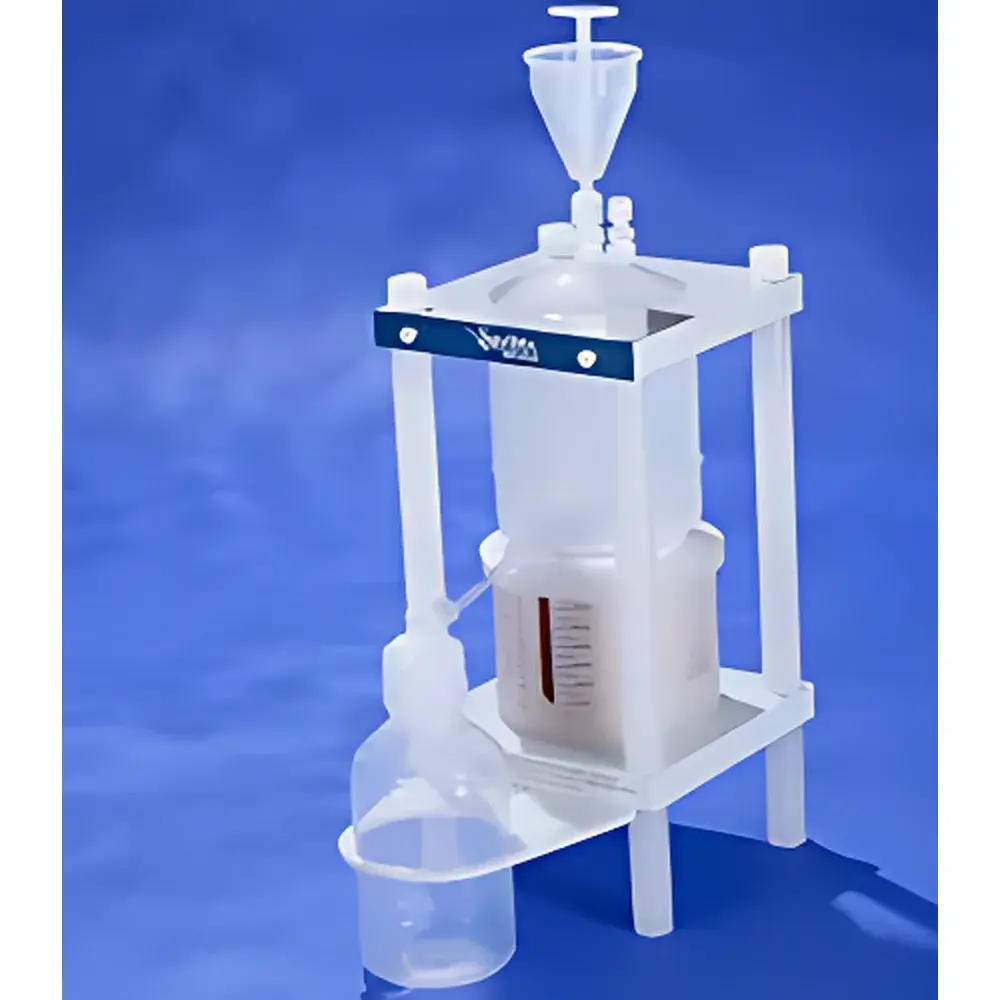
Savillex DST-1000B PFA Sub-Boiling Acid Distillation System
| Brand | Savillex |
|---|---|
| Origin | USA |
| Model | DST-1000B |
| Power Input | 100/115/230 VAC ±10%, 50/60 Hz |
| Power Consumption | 70 W |
| Weight | 4.6 kg (10.15 lbs) |
| Dimensions (L×W×H) | 20 cm × 20 cm × 43 cm (10.15" × 10.15" × 16.92") |
| Height with Funnel | 51 cm (20.08") |
| Capacity | 125 mL – 1 L |
| Material of Wetted Parts | Molded PFA Fluoropolymer |
| Cooling | Air-cooled (no water required) |
| Temperature Control | Adjustable, sub-boiling range |
Overview
The Savillex DST-1000B PFA Sub-Boiling Acid Distillation System is an ultra-high-purity, benchtop acid purification instrument engineered for trace-metal analysis laboratories requiring reagent-grade acids for ICP-OES, ICP-MS, and other ultra-trace elemental applications. Operating on the principle of sub-boiling (or “anti-boiling”) distillation—where the heating surface temperature remains deliberately below the atmospheric boiling point of the target acid—the system minimizes aerosol entrainment, volatile impurity carryover, and thermal decomposition. This physical separation mechanism ensures exceptional removal of metallic contaminants (e.g., Al, Fe, Cr, Ni, Pb), silicates, and particulates commonly introduced during acid manufacturing or storage. Constructed entirely from molded perfluoroalkoxy alkane (PFA) fluoropolymer for all wetted surfaces—including the evaporator chamber, condenser, receiver, and feed funnel—the DST-1000B eliminates leaching from glass, quartz, or metal components. Its fully enclosed architecture prevents ambient contamination and operator exposure, making it compliant with OSHA and NIOSH guidelines for handling concentrated hydrochloric, nitric, hydrofluoric, and perchloric acids.
Key Features
- Sub-boiling thermal profile enabled by integrated, low-wattage PFA-wrapped heating mantle—eliminates hot-spot formation and ensures uniform, gentle evaporation without reflux or bumping.
- Zero-water-cooling design: air-cooled condensation via optimized PFA geometry and ambient convection; reduces lab infrastructure dependency and eliminates risk of coolant contamination or condensate dilution.
- Compact footprint (≤0.1 m² / <1 ft²) enables installation in standard fume hoods—even under space-constrained conditions typical of ISO Class 5 cleanrooms or regulated QC labs.
- Adjustable temperature controller housed in a rugged, chemically resistant polymer enclosure; supports multi-voltage input (100/115/230 VAC) for global deployment without external transformers.
- Integrated gravity-fed drain channel allows safe, pump-free disposal of residual spent acid into secondary containment—designed to meet EPA 40 CFR Part 264 spill control requirements.
- All PFA components are injection-molded (not laminated or bonded), ensuring seamless internal surfaces, no crevices, and full compliance with ASTM D5127 and USP for fluoropolymer extractables testing.
Sample Compatibility & Compliance
The DST-1000B is validated for distillation of high-purity HCl (37%), HNO₃ (69–70%), HF (49%), and HBr (48%) at volumes ranging from 125 mL to 1 L per batch. It is not intended for use with oxidizing mixtures (e.g., aqua regia) or organic solvents. All PFA components comply with FDA 21 CFR §177.1550 for food-contact fluoropolymers and pass USP heavy-metal leach testing (5,000 distillation cycles.
Software & Data Management
The DST-1000B operates as a standalone analog-controlled instrument—intentionally omitting digital interfaces to eliminate electromagnetic interference risks near sensitive mass spectrometers and prevent firmware-related validation complications in regulated environments. Temperature is adjusted via calibrated rotary potentiometer with tactile detents; each setting corresponds to a defined evaporation rate (e.g., 0.5–3.0 mL/h for HNO₃), enabling method transfer consistency between instruments. While no software is bundled, the unit is compatible with external data loggers (e.g., Omega OM-DAQPRO-5300) via 0–5 V analog output (optional accessory). All operational parameters—including voltage, wattage, and ambient temperature—are documented in the included IQ/OQ protocol templates aligned with FDA 21 CFR Part 11 Annex 11 expectations for manual systems.
Applications
- Preparation of ultrapure acids for calibration standards and blanks in ICP-MS trace metal analysis (detection limits ≤0.01 pg/g).
- Purification of HF for semiconductor wafer etching reagents and geological sample dissolution (e.g., zircon U–Pb dating).
- Recovery and reuse of spent HCl in hydrometallurgical QA/QC labs—reducing hazardous waste generation by >70% versus single-use reagents.
- Supporting ISO 17025-accredited environmental testing labs performing EPA Method 6020B and ASTM D5673 for metals in soil and water extracts.
- Enabling CRMs (Certified Reference Materials) producers to meet ISO Guide 35 traceability requirements through documented acid purity verification prior to CRM synthesis.
FAQ
Can the DST-1000B be used for aqua regia or mixed acid systems?
No. Aqua regia and other oxidizing mixtures pose uncontrolled decomposition and pressure buildup risks in a sealed sub-boiling system. Only single-component, high-purity mineral acids are supported.
What is the expected lifetime of the PFA evaporator chamber?
Under normal use (≤200 distillation cycles/year with proper cleaning), the molded PFA chamber maintains structural integrity and surface purity for ≥10 years—verified via FTIR and ICP-MS leach testing per ASTM D5127 Annex A3.
Does the system require calibration or periodic certification?
While no routine calibration is mandated, users must perform initial operational qualification (OQ) per the provided protocol. Annual verification of temperature accuracy (±2 °C at 90 °C setpoint) using a NIST-traceable thermocouple is recommended for GLP compliance.
Is the DST-1000B compatible with cleanroom Class 100 (ISO 5) environments?
Yes. Its static-free PFA construction, zero particulate shedding, and absence of lubricants or adhesives meet ISO 14644-1 particle count thresholds when operated within certified laminar flow hoods.
How is method transfer validated between multiple DST-1000B units?
Method equivalence is established by comparing distillate conductivity (ASTM D1125), blank metal content (ICP-MS), and evaporation rate consistency across three consecutive batches—documented per ISO/IEC 17025 Clause 7.2.2.



