
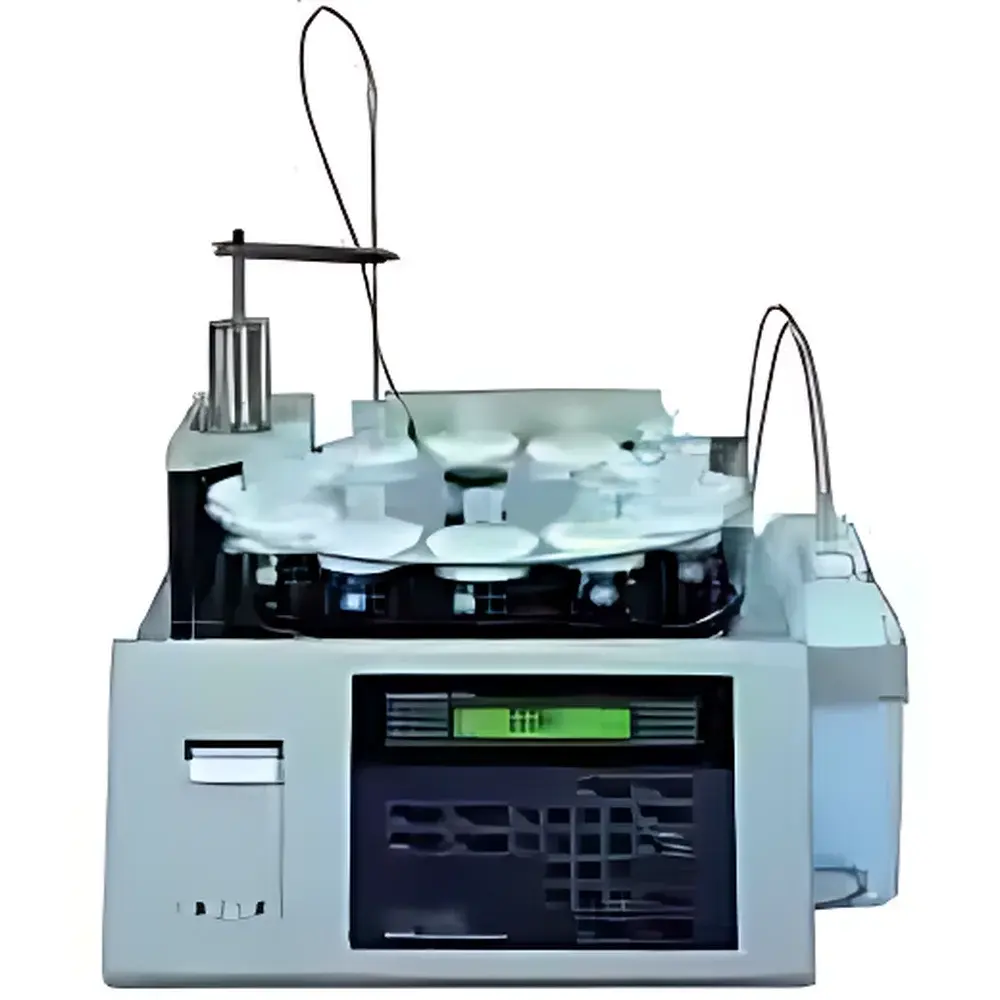
Chinyee APD500A Automated Asphaltene Analyzer
| Brand | Chinyee |
|---|---|
| Origin | Japan |
| Manufacturer Type | Authorized Distributor |
| Origin Category | Imported Instrument |
| Model | APD500A |
| Pricing | Available Upon Request |
| Application | Fuel Oil, Crude Oil Residues, FCC Slurry Oil, Coker Drum Effluents |
| Sample Limitations | Not suitable for samples containing non-toluene-soluble solids (e.g., sludge), high-melting-point paraffins (>50 °C), or natural bitumens |
| Measurement Range | 0.5–15 wt% |
| Repeatability | ±2% RSD |
| Measurement Time | 30 s (excluding sample prep) |
| Optical Method | Dual-wavelength photometry using interference filters |
| Light Source | Tungsten-halogen lamp |
| Wavelengths | 750 nm and 880 nm |
| Detector | Silicon photodiode |
| Interface | RS-232C |
| Power Supply | 220 V, 50/60 Hz |
| Dimensions (W×D×H) | 460 × 165 × 635 mm |
| Weight | 25 kg |
| Output | Integrated thermal printer + RS-232C port |
| Safety Certification | CE-compliant |
Overview
The Chinyee APD500A Automated Asphaltene Analyzer is a dedicated benchtop photometric instrument engineered for rapid, operator-independent quantification of asphaltene content in petroleum-derived liquid samples. It operates on the principle of dual-wavelength absorbance ratio analysis—a validated optical technique that correlates spectral attenuation at two discrete near-infrared wavelengths (750 nm and 880 nm) with the concentration of n-heptane-insoluble, toluene-soluble asphaltene fractions. This method eliminates gravimetric filtration, centrifugation, and solvent evaporation steps inherent in classical ASTM D3279-83, IP 143/82, and UOP 614/84 procedures—reducing total assay time from hours to under 30 seconds per sample. Designed as a direct upgrade to the APD200A platform, the APD500A integrates an all-in-one mechanical architecture where the measurement cell and automated sample positioning carousel are co-located within a single rigid chassis, minimizing alignment drift and enhancing long-term photometric stability.
Key Features
- True walk-up operation: No user calibration, no manual wavelength selection, no solvent blanking—automatic zero-reference compensation via integrated reference channel.
- Dual-wavelength photometry with temperature-stabilized tungsten-halogen source and matched silicon photodiode detection ensures minimal thermal drift and high signal-to-noise ratio across the operational range (0.5–15 wt%).
- CE-certified electrical safety architecture with reinforced insulation, grounded chassis, and overcurrent protection compliant with IEC 61010-1:2010.
- Integrated thermal printer provides immediate hard-copy output of results, including timestamp, sample ID (user-entered), measured absorbance ratio, and calculated wt% asphaltene—fully traceable without external software.
- RS-232C serial interface supports bidirectional communication with LIMS or laboratory data management systems, enabling automated result logging and audit trail generation.
- Compact footprint (460 × 165 × 635 mm) and low mass (25 kg) allow deployment on standard analytical workbenches without structural reinforcement.
Sample Compatibility & Compliance
The APD500A is validated for use with liquid hydrocarbon streams soluble in toluene, including fuel oils (IFO 180, IFO 380), atmospheric and vacuum residues, fluid catalytic cracking (FCC) slurry oils, and delayed coker drum effluents. It is explicitly excluded for samples containing non-toluene-soluble particulates (e.g., pipeline sludge, catalyst fines), waxy crudes with pour points exceeding 50 °C, or naturally occurring bitumens (e.g., Gilsonite, Trinidad Lake Asphalt). Method correlation studies confirm strong linear agreement (R² > 0.98) against reference ASTM D3279 gravimetric data across 12 independent refinery laboratories. The instrument’s optical methodology satisfies the technical intent of JPI-5S-45-95 and aligns with ISO 13700:2018 (Petroleum products — Determination of asphaltene content — n-Heptane insolubles method) for screening-level quantification in QC environments.
Software & Data Management
While the APD500A operates autonomously without host software, its RS-232C interface transmits ASCII-formatted data packets containing raw absorbance values, calculated concentration, system status flags, and internal diagnostic codes. When connected to compliant laboratory information systems, it supports 21 CFR Part 11–ready audit trails when paired with validated middleware (e.g., LabWare LIMS, Thermo Fisher SampleManager). All printed outputs include immutable timestamps and sequential run identifiers—enabling full GLP/GMP traceability. Firmware updates are delivered via secure USB-to-serial adapter and require password-authenticated access to prevent unauthorized configuration changes.
Applications
- Real-time monitoring of asphaltene stability in heavy feedstocks prior to hydrotreating or FCC unit charging.
- Quality control of marine bunker fuels to verify compliance with ISO 8217:2024 Annex B (asphaltene limits for residual fuels).
- Rapid assessment of fouling potential in heat exchanger networks and distillation column trays.
- Supporting research into asphaltene precipitation inhibitors by enabling high-throughput screening of additive efficacy under controlled dilution conditions.
- Refinery lab workflow optimization: replaces three-step ASTM D3279 workflows with single-button analysis, reducing analyst labor by >90% per test.
FAQ
What sample preparation is required prior to analysis?
Samples must be homogenized and dissolved in analytical-grade toluene at a defined dilution ratio (typically 1:10 w/v). No filtration or heating is required unless visible particulates are present; if so, 0.45 µm membrane filtration is recommended.
Can the APD500A measure asphaltenes in bio-blended fuels?
Yes—provided the biomass-derived component is fully miscible in toluene and does not introduce interfering chromophores at 750/880 nm. Validation against gravimetric reference is advised for novel blends.
Is method validation support available from Chinyee?
Chinyee provides IQ/OQ documentation templates, certified reference material (CRM) correlation reports, and on-site installation qualification services upon request—fully aligned with ISO/IEC 17025:2017 requirements.
Does the instrument require annual recalibration?
No scheduled recalibration is mandated. Photometric stability is verified daily via built-in reference check; annual verification using NIST-traceable optical density standards is recommended for regulated environments.
How is data integrity ensured during power interruption?
All measurements are buffered in non-volatile memory; unsent RS-232 data persists through brownout events and resumes transmission upon power restoration.





