
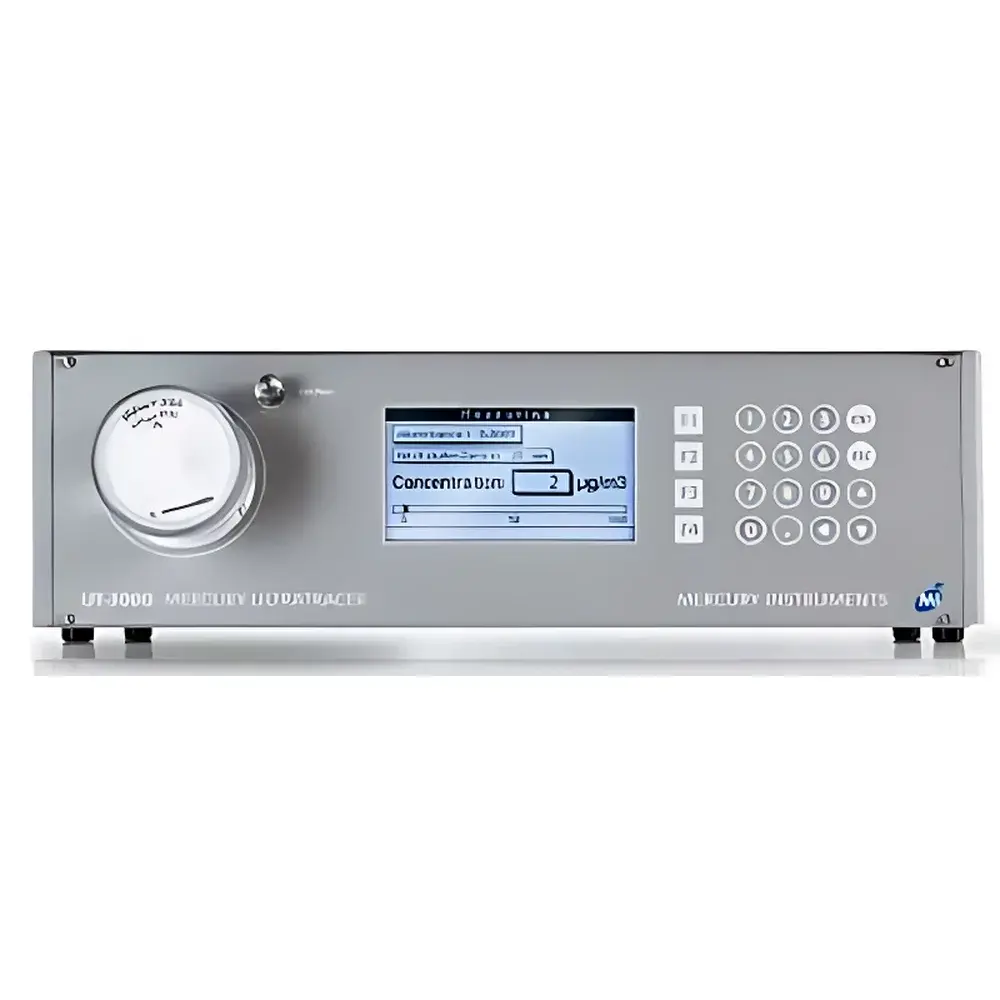
MI UT 3000 Ultra-Trace Mercury Analyzer (Germany)
| Origin | Germany |
|---|---|
| Type | Portable Mercury Analyzer |
| Principle | Cold Vapor Atomic Absorption Spectrometry (CVAAS) with Gold Amalgamation Preconcentration |
| Detection Limit | ≤0.1 ng/m³ (or 0.5 pg Hg absolute) |
| Repeatability | ≤1.0% RSD |
| Linearity Error | ±1% |
| Sample Volume Range | 0.1–100 L |
| Sampling Cycle | 10 s–15 min |
| Measurement Cycle | 10 s–16 min |
| Measurement Range (10 L sample) | 0.1–2000 ng/m³ |
| Measurement Range (1 L sample) | 1–10,000 ng/m³ |
| Flow Control | Electronic mass flow meter |
| Pump Type | Diaphragm pump with Viton membranes |
| Filter | Disposable 0.45 µm PTFE membrane |
| Light Source | Electrodeless low-pressure mercury lamp (253.7 nm) |
| Data Storage | 10,000 records (~100 days) |
| Interface | USB & RS232 |
| Power Supply | 110/230 V, 50/60 Hz, max. 125 W |
| Dimensions (W×H×D) | 45 × 15 × 35 cm |
| Weight | ~9 kg |
| Operating Temperature | 5–35 °C |
Overview
The MI UT 3000 Ultra-Trace Mercury Analyzer is a field-deployable, laboratory-grade instrument engineered for the quantitative determination of total gaseous mercury (TGM) in ambient air, stack emissions, natural gas streams, soil gas, and other low-concentration gaseous matrices. It employs cold vapor atomic absorption spectrometry (CVAAS) coupled with selective gold amalgamation preconcentration—a technique widely recognized for its specificity, robustness, and sub-picogram-level sensitivity. Unlike continuous emission monitoring systems requiring carrier gases or complex optical alignment, the UT 3000 operates without external purge gas, relying instead on integrated diaphragm pumping and thermally controlled gold trap desorption to deliver high reproducibility at ultra-trace concentrations (≤0.1 ng/m³). Its design conforms to methodological frameworks referenced in EPA Method 1631, ASTM D6784-22 (Standard Test Method for Elemental, Oxidized, Particle-Bound, and Total Mercury in Flue Gas), and ISO 6978-2 for mercury in natural gas—making it suitable for regulatory-compliant environmental monitoring and research-grade atmospheric chemistry studies.
Key Features
- Patented gold amalgamation trap enabling quantitative capture and thermal release of TGM at room temperature, followed by rapid flash-heating (≥800 °C) for complete mercury desorption;
- Stable electrodeless low-pressure mercury lamp emitting at 253.7 nm, optimized for maximum absorption cross-section and minimal spectral interference;
- High-precision electronic mass flow meter with dynamic range adjustment—automatically switches to low-flow mode during desorption to maximize residence time and analytical sensitivity;
- Integrated microprocessor control system supporting fully automated sampling, enrichment, desorption, detection, and data logging without manual intervention;
- Real-time graphical display during gold trap heating phase, including bar-chart visualization of signal intensity and baseline stability metrics;
- Compact footprint (45 × 15 × 35 cm) and lightweight chassis (~9 kg) compatible with vehicle-mounted deployment, handheld operation, and remote field stations;
- No requirement for external carrier or purge gas—reducing operational complexity, consumable dependency, and long-term maintenance overhead.
Sample Compatibility & Compliance
The UT 3000 accepts gaseous samples directly from ambient air, indoor environments, flue ducts, natural gas pipelines, soil gas probes, and marine boundary layer samplers. Particulate matter is removed upstream using a disposable 0.45 µm PTFE membrane filter, ensuring protection of the gold trap and optical cell from contamination. The instrument supports compliance with international quality assurance protocols: data integrity is preserved via timestamped storage (10,000 entries), audit-ready export via USB/RS232, and optional integration with GLP/GMP-aligned calibration workflows. When equipped with the MC-3000 dynamic calibrator, traceable calibration can be performed in situ using NIST-traceable mercury vapor standards—meeting requirements for ISO/IEC 17025-accredited laboratories and EPA-approved ambient monitoring networks.
Software & Data Management
Data acquisition and instrument control are managed through an embedded firmware interface accessible via serial or USB connection to Windows-based PCs or laptops. Raw absorbance signals, flow rate logs, trap temperature profiles, and calculated concentration values are stored with UTC timestamps and sample ID tagging. Export formats include CSV and ASCII-compatible tables, facilitating direct import into statistical analysis platforms (e.g., R, Python pandas, or MATLAB) and LIMS environments. Optional software packages support automated report generation compliant with US EPA QA/QC reporting templates, including MDL verification logs, calibration curve statistics (r² ≥ 0.999), and drift correction summaries across multi-day deployments.
Applications
- Ambient air quality monitoring networks tracking long-range mercury transport and seasonal deposition patterns;
- Indoor air assessment in dental clinics, chlor-alkali facilities, and coal-fired power plant control rooms;
- Soil gas flux studies investigating geogenic mercury emissions linked to tectonic activity and mantle degassing;
- Ocean-atmosphere exchange modeling via shipboard or coastal observatory deployments;
- Natural gas purity verification prior to liquefaction or pipeline injection, per ISO 14111 and AGA Report No. 9;
- Source apportionment campaigns identifying point vs. diffuse mercury emissions using spatially resolved TGM mapping;
- Method validation and inter-laboratory comparison exercises under EU JRC-coordinated proficiency testing schemes.
FAQ
Does the UT 3000 require carrier gas for operation?
No—unlike many CVAAS systems, the UT 3000 uses internal clean-air purging and does not rely on external nitrogen or argon supply.
Can the instrument perform unattended multi-day measurements?
Yes—the built-in data logger retains up to 10,000 measurement records with timestamps, supporting continuous operation for over 100 days at standard 15-minute intervals.
What calibration options are available?
Calibration may be conducted manually via the PTFE-sealed injection port using certified mercury standard gas and syringe, or automatically using the optional MC-3000 dynamic mercury vapor generator.
Is the gold trap replaceable in the field?
Yes—the gold amalgamation module is designed as a user-serviceable cartridge with tool-free installation and factory pre-conditioning.
How is interference from halogens or ozone mitigated?
The gold trap selectively adsorbs elemental mercury; oxidized mercury species (e.g., HgCl₂) are reduced upstream using a heated SnCl₂ catalyst—configuration supported via optional inlet conditioning modules.
Related Products





