
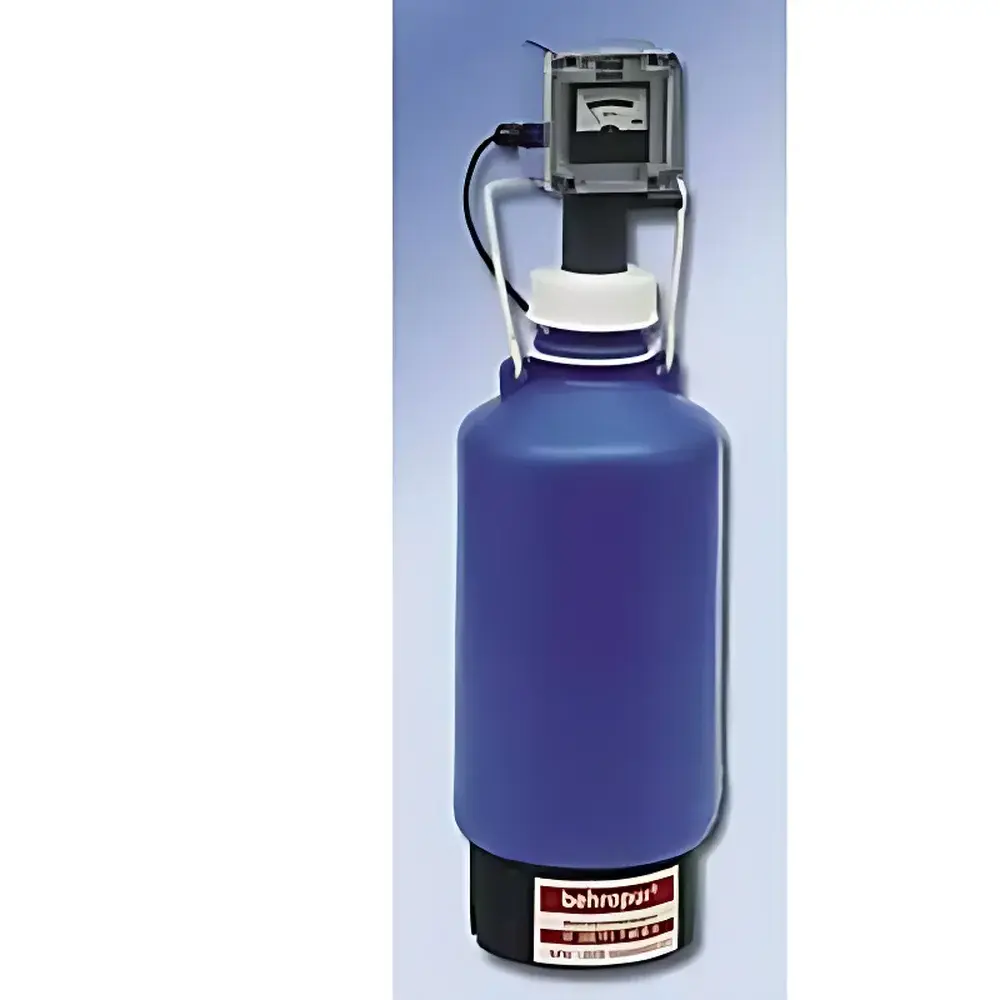
Behr B5/B10 Negative-Pressure Deionization Unit
| Origin | Germany |
|---|---|
| Manufacturer Type | Authorized Distributor |
| Origin Category | Imported |
| Model | Behr B5/B10 |
| Pricing Range | USD 720 – 7,200 (FOB) |
| Water Grade | ASTM Type I Ultra-Pure Water |
| Resistivity | 18.2 MΩ·cm at 25 °C |
| Heavy Metals & Soluble Silica | < 0.1 ppb |
| Total Organic Carbon (TOC) | < 10 ppb |
| Microbial Count / Endotoxins | < 0.001 EU/mL |
| Particulates (>0.1 µm) | < 1 particle/mL |
Overview
The Behr B5/B10 Negative-Pressure Deionization Unit is a precision-engineered, wall-mountable ultra-pure water polishing system designed for continuous, low-maintenance operation in analytical laboratories, pharmaceutical QC environments, and semiconductor R&D facilities. Unlike pressure-driven deionizers, the B5/B10 operates under controlled negative pressure—drawing feed water from upstream sources (e.g., reverse osmosis permeate or municipal pretreated water) via vacuum-assisted suction. This architecture eliminates backpressure-related membrane fatigue, minimizes risk of seal failure, and inherently suppresses microbial ingress during water intake. The unit employs a dual-bed mixed ion exchange resin configuration housed in a monolithic, rotationally molded blue polyethylene vessel with reinforced wall thickness—ensuring structural integrity over extended service cycles and compatibility with aggressive low-conductivity water chemistries. Its design conforms to ISO 3696:1987 (Grade 1 water), ASTM D1193-20 (Type I), and supports compliance with USP and EP 2.2.44 for purified water specifications.
Key Features
- Integrated vacuum-assisted feed system with bottom-inlet supply—enabling automatic degassing during water entry and eliminating dissolved air nucleation sites that promote biofilm formation
- Slit-nozzle distribution manifold fabricated from chemically inert, UV-stabilized polyethylene; engineered to deliver laminar, non-turbulent flow across the resin bed—reducing channeling and maximizing ion exchange capacity utilization
- Onboard high-accuracy conductivity sensor (0.001–20.00 µS/cm range) mounted directly on the top cap assembly, calibrated traceably to NIST standards and featuring temperature compensation per DIN EN 27888
- Fail-safe electrical cutoff activated upon reaching user-defined resistivity threshold (default: 18.2 MΩ·cm); configurable via front-panel potentiometer or remote 4–20 mA signal input
- Robust rotational molding process ensures seamless, weld-free construction—eliminating potential leak paths and enhancing long-term chemical resistance against oxidants and low-pH eluents
- Wall-mount bracket included as standard; compact footprint (B5: 320 × 240 × 580 mm; B10: 380 × 280 × 650 mm) optimized for under-bench or utility corridor installation
Sample Compatibility & Compliance
The B5/B10 is validated for use with RO permeate (conductivity ≤ 5 µS/cm), distilled water, or double-distilled feed streams. It is not intended for direct connection to raw tap water or high-hardness municipal supplies without prior pretreatment. All wetted components comply with USP Class VI biocompatibility requirements and FDA 21 CFR 177.1520 for food-contact polymers. System output meets or exceeds ISO 3696:1987 Grade 1, ASTM D1193-20 Type I, and CLSI EP23-A guidelines for critical reagent water. Endotoxin retention is verified per LAL assay (USP ) using certified reference standards; particulate performance is validated per ISO 21501-4 using light-scattering particle counters calibrated to NIST SRM 1963.
Software & Data Management
While the B5/B10 operates as a standalone analog-controlled unit, its 4–20 mA conductivity output enables integration into centralized laboratory monitoring systems (e.g., DeltaV, LabVantage, or custom SCADA). The analog interface supports audit-trail-capable data logging when paired with compliant DAQ hardware meeting FDA 21 CFR Part 11 requirements (electronic signatures, time-stamped events, and immutable storage). Optional digital upgrade kits—including RS-485 Modbus RTU interface and local LCD display with historical min/max tracking—are available through Behr’s authorized technical partners.
Applications
- HPLC and UHPLC mobile phase preparation requiring sub-ppb metal and TOC control
- ICP-MS sample dilution and rinse solutions where silicate leaching must be avoided
- Cell culture media formulation and sterile filtration validation protocols
- Calibration standard preparation for trace elemental analysis (e.g., EPA Method 200.8)
- Final polishing stage in multi-stage ultrapure water systems serving cleanrooms (ISO 14644-1 Class 5/ISO 5)
- Aquaculture recirculating systems requiring endotoxin-free makeup water for sensitive larval stages
FAQ
Can the B5/B10 be connected directly to municipal tap water?
No. Feed water must be pre-treated to ≤ 5 µS/cm conductivity and free of chlorine, chloramines, and suspended solids—typically achieved via RO or distillation.
What is the expected service life of the mixed-bed resin under typical lab usage?
With RO-fed inlet water (≤ 2 µS/cm), average resin exhaustion occurs after 800–1,200 L for B5 and 1,600–2,400 L for B10—monitored continuously via real-time conductivity feedback.
Is the unit compliant with GLP/GMP documentation requirements?
Yes. When integrated with Part 11–compliant data acquisition, all conductivity events, alarm triggers, and power-cycle logs are timestamped, attributable, and retained for ≥ 2 years per ALCOA+ principles.
Does the slit-nozzle design require periodic disassembly for cleaning?
No. The nozzle geometry prevents biofouling accumulation; routine cleaning is accomplished via 10-minute citric acid (2% w/v) recirculation without component removal.
Can the B5/B10 be installed in a vertical orientation only?
Yes. The negative-pressure operating principle and bottom-feed configuration mandate vertical mounting to ensure consistent resin bed hydration and avoid air entrapment.



