
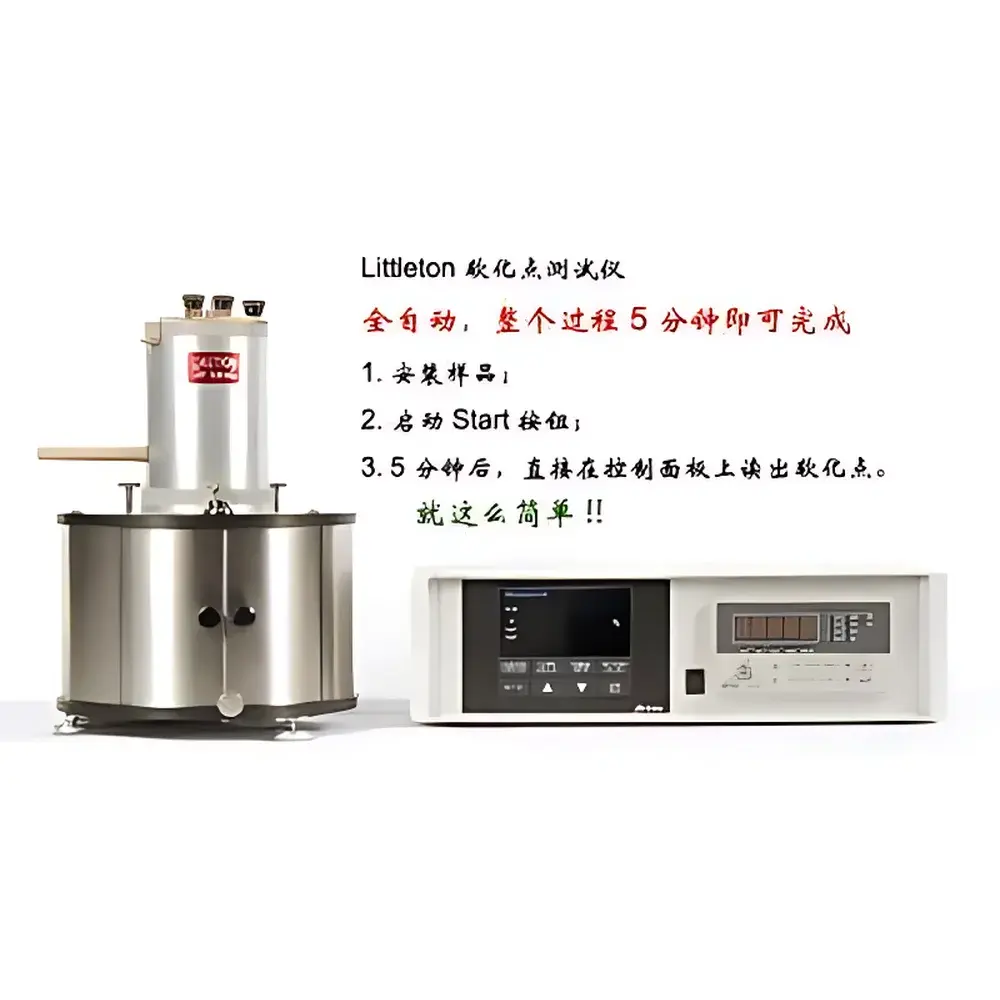
Orton SP900D/1000D Littleton Softening Point Tester
| Brand | Orton |
|---|---|
| Origin | USA |
| Model | SP900D / SP1000D |
| Temperature Range | Up to 900°C or 1000°C |
| Heating Rate Control | Programmable PID, 5°C/min standard per ASTM C338 |
| Sample Geometry | Glass fiber, Ø0.65 mm × 235 mm |
| Softening Detection Method | Laser-based axial elongation tracking at 1 mm/min under self-weight |
| Compliance | ASTM C338 (Littleton softening point) |
| Data Acquisition | Real-time PC software with automated calculation, statistical reporting, and audit-ready output |
| Accuracy | ±1°C (repeatability on identical fibers) |
| Software Features | Mode selection, heating profile customization, GLP-compliant data logging, export to CSV/PDF |
Overview
The Orton SP900D/1000D Littleton Softening Point Tester is a precision-engineered thermal analysis instrument designed specifically for the determination of the Littleton softening point of inorganic glasses in accordance with ASTM C338. This method defines the softening point as the temperature at which a standardized glass fiber—0.65 mm in diameter and 235 mm in length—elongates at a rate of 1 mm/min under its own gravitational load during controlled linear heating. The instrument employs a high-stability vertical furnace with programmable PID temperature control and an integrated laser displacement sensor that continuously monitors axial extension of the suspended fiber segment. Unlike empirical or differential thermal methods, the Littleton test provides a direct, mechanically anchored thermomechanical transition metric directly tied to glass network viscosity (~10⁷.6 poise), making it indispensable for compositional consistency control in flat glass, container glass, optical glass, and fiberglass manufacturing.
Key Features
- Two configurable models: SP900D (max 900°C) and SP1000D (max 1000°C), both engineered for long-term thermal stability and uniformity across the sample zone.
- Laser-based real-time elongation tracking with sub-micron resolution, eliminating parallax error and operator-dependent visual estimation.
- Automated ASTM C338-compliant test execution: software-controlled ramp rate (standard 5°C/min), automatic start/stop logic based on elongation velocity threshold, and direct softening point calculation.
- Customizable heating profiles—users may define non-standard ramp rates (e.g., 10°C/min) for rapid QC screening while retaining full traceability of applied parameters.
- Robust mechanical design with quartz-fiber suspension fixture, ceramic insulation, and inert atmosphere compatibility (N₂ purge port optional).
- Integrated safety interlocks including overtemperature cutoff, door-open detection, and emergency cooling activation.
Sample Compatibility & Compliance
The SP900D/1000D accepts only ASTM-specified glass fibers (diameter 0.65 ± 0.01 mm, length 235 ± 1 mm, straightness ≤ 0.2 mm deviation over 100 mm). Sample preparation requires precise cutting and end-polishing to ensure reproducible gravitational loading geometry. The system fully satisfies ASTM C338 requirements for apparatus calibration, thermal gradient verification (<2°C/cm over active zone), and measurement repeatability. It supports GLP and GMP-aligned workflows through time-stamped, user-identified test logs; all raw elongation vs. temperature data are retained with metadata (operator ID, calibration date, furnace serial number). While not FDA-certified as standalone hardware, the software architecture complies with 21 CFR Part 11 principles via electronic signature support, audit trail generation, and immutable record archiving when deployed on validated Windows OS environments.
Software & Data Management
Orton’s proprietary SP-Control Suite runs on Windows 10/11 and provides three operational modes: Standard ASTM C338, Rapid QC (user-defined ramp), and Manual Diagnostic (for calibration validation). During acquisition, the interface displays live plots of temperature, elongation, and dL/dt—enabling immediate anomaly detection. Post-run, the software calculates the softening point using the prescribed linear regression over the 1 mm/min elongation window and reports uncertainty per ISO/IEC 17025 guidelines. Statistical modules generate batch summaries (mean, SD, CV%), trend charts across shifts or batches, and customizable PDF reports compliant with internal QA templates. All data exports retain native timestamping and are compatible with LIMS integration via ODBC drivers.
Applications
This instrument serves critical quality assurance functions across glass R&D and production: monitoring batch-to-batch compositional drift in soda-lime silica melts; validating fining agent efficacy; qualifying recycled cullet blends; certifying specialty borosilicate or aluminosilicate formulations for pharmaceutical vials; and supporting DOE studies on alkali oxide substitution effects. In academic and national labs, it supports fundamental viscosity modeling (e.g., Vogel–Fulcher–Tammann parameterization) and interlaboratory round-robin studies requiring metrological traceability to NIST-traceable thermocouples and certified reference fibers.
FAQ
What is the difference between Littleton softening point and annealing point?
The Littleton softening point (ASTM C338) reflects viscous deformation under gravity at ~10⁷.6 poise, whereas the annealing point (ASTM C336) corresponds to ~10¹³.5 poise—the temperature at which internal stresses relax within minutes. They represent distinct rheological regimes and are not numerically interchangeable.
Can the SP900D/1000D test non-cylindrical samples?
No. ASTM C338 mandates strict dimensional conformity of the glass fiber specimen. Deviations invalidate compliance and compromise measurement physics due to altered stress distribution and heat transfer.
Is furnace calibration required before each test?
A full system calibration (thermocouple verification, laser alignment, and reference fiber validation) is recommended quarterly or after maintenance. Daily verification uses a certified reference fiber with known softening point; deviation >±1°C triggers recalibration.
Does the software support multi-user access with role-based permissions?
Yes. SP-Control Suite includes administrator, analyst, and viewer roles with configurable permissions for method editing, test execution, and report export—aligned with ISO 17025 personnel competency requirements.
How is thermal uniformity verified across the furnace zone?
Per ASTM C338 Section 7.2, users perform a temperature gradient mapping using three calibrated thermocouples positioned at top/middle/bottom of the sample region during a stabilized 500°C soak; maximum allowable gradient is 2°C/cm.



