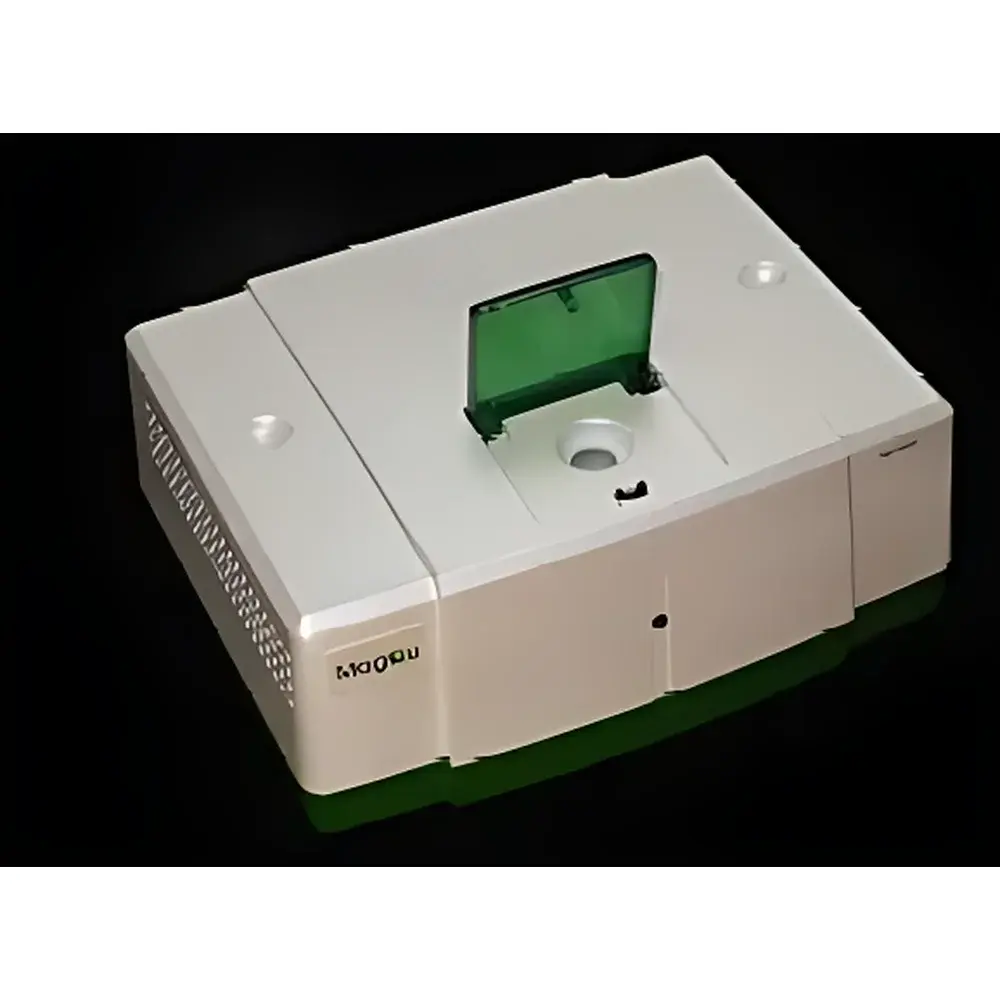
MagQu XacQuan Variable-Frequency AC Magnetic Susceptibility Analyzer
| Brand | MagQu |
|---|---|
| Origin | Taiwan |
| Model | XacQuan |
| Frequency Range | 10 Hz – 25 kHz |
| Output | Real (χ′) and Imaginary (χ″) Components of AC Susceptibility |
| Sample Volume | ≥ 0.1 mL |
| Measurement Time | < 60 s per sample |
| Compliance | CE-marked, RoHS-compliant |
| Software Interface | Windows-based GUI with real-time plotting and data export (CSV, TXT) |
Overview
The MagQu XacQuan Variable-Frequency AC Magnetic Susceptibility Analyzer is a precision benchtop instrument engineered for quantitative characterization of dynamic magnetic response in paramagnetic, superparamagnetic, and weakly ferromagnetic materials. It operates on the fundamental principle of AC susceptibility spectroscopy—applying a small-amplitude sinusoidal magnetic field (Hac) at tunable frequencies (10 Hz to 25 kHz) and measuring the resulting magnetization response (Mac) in-phase (real component, χ′) and quadrature (imaginary component, χ″) relative to the drive field. This complex susceptibility χ* = χ′ − iχ″ directly reflects the relaxation dynamics of magnetic moments—including Néel and Brownian relaxation mechanisms—and their dependence on particle size, anisotropy, interparticle interactions, and thermal energy. Unlike static magnetometry techniques, the XacQuan enables non-invasive, rapid, and highly reproducible assessment of magnetic dispersion behavior without requiring cryogenic cooling or high-field electromagnets. Its design conforms to core metrological principles defined in ISO/IEC 17025 for measurement uncertainty management and supports traceable calibration via reference standards.
Key Features
- Wide-frequency sweep capability (10 Hz – 25 kHz) with programmable step resolution and dwell time control
- Simultaneous dual-channel acquisition of χ′ and χ″ with phase-sensitive detection (lock-in amplification)
- Low-noise excitation coil system optimized for signal-to-noise ratio (SNR) > 60 dB across full bandwidth
- Minimal sample requirement: compatible with 0.1 mL liquid suspensions, powders, thin films, and solid pellets
- Benchtop form factor (W × D × H: 320 × 280 × 140 mm; weight: < 5 kg) with integrated power supply and USB-C interface
- Real-time spectral visualization, automatic baseline correction, and peak detection algorithms for χ″ maxima identification
- Factory-calibrated using certified magnetic reference materials traceable to NIST SRM 2870 (Fe3O4 nanoparticle suspension)
Sample Compatibility & Compliance
The XacQuan accommodates diverse physical states without modification: aqueous or organic magnetic fluids, dry powders in quartz tubes, spin-coated thin films on non-magnetic substrates, and bulk ceramic or polymer composites. All sample holders are non-ferromagnetic (quartz, borosilicate glass, or PTFE) to eliminate background interference. The analyzer meets electromagnetic compatibility (EMC) requirements per EN 61326-1:2013 and carries CE marking for use in EU laboratories. It complies with RoHS Directive 2011/65/EU for hazardous substance restriction. While not a regulated medical device, its measurement methodology aligns with ASTM E3029–16 (Standard Guide for Magnetic Nanoparticle Characterization) and supports GLP-aligned documentation workflows when paired with MagQu’s optional audit trail module (21 CFR Part 11 compliant logging available upon request).
Software & Data Management
The XacQuan Control Suite is a native Windows application (64-bit, Windows 10/11) providing intuitive instrument control, automated frequency sweeps, and multi-sample batch processing. Raw data files include timestamp, temperature (via optional external probe), drive amplitude, and full χ′/χ″ spectra. Export formats support CSV, TXT, and MATLAB .mat for downstream analysis in Python (NumPy/SciPy), OriginLab, or custom fitting routines (e.g., Debye, Cole-Cole, or Néel-Brownian superposition models). The software includes built-in calibration verification tools and allows user-defined concentration calibration curves—enabling rapid quantification of iron-equivalent content (mg-Fe/mL) or specific magnetization (emu/g) from χ′ values at fixed frequency (e.g., 1 kHz). All data entries are timestamped and stored with metadata (operator ID, sample ID, instrument serial number), facilitating ISO 17025-compliant record retention.
Applications
- Magnetic nanoparticle characterization: Determination of hydrodynamic size distribution, core diameter, and surface coating integrity via χ″ peak frequency analysis (fmax) and width
- Quality control in magnetic fluid manufacturing: Batch-to-batch consistency monitoring of colloidal stability and concentration without destructive sampling
- Academic teaching labs: Hands-on demonstration of magnetic relaxation physics, Curie law deviations, and frequency-domain spectroscopy fundamentals
- Biomedical material screening: Rapid assessment of functionalized iron oxide nanoparticles for MRI contrast agents or magnetic hyperthermia applications
- Thin-film and composite R&D: Non-contact evaluation of magnetic phase dispersion in polymer nanocomposites or spintronic multilayers
FAQ
What is the minimum detectable magnetic moment sensitivity of the XacQuan?
The system achieves a typical noise floor of 1 × 10⁻⁸ emu under standard operating conditions (1 kHz, 1 Oe ac field, 0.1 mL sample), corresponding to ~0.1 µg Fe3O4 in aqueous suspension.
Can the XacQuan measure temperature-dependent AC susceptibility?
Yes—when coupled with MagQu’s optional Peltier-controlled sample stage (XacTemp, −10°C to +80°C), full χ′(T,f) and χ″(T,f) mapping is supported.
Is calibration required before each measurement?
No—factory calibration remains stable for ≥12 months under normal lab conditions. A quick zero-field offset check is recommended prior to critical measurements.
Does the instrument support third-party automation via API or SCPI commands?
Yes—the XacQuan exposes a documented COM-based ActiveX interface and SCPI command set for integration into LabVIEW, Python (pywin32), or MATLAB automation frameworks.
How does the XacQuan differ from a VSM or SQUID magnetometer?
Unlike VSM/SQUID systems—which measure static M(H) hysteresis loops at fixed temperatures—the XacQuan specializes in dynamic, low-field, frequency-resolved susceptibility, offering superior speed, lower cost, and higher throughput for routine magnetic dispersion analysis.