
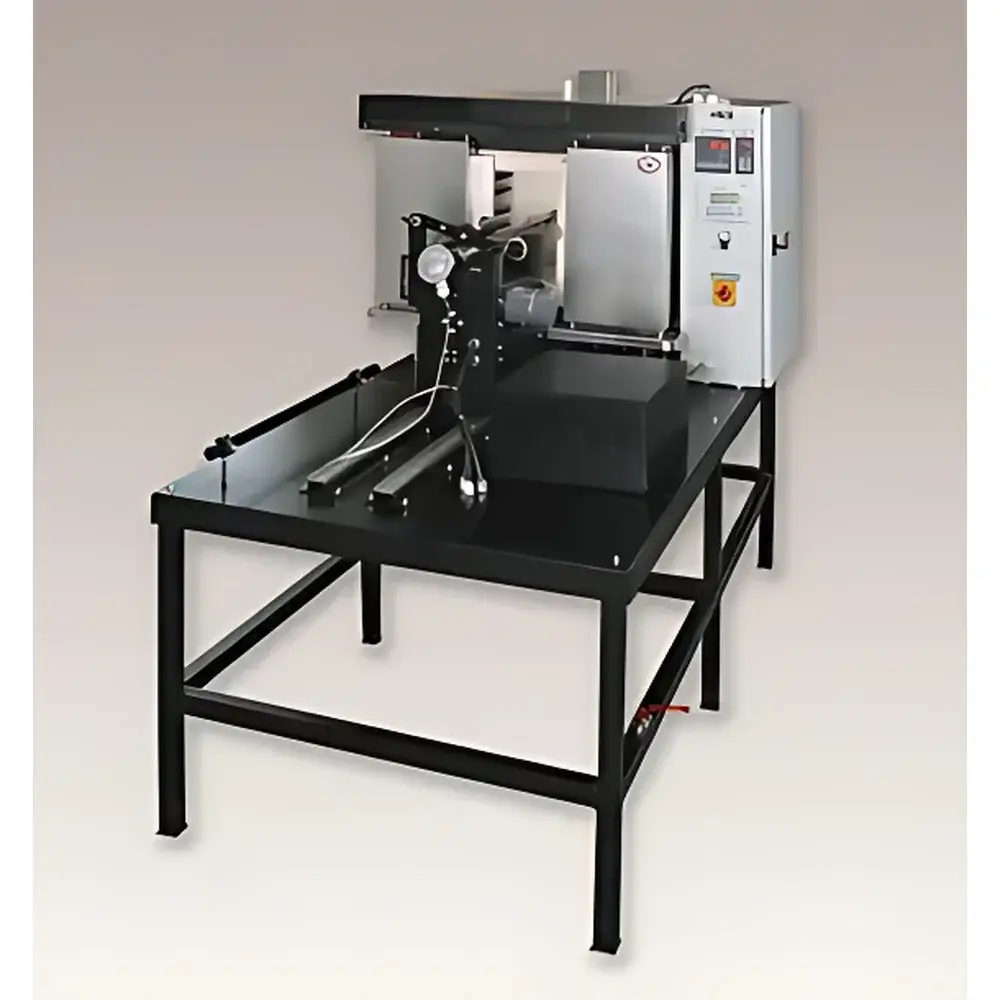
LAC KR-30/12 Integrated Muffle Furnace with Rotating Quartz Evaporator
| Origin | Imported |
|---|---|
| Manufacturer Type | Authorized Distributor |
| Model | KR-30/12 |
| Max Temp | 1200 °C |
| Chamber Volume | 3 L |
| External Dimensions (W×H×D) | 1100×1600×2100 mm |
| Internal Dimensions (W×H×D) | 310×310×310 mm |
| Power Rating | 3.5 kW |
| Net Weight | 155 kg |
| Voltage | 230 V AC, Single-phase |
| Temperature Control | Programmable PID via INDUSTRY controller with real-time clock |
| Programs | 30 stored profiles, up to 15 segments per program |
| Thermocouple Type | S-type (Pt/Pt–10% Rh) |
| Heating Element | Embedded resistance wire in refractory grooves |
| Insulation | Lightweight firebrick + ceramic fiber + calcium silicate board |
| Evaporator Drive | PLC-controlled rotary–translational mechanism |
| Optional Accessories | HT-100 multi-point temperature monitor (10 channels), RS232/RS485 interface, PC-based cycle logging software |
Overview
The LAC KR-30/12 Integrated Muffle Furnace with Rotating Quartz Evaporator is an engineered solution for high-precision thermal processing of laboratory-scale samples requiring simultaneous controlled heating and solvent removal or volatile fraction extraction. Unlike conventional muffle furnaces, this system integrates a motorized quartz evaporator assembly that moves along a linear rail and rotates synchronously—enabling reproducible positioning of the sample vessel directly into the uniform thermal zone of the furnace chamber. The furnace operates on resistive heating principles, with Kanthal A1 or equivalent high-temperature alloy wire embedded in grooved lightweight refractory bricks. Thermal isolation is achieved through a triple-layer insulation architecture: dense firebrick lining, low-conductivity ceramic fiber blanket, and outer calcium silicate board—ensuring rapid ramp rates (typical 10–15 °C/min to 1000 °C), low standby heat loss (<1.2 kW/h at 1000 °C), and spatial temperature uniformity of ±5 °C across the 310 mm³ hot zone (per ASTM E220 calibration practice). Designed for applications such as calcination of TiO₂ pigment precursors, thermal decomposition of metal-organic frameworks (MOFs), and ashing of polymer composites, the system complies with IEC 61000-6-3 (EMC emission limits) and meets mechanical safety requirements per EN 61000-6-2.
Key Features
- Stainless steel outer casing with reinforced structural rigidity and corrosion-resistant finish—designed for >15 years of continuous lab service under routine thermal cycling.
- Two-section hinged door with double-layer metallic shell filled with high-density ceramic fiber—provides effective thermal barrier and minimizes front-face surface temperature rise during operation.
- Dual-mode ventilation system: integrated axial exhaust fan with acid-resistant impeller evacuates corrosive volatiles (e.g., HCl, SO₂) generated during sample decomposition, protecting heating elements and extending service life.
- PLC-driven evaporator carriage: precisely coordinates horizontal translation (±0.5 mm repeatability) and continuous rotation (0–60 rpm, adjustable) of the quartz evaporation vessel—ensuring homogeneous exposure and preventing localized overheating or crust formation.
- INDUSTRY-series programmable temperature controller with built-in real-time clock (RTC), supporting up to 30 user-defined thermal cycles; each cycle comprises up to 15 independent ramp/soak steps with rate control from 0.1 to 30 °C/min.
- S-type thermocouples (IEC 60584-1 compliant) installed both in chamber wall and directly within evaporator shaft—enabling dual-point validation and closed-loop feedback for ±1 °C temperature stability at setpoint.
- Zero-crossing solid-state relays (SSRs) replace electromechanical contactors—eliminating audible switching noise and reducing electromagnetic interference (EMI) to adjacent instrumentation (tested per CISPR 11 Class B).
Sample Compatibility & Compliance
The KR-30/12 accommodates standard quartz or high-purity alumina crucibles (up to Ø90 mm × 120 mm height) and supports direct integration of rotary evaporation flasks (100–500 mL capacity) via its custom mounting interface. It is suitable for air, inert (N₂, Ar), or mildly reducing (5% H₂/N₂) atmospheres—though not rated for vacuum or positive-pressure operation. All refractory materials conform to ISO 13707 (classification of insulating firebricks) and are free of asbestos and heavy-metal binders. Electrical design adheres to UL 61010-1 / EN 61010-1 for laboratory equipment safety, including overtemperature cut-off (independent hardware limiter at 1250 °C), ground-fault detection, and insulated terminal blocks rated for 600 V. Optional HT-100 multi-sensor probe enables GLP-compliant temperature mapping per ASTM E220 and ISO/IEC 17025 requirements.
Software & Data Management
The standard INDUSTRY controller logs timestamped temperature data internally (1 Hz sampling, 30-day buffer). When equipped with RS232 or RS485 interface (optional), the furnace communicates with third-party SCADA or LIMS platforms using Modbus RTU protocol. The optional PC-based CycleLogger software provides FDA 21 CFR Part 11–ready audit trail functionality—including user authentication, electronic signatures, immutable event logs, and export to CSV/PDF formats. All thermal profiles are digitally signed and time-stamped via synchronized NTP client—supporting traceability in regulated environments (e.g., pharmaceutical excipient calcination per USP ).
Applications
- Calcination of titanium dioxide (TiO₂) pigment intermediates to achieve optimal crystal phase transformation (anatase → rutile) and particle sintering control.
- Thermal gravimetric analysis (TGA) pre-conditioning of catalyst supports (e.g., γ-Al₂O₃, SiO₂) prior to BET surface area measurement.
- Ash content determination in polymers, textiles, and food matrices per AOAC 942.05 and ISO 2171.
- Decomposition kinetics studies of metal nitrates, carbonates, and oxalates under controlled heating ramps.
- In-situ solvent removal during sol-gel synthesis—where simultaneous evaporation and thermal treatment prevent gel collapse.
FAQ
Is the furnace compatible with inert gas purging?
Yes—the chamber includes dedicated inlet and outlet ports (¼” NPT) for continuous inert gas flow; recommended purge rate is 0.5–2.0 L/min to maintain atmosphere integrity.
What is the maximum allowable load mass inside the chamber?
The recommended maximum gross load is 2.5 kg, including crucible and sample, to preserve thermal uniformity and avoid excessive thermal inertia.
Can the rotating evaporator be operated independently of furnace heating?
Yes—rotary motion and translational positioning are fully decoupled from temperature control and may be activated manually or via discrete digital I/O signals.
Does the system support remote start/stop via network command?
Only when configured with RS485 interface and CycleLogger software; native Ethernet or Wi-Fi connectivity is not supported.
Are calibration certificates provided with shipment?
A factory-as-found temperature uniformity report (per ASTM E220 Annex A3) and thermocouple calibration certificate (NIST-traceable) are included with each unit.



