
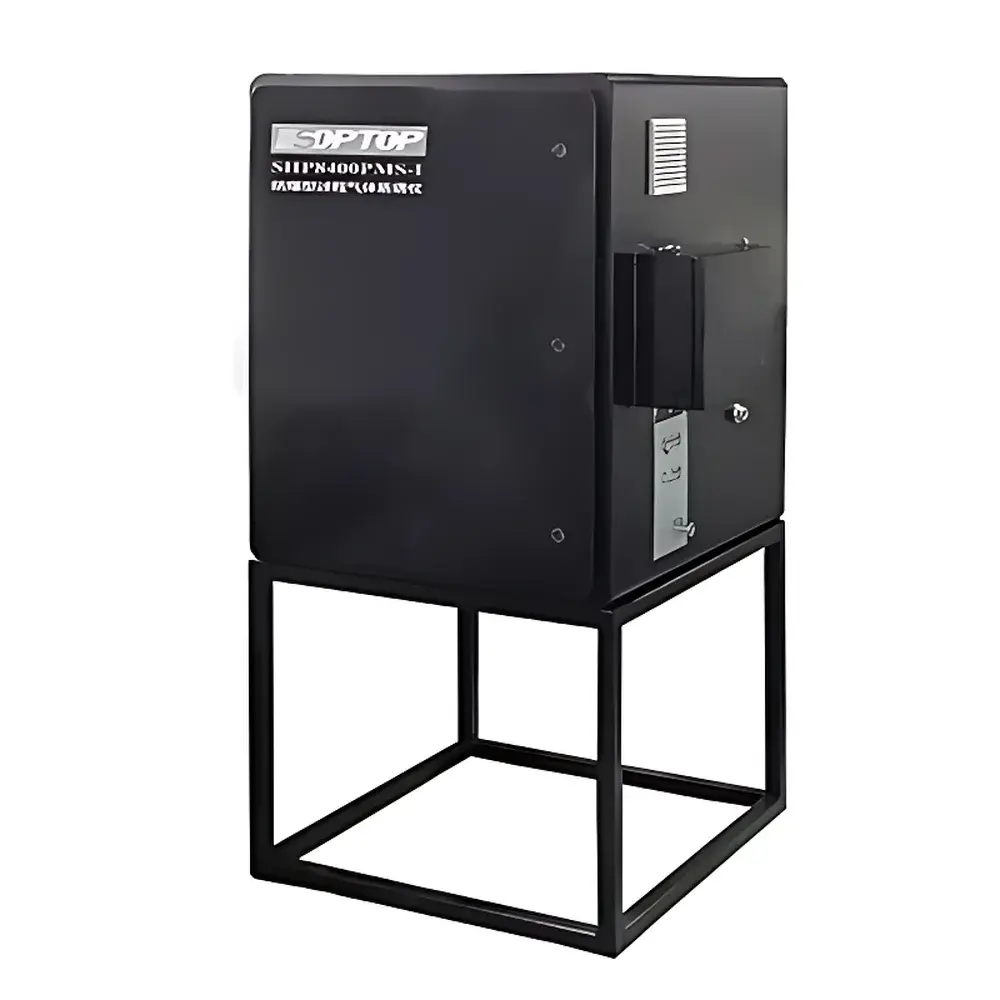
SOPTOP SHP8400PMS-I Intrinsically Safe Process Gas Mass Spectrometer
| Brand | SOPTOP |
|---|---|
| Origin | Shanghai, China |
| Model | SHP8400PMS-I |
| Price Range | USD 140,000 – 280,000 |
| Certifications | Ex d IIB T4 Gb / IP66 |
| Detection Principle | Quadrupole Mass Spectrometry (QMS) |
| Mass Range | 1–100 amu (standard), up to 300 amu (optional) |
| Resolution | Unit mass resolution (M/ΔM ≥ 100 at 10% valley) |
| Detection Limit | <1 ppm (for N₂, O₂, CH₄, CO, CO₂, H₂, Ar, etc.) |
| Sampling Channels | Up to 16 independent gas inlets with sequential auto-switching |
| Vacuum System | Dual-stage: Turbo-molecular pump (≥ 300 L/s) + Dry scroll backing pump |
| Operating Temperature | −10 °C to +50 °C ambient |
| Response Time | <3 s per component (typical), <30 s for full 16-channel cycle |
| Data Output | Modbus TCP, OPC UA, 4–20 mA analog outputs (configurable) |
| Compliance | IEC 60079-0/-1/-11, GB 3836.1/2/4, ISO/IEC 17025 (when operated per validated SOP) |
Overview
The SOPTOP SHP8400PMS-I Intrinsically Safe Process Gas Mass Spectrometer is a ruggedized, certified industrial-grade quadrupole mass spectrometer engineered for continuous, real-time compositional analysis of process gases in hazardous environments. Unlike laboratory-based benchtop MS systems, the SHP8400PMS-I integrates explosion-proof mechanical design (Ex d IIB T4 Gb), IP66-rated enclosure, and fully sealed internal gas pathways to meet stringent ATEX/IECEx and GB 3836 requirements for Zone 1/21 installations. Its core analytical principle relies on electron ionization (EI) at 70 eV followed by mass filtering via a temperature-stabilized RF/DC quadrupole mass analyzer. The system delivers unit-mass resolution across a standard 1–100 amu range—sufficient to resolve critical process species including H₂ (2 amu), He (4 amu), CH₄ (16 amu), NH₃ (17 amu), H₂O (18 amu), CO (28 amu), N₂ (28 amu), C₂H₄ (28 amu), O₂ (32 amu), CO₂ (44 amu), and Ar (40 amu)—with baseline separation of isobaric interferences (e.g., N₂ vs. CO) enabled by optimized ion optics and dwell-time allocation algorithms.
Key Features
- Intrinsically safe architecture compliant with IEC 60079-11 and GB 3836.4 for use in flammable gas atmospheres (IIB group, T4 temperature class)
- Integrated temperature-compensated electronic pressure control (EPC) system ensuring stable ion source pressure (1–5 × 10⁻⁵ mbar) despite upstream sample pressure fluctuations (0.1–1.5 bar(g))
- Mass axis stability ≤ ±0.1 amu over 72 hours—achieved via dual-point mass calibration and real-time thermal drift correction using reference peaks (e.g., N₂⁺, O₂⁺)
- Multi-stream sampling manifold supporting up to 16 independently valved gas inlets with programmable cycle sequencing, dwell time allocation, and automatic leak-check routines
- Self-diagnostic vacuum monitoring: real-time readout of turbo pump speed, scroll pump current, chamber pressure (Pirani + cold cathode gauges), and filament emission current
- No consumables required: eliminates carrier gas, detector gases, chromatographic columns, or sacrificial filaments typical of GC-based systems
Sample Compatibility & Compliance
The SHP8400PMS-I is validated for direct analysis of wet, corrosive, and particulate-laden process streams—including syngas, refinery off-gases, fermentation headspace, chlor-alkali vent streams, and semiconductor etch exhaust—without pre-concentration or cryo-trapping. Sample conditioning is limited to heated stainless-steel filters (1 µm), PTFE-lined capillary lines, and optional catalytic converters for NOₓ/NO₂ speciation. All wetted materials conform to ASTM F838-20 (bacterial retention) and USP Class VI biocompatibility standards. The instrument supports audit-ready operation under GLP/GMP frameworks: raw spectral data, calibration logs, alarm history, and user action timestamps are stored with SHA-256 hashing and write-once-read-many (WORM) archival options. Full traceability aligns with FDA 21 CFR Part 11 requirements when deployed with SOPTOP’s optional secure authentication module.
Software & Data Management
SOPTOP MassView™ v4.2 provides browser-based configuration, real-time spectrum visualization, multi-component quantification (internal standard or response factor methods), and automated reporting (PDF/CSV/Excel). The software implements ISO/IEC 17025-compliant uncertainty propagation models for concentration results, incorporating ion transmission efficiency, detector gain drift, and calibration curve nonlinearity. Data export supports Modbus TCP and OPC UA protocols for seamless integration into DCS/SCADA systems (e.g., Emerson DeltaV, Honeywell Experion, Siemens PCS7). Historical trend databases retain >10 years of second-level resolution data with configurable compression; all datasets are timestamped to UTC with NTP synchronization and support SQL query interfaces for MES/LIMS interoperability.
Applications
- Real-time hydrogen purity monitoring in PEM electrolyzer stacks (H₂ ≥ 99.99 vol%)
- Ammonia synthesis loop composition control (N₂:H₂ ratio, CH₄, Ar, H₂O)
- Fermentation off-gas profiling for metabolic flux analysis (O₂ uptake rate, CO₂ evolution rate, ethanol vapor)
- Refinery fluid catalytic cracking (FCC) regenerator flue gas O₂/CO/CO₂ optimization
- Semiconductor fab tool exhaust monitoring for NF₃, Cl₂, SiH₄, and HF abatement efficiency verification
- Landfill gas CH₄/CO₂/N₂/O₂ ratio tracking for energy recovery compliance (EPA Method 3C)
FAQ
What certifications does the SHP8400PMS-I hold for hazardous area installation?
It carries IECEx and CNEx certification to IEC 60079-0/-1/-11 (Ex d IIB T4 Gb), plus IP66 ingress protection rating—validating suitability for Zone 1 gas environments per Directive 2014/34/EU.
Can the system quantify isotopic ratios (e.g., ¹³CO₂/¹²CO₂)?
Yes—unit-resolution QMS enables baseline separation of 44/45/46 amu peaks; quantitative isotopic analysis requires factory-installed high-transmission ion optics and custom calibration standards.
Is remote firmware update supported without physical access?
Yes—over-the-air (OTA) updates are delivered via TLS 1.2-encrypted HTTPS; each update package includes cryptographic signature verification and rollback capability.
How is long-term mass calibration stability verified in practice?
A built-in reference gas inlet (optional N₂/Ar mixture) enables automated weekly mass calibration checks; deviation logs are exported to CSV and trigger alerts if >0.08 amu drift is detected.
Does the system comply with cybersecurity standards for OT networks?
It meets IEC 62443-3-3 SL2 requirements: disabled Telnet/FTP, mandatory TLS 1.2+ for web interface, role-based access control (RBAC), and configurable network lockdown modes (e.g., Modbus-only port isolation).





