
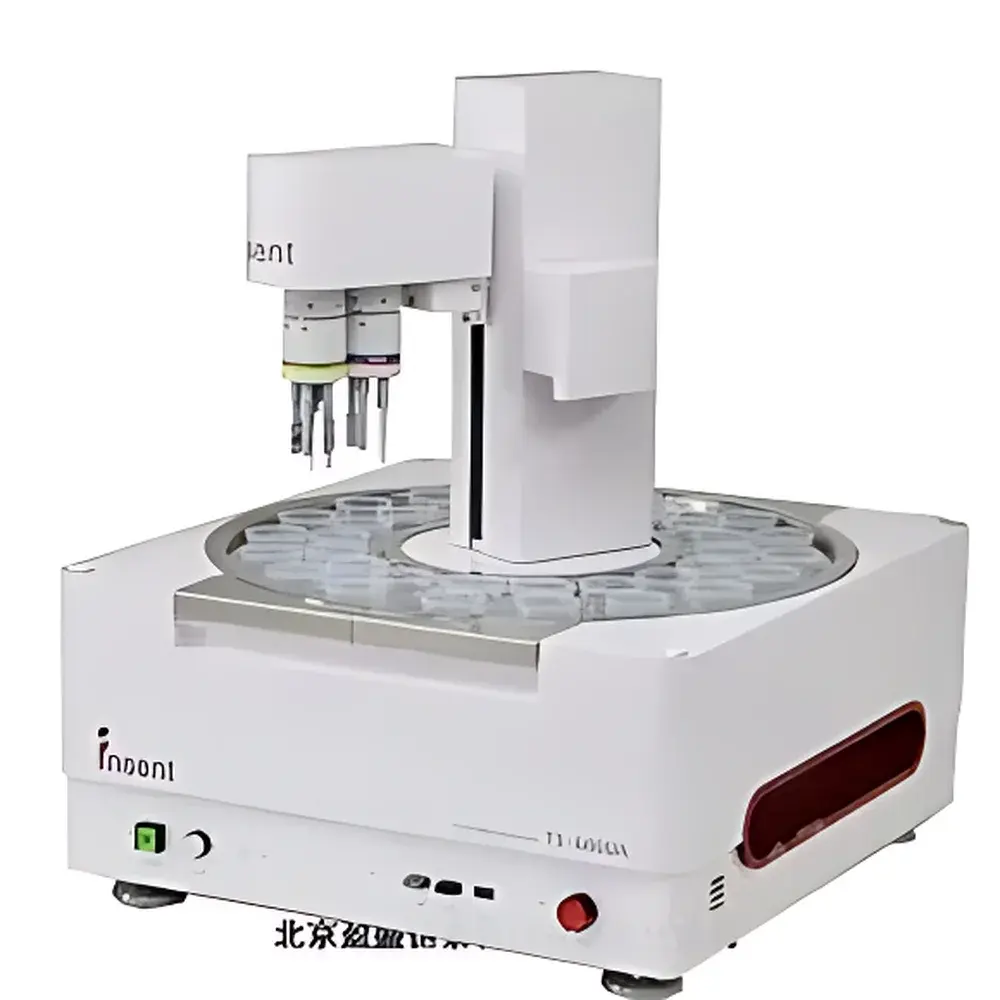
INSENT TS-5000Z Professional Taste Sensing System
| Brand | INSENT (Japan) |
|---|---|
| Origin | Japan |
| Type | Electronic Tongue / Taste Sensory Analyzer |
| Model | TS-5000Z |
| Sensor Technology | Artificial Lipid Membrane Sensors |
| Measurement Parameters | Sourness, Sweetness, Bitterness, Saltiness, Umami, Astringency, and Aftertastes (Bitter, Astringent, Umami Richness) |
| Compliance | Designed for GLP/GMP-aligned sensory laboratories |
| Software | TS-5000Z Analysis Suite with Audit Trail & Data Export (CSV, PDF, PNG) |
| Interface | Touchscreen GUI with Wizard-Based Operation |
| Data Management | Integrated Server-Side Storage with User Access Control |
Overview
The INSENT TS-5000Z Professional Taste Sensing System is a high-fidelity electronic tongue platform engineered for objective, quantitative assessment of taste profiles in liquid and semi-liquid samples. Unlike conventional chemical assays or subjective human sensory panels, the TS-5000Z employs an array of artificial lipid membrane sensors—each chemically tuned to mimic the ion-channel–mediated response mechanisms of human taste receptor cells. These sensors generate voltage potential shifts upon interaction with tastants (e.g., organic acids, amino acids, alkaloids, salts), which are converted into reproducible, multivariate taste fingerprints. The system operates on the principle of cross-sensitive sensor response patterns, where principal component analysis (PCA) and discriminant function analysis (DFA) extract discriminative features across six primary taste modalities and three aftertaste dimensions. It is calibrated and validated per ISO 11132:2020 (Sensory analysis — Methodology — General guidance for sensory evaluation of food and beverages) and supports traceable measurement protocols required in pharmaceutical development (USP and ICH Q5E) and food quality assurance.
Key Features
- Eight-channel artificial lipid membrane sensor array with differential selectivity for sourness, sweetness, bitterness, saltiness, umami, astringency, and their respective aftertaste kinetics
- Real-time signal acquisition at 10 Hz sampling rate, enabling temporal profiling of taste onset, peak intensity, and decay dynamics
- Integrated temperature-controlled sample chamber (25 ± 0.1 °C) ensuring thermal stability critical for lipid membrane response fidelity
- Touchscreen interface with guided workflow wizard—no programming expertise required for method setup, calibration, or batch analysis
- Macro scripting capability for automated sequence execution (e.g., rinse–measure–clean cycles across 96-well plate formats)
- Electromagnetic interference (EMI)-shielded sensor housing and grounded analog front-end architecture, delivering signal-to-noise ratios >72 dB under industrial laboratory conditions
- Onboard data encryption and role-based user authentication aligned with FDA 21 CFR Part 11 requirements for electronic records and signatures
Sample Compatibility & Compliance
The TS-5000Z accepts aqueous extracts, beverages, sauces, oral suspensions, dissolution media, and homogenized food slurries (viscosity ≤ 50 mPa·s). Samples require no derivatization or pre-concentration; filtration through 0.45 µm PVDF membranes is recommended to prevent sensor fouling. The system conforms to ISO/IEC 17025:2017 for testing laboratories and supports audit-ready documentation—including calibration logs, sensor lifetime tracking, and full measurement metadata (time stamp, operator ID, environmental parameters). Sensor cartridges are certified for ≥ 500 measurements per set and are replaceable without recalibration. All firmware and software updates undergo internal verification per ASTM E2500-13 (Standard Guide for Specification, Design, and Verification of Pharmaceutical and Biopharmaceutical Manufacturing Systems).
Software & Data Management
The TS-5000Z Analysis Suite runs on Windows 10 IoT Enterprise and provides dual-mode operation: standalone instrument control and networked server deployment. Core modules include Sensor Response Visualization, PCA/DFA Workspace, Taste Pattern Comparison Engine, and Time-Series Aftertaste Kinetics Plotter. All raw voltage traces and processed metrics are stored in an encrypted SQLite database with automatic daily backup to configurable NAS or cloud endpoints (AWS S3 or Azure Blob, optional). Audit trails record every user action—including parameter edits, report generation, and sensor replacement—with immutable timestamps and digital signatures. Export formats include CSV (for statistical packages such as JMP or R), PDF (print-ready reports with embedded spectra), and PNG (publication-grade graphics with DPI ≥ 300).
Applications
- Pharmaceutical: Quantification of bitter taste intensity in API formulations; evaluation of taste-masking efficacy of cyclodextrin complexes or ion-exchange resins; correlation studies between e-tongue output and human sensory panel data (r ≥ 0.89, n = 42, peer-reviewed validation)
- Food & Beverage: Shelf-life modeling based on umami degradation kinetics; origin authentication of soy sauce via taste fingerprint clustering; reformulation support for sodium reduction while preserving saltiness perception
- Quality Control: Rapid lot-release testing for off-taste detection (e.g., lipid oxidation in dairy powders); supplier consistency monitoring using Mahalanobis distance thresholds
- Regulatory Support: Generation of objective taste dossiers for health claim substantiation (EFSA Panel on Dietetic Products, Nutrition and Allergies) and pediatric formulation approval (FDA Guidance for Industry: Pediatric Formulations, 2022)
FAQ
How does the TS-5000Z differ from generic potentiometric sensor arrays?
It uses biologically inspired lipid membranes—not metal oxides or conductive polymers—enabling selective, reversible, and physiologically relevant responses to low-molecular-weight tastants.
Can the system quantify taste intensity on an absolute scale (e.g., “bitterness units”)?
No. It delivers relative, multivariate pattern scores normalized against reference standards (e.g., 1 mM quinine HCl for bitterness), consistent with ISO 8586:2014 sensory scaling conventions.
Is sensor recalibration required between sample batches?
A standardized rinse cycle (deionized water + ethanol wash) suffices for carryover control; full recalibration is only needed after cartridge replacement or quarterly verification.
Does the software support integration with LIMS or ERP systems?
Yes—via RESTful API (JSON over HTTPS) and ODBC-compliant database connectors, enabling bidirectional data exchange with LabVantage, Thermo Fisher SampleManager, and SAP QM modules.
What is the typical throughput for routine QC testing?
Approximately 30 samples per hour, including cleaning, calibration verification, and report generation—scalable to 120+ samples/day using optional autosampler integration.





