
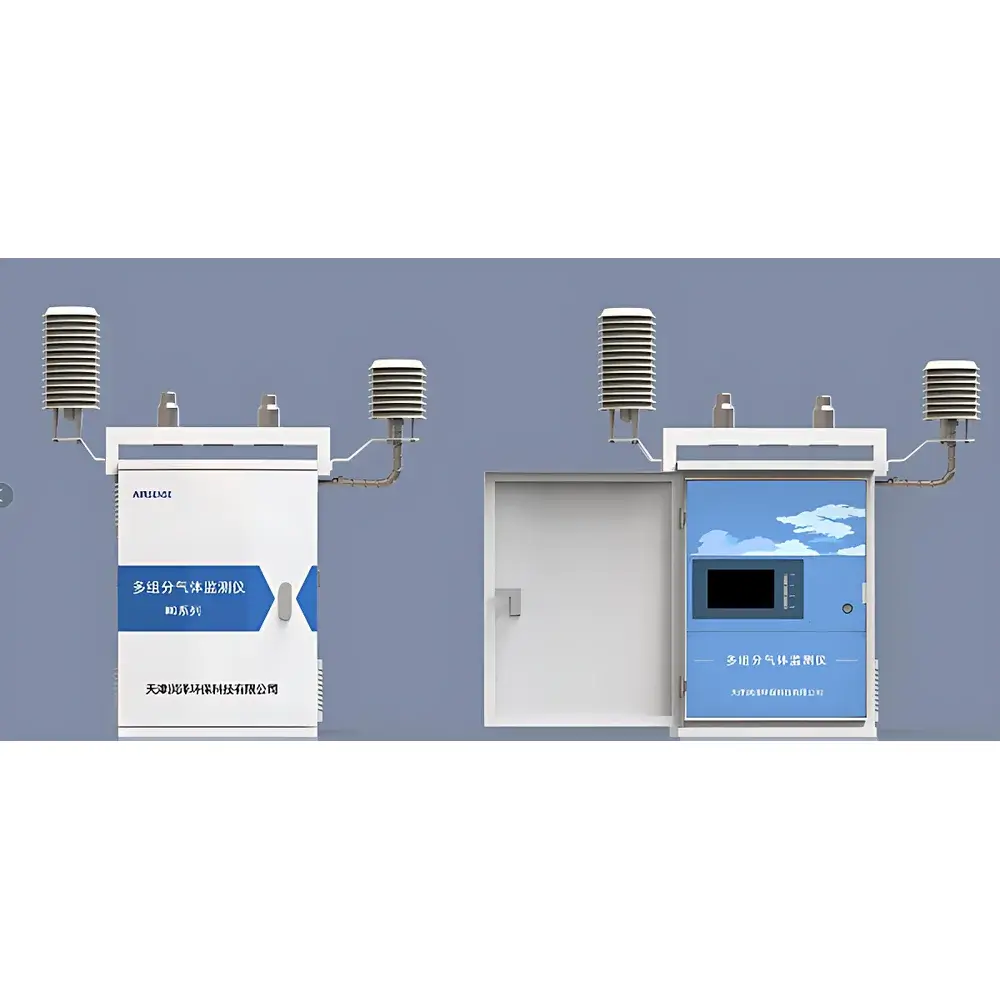
Ruzehuanbao MG Series Grid-Based Online Multicomponent Gas Analyzer
| Origin | Tianjin, China |
|---|---|
| Manufacturer Type | Authorized Distributor |
| Model | MG Series |
| Pricing | Available Upon Request |
| Measurement Principle | Electrochemical Sensing (with optional PID for VOCs) |
| Configuration | Fixed-Installation Online Analyzer |
| Response Time | < 30 s (typical for electrochemical sensors) |
| Repeatability | ±2% FS for H₂S, NH₃, CH₃SH, (CH₃)₂S, CH₃SSCH₃, CS₂, C₈H₈, (CH₃)₃N, NOₓ, O₃ |
| Detectable Gases | H₂S, NH₃, CH₃SH, (CH₃)₂S, CH₃SSCH₃, CS₂, C₈H₈, (CH₃)₃N, NOₓ, O₃, SO₂, VOCs (via PID), and derived odor unit (OU) calculation per GB/T 14675–2023 and EN 13725:2022 |
Overview
The Ruzehuanbao MG Series Grid-Based Online Multicomponent Gas Analyzer is an engineered solution for continuous, real-time monitoring of toxic and odorous industrial gases in ambient air. Designed for fixed-site deployment within environmental regulatory frameworks, the system employs selective electrochemical sensing technology—complemented by photoionization detection (PID) for volatile organic compounds (VOCs)—to quantify up to ten target analytes simultaneously. Its core operational principle relies on diffusion-controlled electrochemical oxidation/reduction at gas-permeable working electrodes, generating current signals linearly proportional to analyte concentration. Calibration traceability follows ISO/IEC 17025–compliant procedures, with sensor outputs referenced to NIST-traceable standard gas mixtures. The analyzer supports dynamic odor assessment by computing odor units (OU) in accordance with Chinese national standard GB/T 14675–2023 and European reference method EN 13725:2022, enabling quantitative correlation between chemical composition and human-perceived odor intensity. It is intended for permanent installation in municipal environmental monitoring stations, industrial park boundary zones, landfill perimeter networks, wastewater treatment facilities, and pharmaceutical manufacturing sites where regulatory compliance and emission source attribution are operationally critical.
Key Features
- Simultaneous quantification of up to 10 preconfigured gases—including H₂S, NH₃, CH₃SH, (CH₃)₂S, CH₃SSCH₃, CS₂, styrene, (CH₃)₃N, NOₓ, O₃, SO₂, and broad-spectrum VOCs—with modular sensor slots supporting user-selectable configurations (4-, 6-, or 8-gas variants).
- Ruggedized enclosure rated IP65 for dust and water resistance; integrated mounting flanges enable secure wall or pole mounting in outdoor or semi-outdoor environments.
- Dual communication architecture: RS-485 Modbus RTU (compliant with HJ 212–2017 data transmission protocol) and optional LTE/WiFi wireless telemetry, supporting multi-device network topology for spatially distributed grid monitoring.
- Hot-swappable intelligent electrochemical and PID sensor modules—each with embedded calibration memory, serial number, and lifetime tracking—enabling field replacement without system downtime or recalibration of adjacent channels.
- Open API and standardized Modbus TCP/RTU interfaces facilitate integration into SCADA systems, centralized environmental data platforms (e.g., EPA AirNow-compatible dashboards), and third-party LIMS or EMS software.
- Configurable operational parameters—including sampling interval (1–30 min), automatic zero/span cycle timing, sensor cleaning duration, and alarm thresholds—accessible via local touchscreen or remote web interface.
- Native interoperability with electronic nose systems and automated gas sampling controllers for synchronized multi-modal odor characterization and time-resolved plume mapping.
Sample Compatibility & Compliance
The MG Series is validated for continuous measurement of gaseous pollutants in ambient air matrices across temperature ranges of −20 °C to +50 °C and relative humidity up to 90% RH (non-condensing). Sensor cross-sensitivity profiles have been characterized per IEC 60079-29-1 for hazardous area suitability (Zone 2/22 classification pending external certification). All electrochemical sensors meet RoHS Directive 2011/65/EU requirements and are manufactured under ISO 9001:2015 quality management systems. Data integrity complies with GLP-aligned audit trail functionality: all configuration changes, calibration events, alarm triggers, and firmware updates are timestamped and logged with operator ID (where authenticated). The system supports 21 CFR Part 11–compatible electronic signatures when deployed with validated authentication middleware.
Software & Data Management
Embedded firmware provides local data buffering (≥30 days at 1-min resolution) and configurable alarm logic (threshold-based, rate-of-change, and duration-weighted alerts). The optional Ruzehuanbao Cloud Platform enables remote device management, over-the-air firmware updates, and multi-site dashboard visualization. Raw sensor outputs are stored in CSV/JSON format with metadata tags (sensor ID, calibration date, ambient T/RH, GPS coordinates if equipped). Trend analysis tools generate time-series plots, moving averages, and OU evolution curves. Exported datasets conform to AQMS (Ambient Air Quality Monitoring System) schema requirements defined in HJ 653–2013 and support direct ingestion into national environmental information systems compliant with China’s Ministry of Ecology and Environment (MEE) technical specifications.
Applications
- Regulatory boundary monitoring at chemical parks and industrial clusters under MEE Order No. 15 (2020) and local odor emission control ordinances.
- Odor impact assessment near landfills, composting facilities, and sewage pumping stations using OU-based compliance reporting.
- Real-time fugitive emission detection and source localization through dense sensor grid deployments (e.g., 50–200 m node spacing).
- Process safety interlocks in pharmaceutical synthesis areas where H₂S, ClH, or VOC excursions pose acute toxicity risks.
- Long-term trend analysis for riverbank and wetland air quality studies—correlating diurnal/seasonal gas profiles with hydrological and meteorological variables.
FAQ
What standards does the MG Series comply with for odor unit calculation?
It implements odor concentration algorithms aligned with GB/T 14675–2023 (Chinese national standard) and EN 13725:2022 (European reference method), using weighted sum models based on individual compound thresholds and dilution-to-threshold ratios.
Can the system operate in explosive atmospheres?
The base unit meets IP65 ingress protection; intrinsic safety certification (e.g., ATEX or IECEx) requires optional explosion-proof housing and sensor-specific certification—available upon request with third-party validation.
How is sensor drift managed during long-term unattended operation?
Automatic zero/span verification cycles (configurable frequency), temperature/pressure compensation algorithms, and dual-point calibration logs ensure measurement stability; recommended quarterly verification against certified span gases per ISO 12039.
Is cloud data storage mandatory?
No—local SD card logging and Modbus TCP output allow fully offline operation; cloud connectivity is optional and governed by customer-defined data residency policies.
What maintenance intervals are recommended?
Electrochemical sensors require replacement every 12–24 months depending on exposure profile; PID lamps every 18 months; full system functional check every 6 months per manufacturer’s PM checklist (included in documentation).







