
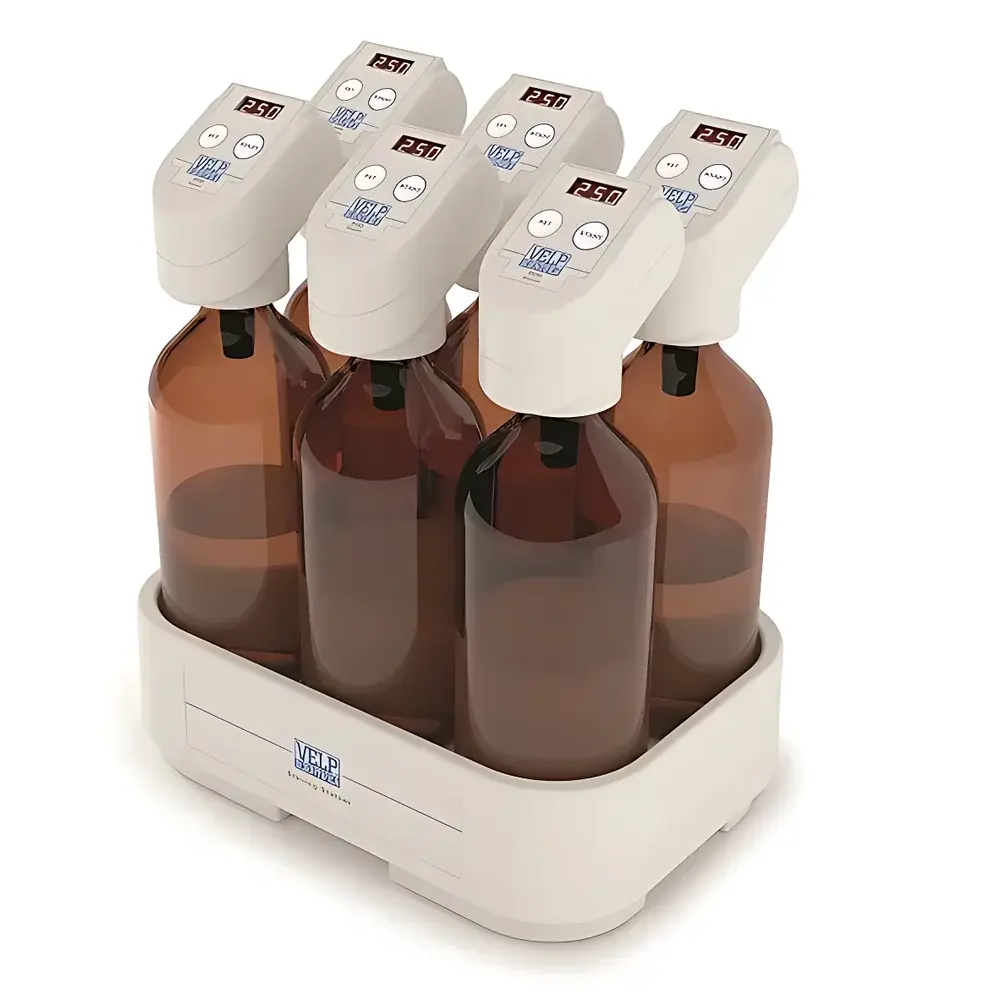
VELP BOD6/20 and BMS6/10 Biochemical Oxygen Demand Analyzers
| Brand | VELP |
|---|---|
| Origin | Italy |
| Model Series | BOD6/20, BMS6/10 |
| Instrument Type | Laboratory BOD Analyzer |
| Measurement Principle | Dissolved Oxygen (DO) Consumption Method |
| Sensor Technology | Mercury-Free Electronic Pressure Sensor |
| BOD Range Options | 90, 250, 600, 1000 ppm |
| Data Logging | Automatic storage of up to five BOD values at 24-hour intervals |
| Compliance | Designed for ISO 5815-1:2017 and ASTM D5210-92 (Standard Test Method for Determining Anaerobic Biodegradation of Organic Compounds in the Presence of Municipal Sewage) |
Overview
The VELP BOD6/20 and BMS6/10 Biochemical Oxygen Demand (BOD) Analyzers are laboratory-grade instruments engineered for precise, standardized assessment of organic pollution load in aqueous samples. These systems operate on the fundamental principle of measuring oxygen depletion over time—specifically, the amount of dissolved oxygen (DO) consumed by aerobic microorganisms during the biochemical oxidation of biodegradable organic matter under controlled incubation conditions (20 °C for 5 days, per ISO 5815-1:2017). Unlike manometric or titrimetric methods requiring manual intervention, the VELP platform employs a mercury-free electronic pressure sensor to monitor headspace pressure changes resulting from oxygen uptake—enabling indirect yet highly reproducible quantification of BOD without chemical reagents or mercury-based components. This approach aligns with modern environmental laboratory priorities: regulatory compliance, operator safety, and long-term instrument stability.
Key Features
- Mercury-free electronic pressure transduction system eliminates hazardous material handling and supports global RoHS and WEEE compliance.
- Dual-platform configuration: BOD6/20 for standard 6-sample capacity with 20 °C incubation control; BMS6/10 optimized for 10-day extended BOD testing (BOD10) with enhanced thermal stability.
- Integrated incubation chamber with PID-controlled temperature regulation (±0.2 °C tolerance at 20 °C), conforming to ISO 5815-1:2017 thermal requirements.
- Automated data acquisition architecture logs one BOD result per 24-hour interval, retaining up to five sequential measurements per sample vial—supporting multi-point kinetic profiling.
- Rugged, corrosion-resistant housing designed for continuous operation in accredited environmental testing laboratories adhering to ISO/IEC 17025 quality management systems.
- Calibration traceability supported via documented sensor zero-point verification and reference gas validation protocols.
Sample Compatibility & Compliance
The BOD6/20 and BMS6/10 accommodate standard 300 mL BOD bottles (glass or PET) with integrated septa-sealed caps. Sample types include raw and treated wastewater, surface water, groundwater, effluents from industrial discharges, and biodegradability screening matrices (e.g., OECD 301 series test media). Instrument design and operational methodology comply with ISO 5815-1:2017 (Water quality — Determination of biochemical oxygen demand after n days — Part 1: BOD5), ASTM D5210-92 (Standard Test Method for Determining Anaerobic Biodegradation), and EU Directive 2000/60/EC (Water Framework Directive) monitoring guidelines. While not inherently 21 CFR Part 11–compliant, the systems support integration into validated LIMS environments through ASCII-exported data files and timestamped audit trails generated during measurement cycles.
Software & Data Management
Data output is delivered as plain-text CSV files with embedded metadata: sample ID, start/end timestamps, incubation temperature, recorded pressure differentials, and calculated BOD concentration (ppm) based on preconfigured dilution factors and headspace volume parameters. No proprietary software is required; files are compatible with common spreadsheet applications and laboratory informatics platforms. For GLP/GMP-aligned operations, users may implement external validation protocols—including instrument qualification (IQ/OQ/PQ), electronic signature workflows, and periodic sensor drift assessments using certified air/N₂ calibration gases. VELP provides comprehensive technical documentation, including calibration certificates, uncertainty budgets, and method verification reports upon request.
Applications
- Regulatory wastewater discharge monitoring per national environmental protection agency requirements (e.g., US EPA Method 405.1, UK Environment Agency WFD monitoring).
- Performance evaluation of biological treatment processes in activated sludge, trickling filter, and MBR systems.
- Ecotoxicological screening of industrial effluents and formulation intermediates under OECD 301B/C/D frameworks.
- Research-scale biodegradability studies in academic and contract research laboratories.
- Quality assurance of drinking water source protection programs and watershed health assessments.
FAQ
What BOD ranges are supported by the VELP BOD6/20 and BMS6/10 systems?
The analyzers are configured for four discrete BOD measurement ranges: 90 ppm, 250 ppm, 600 ppm, and 1000 ppm—selected via hardware jumper settings prior to assay initiation.
Is temperature control fully automated and compliant with ISO 5815-1?
Yes. Both models feature an integrated, PID-regulated incubation chamber maintaining 20.0 ± 0.2 °C throughout the 5-day (or 10-day) test period, satisfying ISO 5815-1:2017 thermal stability criteria.
How is data integrity ensured without onboard software or database storage?
Each measurement cycle generates a timestamped, immutable CSV file with embedded instrument ID, operator code (manually entered), and environmental metadata—enabling full traceability within externally managed QA/QC systems.
Can the systems be used for seeded BOD testing of low-BOD or inhibitory samples?
Yes. The pressure-sensing architecture accommodates seeded assays when combined with appropriate microbial inoculum (e.g., domestic sewage supernatant) and nitrification inhibition (e.g., allylthiourea), following ISO 5815-1 Annex C protocols.
Does VELP provide installation qualification (IQ) and operational qualification (OQ) documentation?
VELP supplies manufacturer-provided IQ/OQ templates aligned with ISO/IEC 17025 and GxP expectations; site-specific execution and verification remain the responsibility of the end-user’s qualified personnel.
Related Products







