
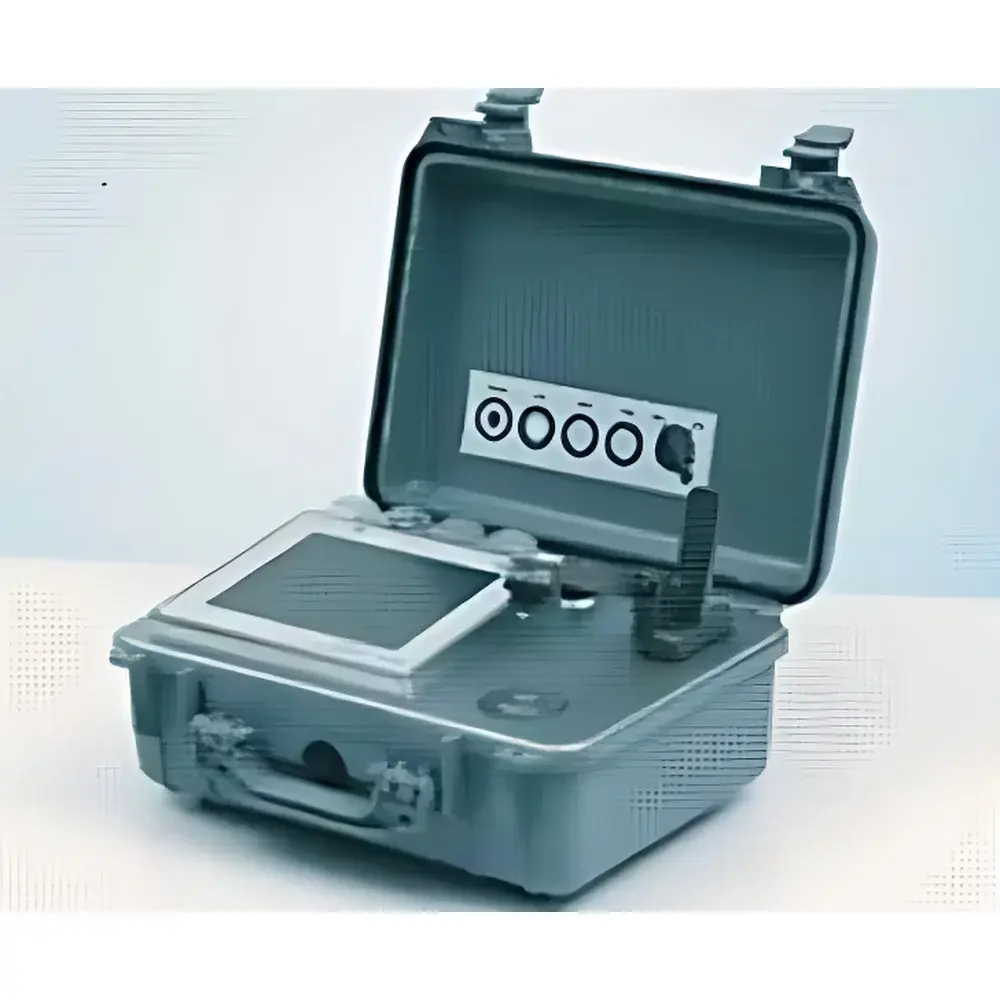
AIRSENSE M-IR Portable Fourier Transform Infrared (FTIR) Chemical Identification System
| Brand | AIRSENSE |
|---|---|
| Origin | Germany |
| Manufacturer Type | Authorized Distributor |
| Product Origin | Imported |
| Model | M-IR |
| Pricing | Available Upon Request |
Overview
The AIRSENSE M-IR Portable Fourier Transform Infrared (FTIR) Chemical Identification System is an engineered field-deployable analytical instrument designed for rapid, on-site qualitative identification of unknown chemical substances under exigent conditions—including fire scenes, industrial accidents, hazardous material (HAZMAT) incidents, earthquake-damaged zones, and other extreme operational environments. Based on the fundamental principle of molecular vibrational spectroscopy, the M-IR detects characteristic absorption bands in the mid-infrared region (typically 4000–600 cm⁻¹), where functional groups (e.g., C=O, O–H, N–H, C–Cl) exhibit unique spectral fingerprints. Unlike dispersive spectrometers, the M-IR employs a Michelson interferometer and Fourier transformation to deliver high-fidelity spectra with excellent signal-to-noise ratio (SNR) and wavelength accuracy—performance metrics comparable to benchtop FTIR systems. Its core optical architecture integrates a thermoelectrically cooled DTGS detector, precision-machined moving mirror mechanism, and robust beam alignment—ensuring long-term stability and measurement reproducibility even after repeated thermal cycling or mechanical shock.
Key Features
- ATR (Attenuated Total Reflection) sampling interface with diamond or ZnSe crystal—enabling direct, non-destructive analysis of solids, liquids, pastes, gels, and powders without sample preparation
- Compact, ruggedized design housed entirely within a MIL-STD-810G compliant portable carry case (IP67-rated enclosure for dust and water ingress protection)
- Integrated embedded computer with 10.1-inch capacitive multi-touch display—operable with gloves and in low-visibility conditions
- Explosion-proof construction certified to ATEX/IECEx Zone 1 (II 2G Ex ib IIB T4 Gb) and UL Class I, Division 1 standards
- Full decontamination capability: entire unit withstands aqueous and alcohol-based decon protocols without performance degradation
- Wireless connectivity via Wi-Fi 5 (802.11ac) and Bluetooth 5.0 for real-time data export, remote diagnostics, and over-the-air library updates
Sample Compatibility & Compliance
The M-IR accommodates a broad range of physical sample forms—including volatile organic liquids, polymer fragments, pharmaceutical tablets, biological tissues, soil extracts, and viscous industrial residues—without dilution, grinding, or solvent extraction. Its ATR geometry minimizes pathlength variability and eliminates atmospheric CO₂/H₂O interference through real-time background subtraction. The system complies with ISO 17025 requirements for field instrumentation used in accredited testing laboratories. Spectral libraries are curated against reference standards traceable to NIST SRMs and validated per ASTM E1421 (Standard Practice for Describing and Measuring Performance of FTIR Spectrometers). For regulated environments, audit trail functionality and user access controls support compliance with FDA 21 CFR Part 11 and EU Annex 11 when operated with optional OPUS/Mentor GLP mode.
Software & Data Management
The embedded OPUS/Mentor software suite provides guided workflow navigation—from spectrum acquisition and atmospheric compensation to library search, hit quality indexing (HQI), and report generation. Search algorithms employ both correlation matching and Euclidean distance minimization across a preloaded database of >14,000 reference spectra covering toxic industrial chemicals (TICs), chemical warfare agents (CWAs), pharmaceuticals, polymers, and environmental contaminants. Users may import custom spectral entries in JCAMP-DX format and assign metadata (CAS number, hazard class, SDS link). All spectral acquisitions, processing parameters, operator ID, GPS coordinates (via optional GNSS module), and timestamped audit logs are stored in encrypted SQLite databases compliant with IEC 62443-3-3 security profiles.
Applications
- First responder chemical threat identification at CBRNe incident sites
- Post-disaster environmental screening for residual organophosphates, halogenated hydrocarbons, or nitroaromatic explosives
- In-field verification of raw material identity in pharmaceutical manufacturing (per USP )
- Forensic trace evidence analysis of adhesives, paints, and illicit drug cutting agents
- Regulatory inspection of industrial effluents and landfill leachates
- Academic field chemistry education and mobile lab deployments
FAQ
Does the M-IR require external calibration standards for routine operation?
No. The system performs automatic internal calibration using built-in polystyrene and water vapor reference peaks prior to each measurement cycle.
Can spectral libraries be updated in offline field environments?
Yes. Libraries are distributed as signed .oplib packages; updates can be loaded via USB 3.0 or pre-synced SD card without internet connectivity.
Is spectral resolution adjustable during acquisition?
Yes. Users may select nominal resolutions of 4 cm⁻¹, 8 cm⁻¹, or 16 cm⁻¹ depending on required peak discrimination versus measurement speed.
What is the typical measurement time per sample?
Single-spectrum acquisition takes 5–10 seconds; full identification (including search and confidence scoring) completes within 15–25 seconds.
How is data integrity ensured during wireless transmission?
All exported datasets include SHA-256 checksums and digital signatures; TLS 1.2 encryption secures Wi-Fi transfers to authorized endpoints only.
Related Products







