
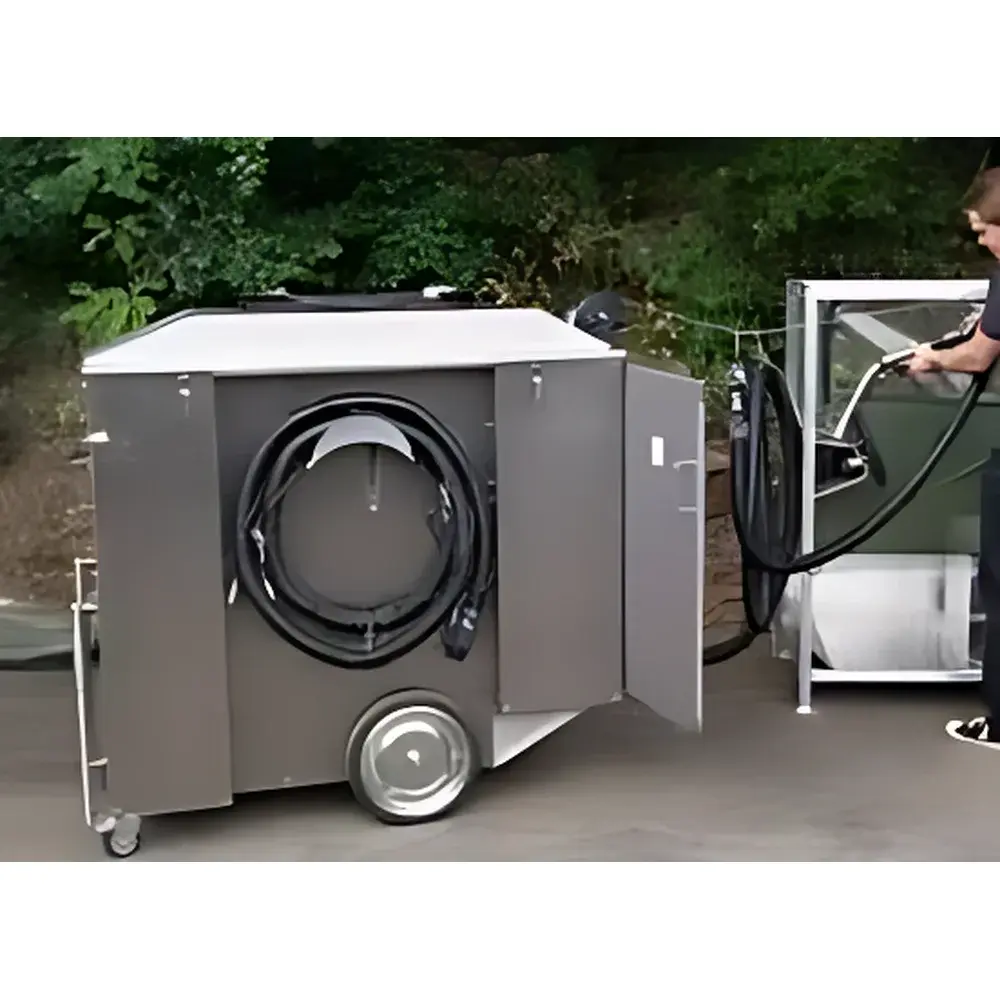
OWR Surf-Ex Nuclear, Biological, Chemical & Explosive (NBC/E) Decontamination System
| Brand | AIRSENSE |
|---|---|
| Origin | Germany |
| Model | Surf-Ex |
| Certification | ATEX Zone 1 & Zone 21 compliant |
| Decontamination Method | Spray-Extraction with Integrated Vacuum Recovery |
| Max Effective Coverage | 200 cm (80 in) |
| Max Hose Extension Length | 15 m |
| Collection Capacity | Compatible with standard 20–60 L containment drums |
| Pump Type | Explosion-proof diaphragm pump |
| Inlet Diameter | Large-diameter suction port for bulk particulate and sorbent material removal |
| Application Scope | Surface decon of sensitive equipment interiors, aircraft fuselages, ship compartments, infrastructure, and contaminated soil/sorbents |
| Compliance | Meets EU Directive 2014/34/EU (ATEX), IEC 60079-0/-10/-14, and supports GLP-aligned documentation workflows |
Overview
The OWR Surf-Ex Nuclear, Biological, Chemical & Explosive (NBC/E) Decontamination System is an engineered solution for controlled, on-site decontamination of surfaces and porous media contaminated with radiological, biological, chemical, or explosive agents. Unlike conventional bottle washers or laboratory cleaning units, the Surf-Ex operates on a validated spray-extraction principle—applying decontaminants (e.g., GD-6, hypochlorite-based formulations, or pH-neutral chelating agents) directly onto the target surface via precision nozzles, followed by immediate vacuum-assisted recovery of the reaction mixture. This closed-loop methodology minimizes secondary dispersion, ensures quantitative removal of particulates—including alpha-emitting radionuclides—and preserves integrity of delicate substrates such as avionics housings, sensor arrays, and sealed instrumentation enclosures. Designed and manufactured in Germany by AIRSENSE, the system integrates intrinsic safety architecture to meet ATEX Zone 1 (gas/vapor) and Zone 21 (combustible dust) requirements—enabling deployment in high-risk environments including aircraft hangars, fuel depots, chemical storage facilities, and emergency response staging zones.
Key Features
- Explosion-proof enclosure certified to ATEX Directive 2014/34/EU (Category 2G for gases, Category 2D for dusts), IEC 60079-0, -10, and -14 standards
- Integrated spray-nozzle manifold with adjustable flow rate and pattern control for uniform reagent application
- High-vacuum diaphragm pump with chemical-resistant wetted materials (PTFE, EPDM, stainless steel 316), capable of handling slurries, gels, and granular sorbents
- Modular hose system supporting up to 15 m extension with quick-connect couplings and swappable terminal accessories (flat nozzles, crevice tools, soil scoops)
- Large-diameter suction inlet (≥80 mm) optimized for rapid removal of spent decontaminant, adsorptive media (e.g., vermiculite, ion-exchange resins), and contaminated soil
- Real-time operational feedback via pressure differential monitoring and vacuum level indicators
- Field-serviceable design with tool-free access to pump head, filter housing, and fluid path components
Sample Compatibility & Compliance
The Surf-Ex is validated for use across heterogeneous sample matrices: non-porous (stainless steel, aluminum, composites), semi-porous (painted surfaces, polymer-coated electronics), and highly porous substrates (concrete, soil, activated carbon filters). It accommodates a broad spectrum of EPA- and NATO-approved decontaminants—including oxidizing agents (e.g., Decon Green™), nucleophilic reagents (e.g., GD-6), and enzymatic formulations—without compromising pump integrity or seal longevity. The system supports traceability requirements under ISO/IEC 17025:2017 for testing laboratories and aligns with US Department of Defense MIL-STD-2051-1B (Decon Procedures) and IAEA Safety Standards Series No. SSG-46 (Radiological Emergency Response). Optional audit-trail logging modules enable compliance with FDA 21 CFR Part 11 when integrated into GxP-regulated decon validation protocols.
Software & Data Management
While the base Surf-Ex operates as a standalone electromechanical unit, optional digital add-ons include a CAN-bus enabled control module with RS-485/Modbus RTU interface for integration into facility-wide SCADA or CBRN command systems. Logged parameters—vacuum pressure, runtime, total fluid volume processed, and nozzle actuation cycles—are exportable in CSV or XML format. Firmware updates follow secure OTA (Over-The-Air) protocols with SHA-256 signature verification. All configuration changes are timestamped and user-ID tagged to satisfy GLP/GMP data integrity expectations. No cloud dependency is required; local SD-card storage ensures operability in offline or EMCON-constrained environments.
Applications
- Decontamination of aircraft interiors, flight control surfaces, and engine bays following suspected NBC exposure
- Rapid response cleanup of chemical spills in laboratories, pharmaceutical cleanrooms, or logistics hubs
- Remediation of alpha-contaminated equipment surfaces where dry wiping risks resuspension
- Soil and sorbent media processing during radiological incident recovery operations
- Pre-deployment conditioning of PPE, detection instruments, and mobile analytical platforms
- Validation of decon efficacy per ASTM E2994-15 (Standard Practice for Evaluating Decontamination Efficacy)
FAQ
Can the Surf-Ex be used indoors without ventilation support?
Yes—the integrated HEPA-filtered exhaust and sealed collection path prevent aerosol release, making it suitable for confined spaces including hangar bays and shielded labs.
Is GD-6 the only approved decontaminant?
No—GD-6 is one validated option; the system is chemically agnostic within pH 2–12 and solvent compatibility limits defined in the Material Compatibility Matrix (provided in Technical Dossier TD-SURF-EX-03).
Does the system require compressed air or external power sources?
It operates exclusively on 230 V AC ±10%, 50/60 Hz; no compressed air, steam, or auxiliary gas supply is needed.
How is residual moisture managed after decontamination?
The vacuum extraction removes >95% of free liquid; residual film drying is achieved passively or via optional heated air purge attachments (sold separately).
What maintenance intervals are recommended for field operation?
Diaphragm pump inspection every 200 operating hours; filter replacement every 10 cycles or after 50 L of slurry processed—documented via built-in service counter.



