
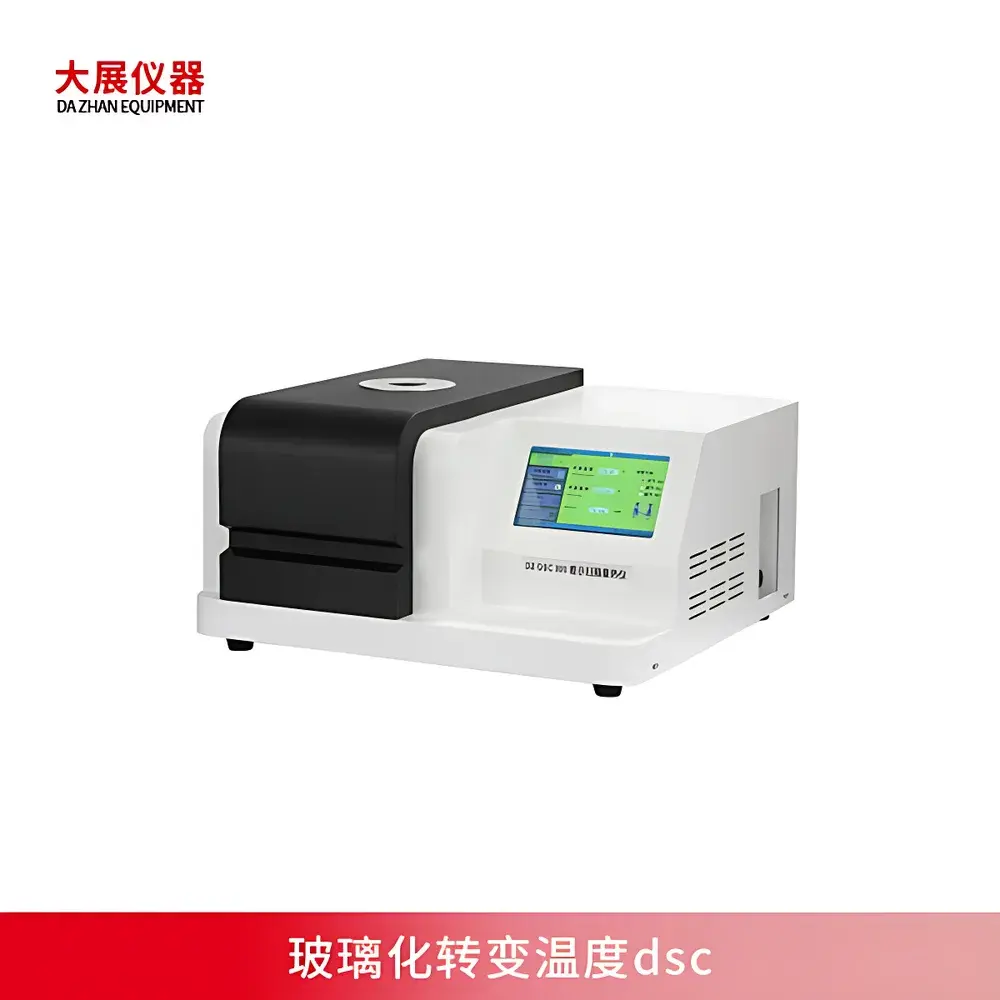
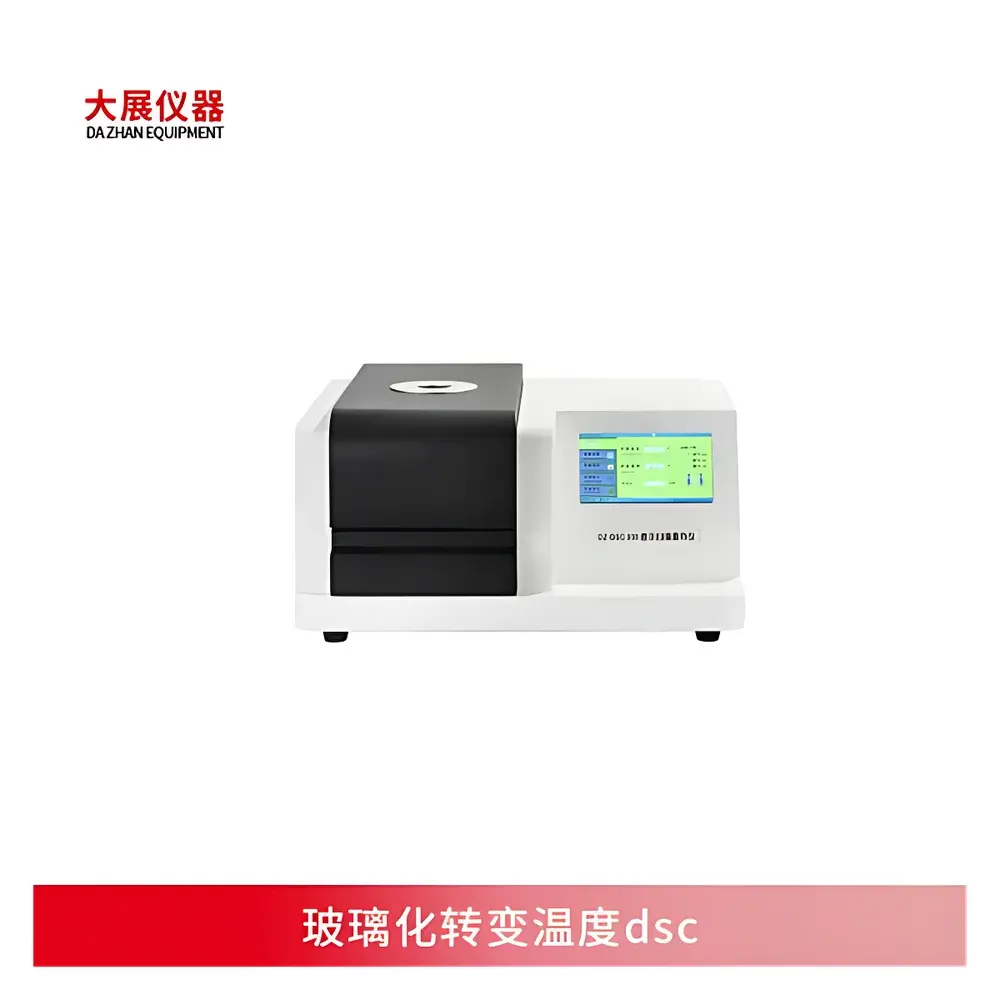
Nanjing Dazhan DZ-DSC300 Differential Scanning Calorimeter
| Brand | Nanjing Dazhan |
|---|---|
| Origin | Jiangsu, China |
| Manufacturer Type | Direct Manufacturer |
| Product Category | Domestic |
| Model | DZ-DSC300 |
| Sample Capacity | Single |
| Instrument Type | Differential Scanning Calorimeter (DSC) |
| Temperature Range | Ambient to 600 °C |
| Heating/Cooling Rate | 0.1–100 K/min |
| Temperature Accuracy | ±0.001 °C |
| Temperature Stability | ±0.01 °C |
| DSC Signal Range | 0 to ±600 mW |
| DSC Resolution | 0.01 µW |
| DSC Sensitivity | 0.001 mW |
| Gas Control | Dual-channel automatic switching (N₂, air, or inert gas), flow rate 0–300 mL/min (customizable), max pressure ≤5 MPa |
| Thermal Program | Up to six segments (heating/holding/cooling), fully programmable |
| Display | 7-inch 24-bit color capacitive touchscreen |
| Data Interface | Standard USB |
| Calibration Standards Included | Indium, tin, lead |
| Power Supply | AC 220 V / 50 Hz (optional customization) |
Overview
The Nanjing Dazhan DZ-DSC300 Differential Scanning Calorimeter is a high-precision thermal analysis instrument engineered for quantitative measurement of heat flow differences between a sample and reference as a function of temperature or time. It operates on the principle of heat-flux DSC, where thermopile-based sensors detect minute enthalpic changes during controlled thermal programs. The system is specifically optimized for determining glass transition temperature (Tg), melting point (Tm), crystallization onset and peak temperatures, cold crystallization, oxidative induction time (OIT), cure kinetics, and thermal stability profiles. Its ambient-to-600 °C operating range, sub-millikelvin temperature accuracy (±0.001 °C), and ultra-low DSC signal resolution (0.01 µW) enable reliable detection of subtle thermal events in polymers, pharmaceuticals, metals, ceramics, and biomaterials — critical for R&D, quality control, and regulatory documentation.
Key Features
- Integrated furnace architecture with triple-lid insulation design, minimizing thermal leakage and enhancing baseline stability across wide temperature ramps.
- Thermally fused sensor assembly replacing conventional spot-welded junctions — delivering improved signal-to-noise ratio and long-term calibration retention.
- Programmable multi-segment thermal control (up to six heating/holding/cooling steps) with independent rate and dwell parameter assignment per segment.
- Dual-gas manifold with automated switching logic, supporting inert (N₂, Ar), oxidative (air, O₂), or custom gas environments; flow regulated from 0 to 300 mL/min at ≤5 MPa inlet pressure.
- Embedded 7-inch 24-bit color capacitive touchscreen interface with real-time curve visualization, manual override capability, and local data storage via USB port.
- Shielded analog acquisition circuitry with EMI/RFI filtering to ensure signal integrity in shared laboratory environments.
- Factory-supplied NIST-traceable calibration standards (indium, tin, lead) and software-supported multi-point temperature calibration routine.
Sample Compatibility & Compliance
The DZ-DSC300 accommodates standard 40 µL aluminum crucibles (hermetic or vented), platinum, and ceramic pans — compatible with solids, powders, films, gels, and small-volume liquids (≤20 mg typical). It supports GLP-compliant workflows through audit-trail-enabled software (optional upgrade), with timestamped method files, raw data export in ASTM E1981-compliant ASCII format, and user-accessible metadata logging. While not pre-certified to ISO 11357 or ASTM E794/E1356 out-of-box, its thermal performance parameters meet the minimum requirements specified in those standards for Tg and Tm determination. Instrument validation documentation (IQ/OQ/PQ templates) is available upon request for GMP-regulated laboratories.
Software & Data Management
The DZ-DSC300 operates with Windows-compatible analytical software featuring real-time data acquisition, baseline subtraction algorithms (tangent, linear, polynomial), peak integration with onset/peak/endpoint marking, and comparative overlay of multiple runs. Export options include CSV, TXT, and image formats (PNG, PDF). Software supports FDA 21 CFR Part 11-ready configurations (user roles, electronic signatures, audit trail export) when deployed with validated IT infrastructure. All raw thermograms are stored with embedded instrument metadata (serial number, firmware version, calibration date, operator ID), enabling full traceability in regulated environments.
Applications
- Quantification of glass transition temperature (Tg) in amorphous polymers, thermosets, and pharmaceutical amorphous dispersions — essential for predicting mechanical behavior and shelf-life stability.
- Analysis of crystallinity evolution during annealing or processing via cold crystallization exotherms and melt enthalpy ratios.
- Determination of oxidative induction time (OIT) per ASTM D3895 to assess antioxidant efficacy in polyolefins and elastomers.
- Characterization of curing kinetics in epoxy, phenolic, and silicone resins using isothermal or dynamic DSC protocols.
- Thermal screening of active pharmaceutical ingredients (APIs) and excipients for polymorphic transitions, desolvation, and degradation onset.
- Phase diagram construction for metal alloys and intermetallic compounds via precise solidus/liquidus identification.
FAQ
What is the minimum detectable heat flow change?
The instrument achieves a DSC sensitivity of 0.001 mW and resolution of 0.01 µW under standard operating conditions (5 K/min ramp, Al pan, N₂ purge).
Can the DZ-DSC300 perform modulated DSC (MDSC)?
No — it is a conventional heat-flux DSC system. MDSC functionality requires additional hardware modulation control not included in this model.
Is temperature calibration traceable to national standards?
Yes — certified indium (Tm = 156.598 °C), tin (231.928 °C), and lead (327.494 °C) standards are supplied; users may perform multi-point calibration aligned with ISO 11357-1 Annex A.
Does the system support purge gas flow monitoring and logging?
Gas flow is manually set via external mass flow controller; real-time digital flow feedback is not integrated but can be added via third-party instrumentation interfaced through analog I/O ports.
What sample mass range is recommended for optimal signal-to-noise?
For most polymer and pharmaceutical applications, 5–15 mg provides optimal balance between sensitivity and thermal lag; metallic samples may require up to 30 mg depending on thermal conductivity.



