
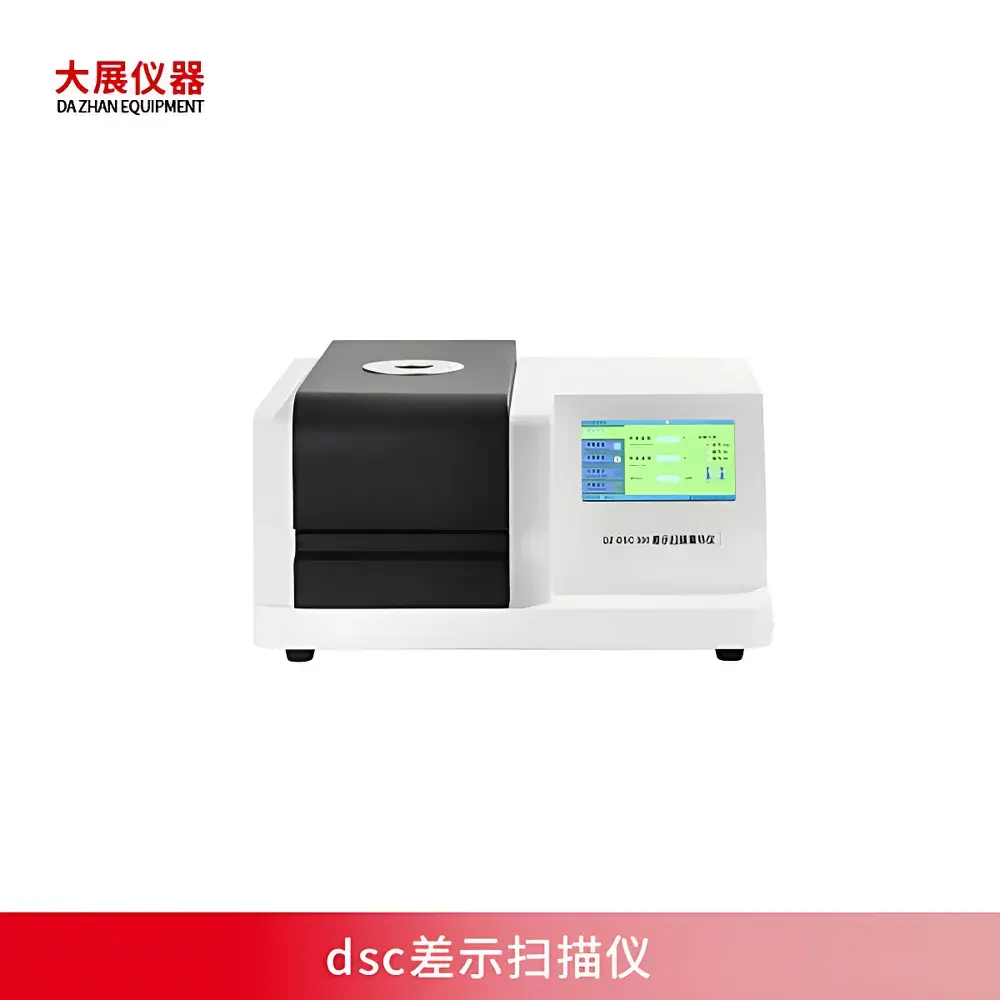
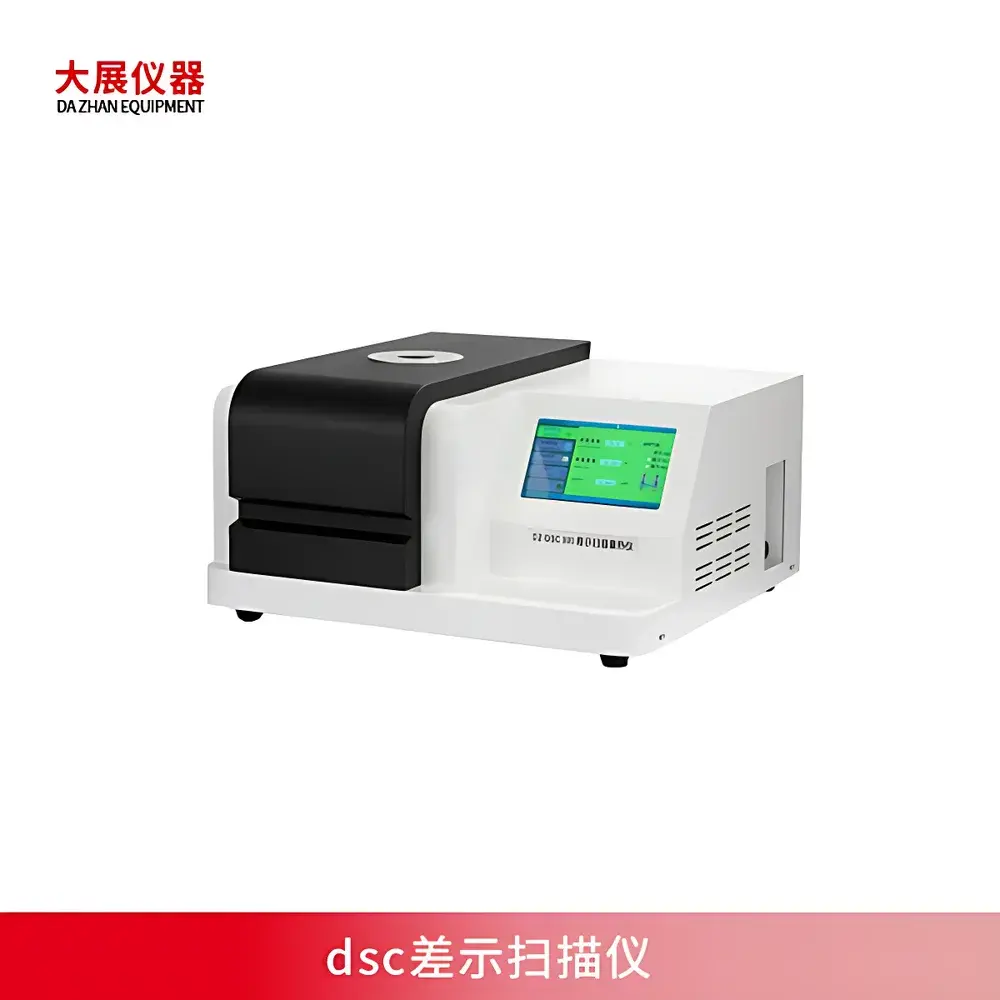
Nanjing Dazhan DZ-DSC300 Differential Scanning Calorimeter
| Brand | Nanjing Dazhan |
|---|---|
| Origin | Jiangsu, China |
| Manufacturer Type | Manufacturer |
| Product Category | Domestic |
| Model | DZ-DSC300 |
| Sample Capacity | Single |
| Instrument Type | DSC |
| Temperature Range | Ambient to 600 °C |
| Heating/Cooling Rate | 0.1–100 K/min |
| Temperature Accuracy | ±0.001 °C |
| DSC Signal Range | 0 to ±600 mW |
| Temperature Stability | ±0.01 °C |
| DSC Resolution | 0.01 µW |
| DSC Sensitivity | 0.001 mW |
| Gas Flow Control | Dual-channel automatic switching, 0–300 mL/min (customizable) |
| Gas Pressure Rating | ≤5 MPa |
| Display | 7-inch 24-bit color capacitive touchscreen |
| Data Interface | Standard USB |
| Calibration Standards Included | Indium, Tin, Lead |
| Software Features | Multi-point temperature calibration, six-segment programmable thermal profile |
Overview
The Nanjing Dazhan DZ-DSC300 Differential Scanning Calorimeter is a high-precision thermal analysis instrument engineered for quantitative measurement of heat flow differences between a sample and inert reference as a function of temperature or time. It operates on the principle of power-compensated DSC, where independent heaters maintain equal temperatures in sample and reference crucibles while dynamically adjusting power input to compensate for thermal events—enabling direct quantification of enthalpy changes with high baseline stability and signal fidelity. Designed for routine and research-grade thermal characterization, the DZ-DSC300 delivers reproducible detection of endothermic and exothermic transitions—including glass transition (Tg), cold crystallization, melting (Tm), recrystallization, solid-solid phase transitions, oxidative induction time (OIT), cure kinetics, and thermal degradation onset—across polymers, pharmaceuticals, metals, composites, and food matrices.
Key Features
- Integrated furnace architecture with triple-layer insulated lid design, minimizing radial heat loss and enhancing thermal homogeneity across the sensor platform.
- Thermally fused sensor assembly replacing conventional spot-welded junctions—improving thermal response time, long-term drift resistance, and signal-to-noise ratio.
- Programmable six-segment thermal profiles supporting complex ramp-hold-cool sequences, including multi-step isothermal holds and reverse-scan protocols for kinetic analysis.
- Dual-gas manifold with automated switching logic, enabling seamless transition between inert (N2, Ar) and reactive (O2, air) atmospheres during a single run—critical for oxidation stability and decomposition pathway studies.
- 24-bit high-resolution analog-to-digital conversion with active electromagnetic shielding on all signal acquisition circuits, ensuring robust performance in electromagnetically noisy laboratory environments.
- Embedded real-time control firmware paired with a responsive 7-inch capacitive touchscreen interface—supporting both standalone operation and synchronized remote control via PC-based software.
Sample Compatibility & Compliance
The DZ-DSC300 accommodates standard aluminum, gold-plated aluminum, and high-pressure stainless-steel crucibles (up to 10 MPa), compatible with solids, powders, films, gels, and small-volume liquids (≤30 µL). All thermal calibrations are traceable to NIST-certified reference materials (indium, tin, lead) included with each system. The instrument supports GLP-compliant workflows through audit-trail-enabled software logging, user-access controls, and electronic signature support. While not pre-certified to ISO 11357 or ASTM E794/E1269, its thermal accuracy (±0.001 °C), baseline repeatability (<0.01 µW RMS over 30 min), and controlled gas delivery meet the foundational metrological requirements for method validation under ISO/IEC 17025-accredited laboratories.
Software & Data Management
The bundled DSC Analysis Suite provides full control over instrument parameters, real-time thermogram visualization, and post-run evaluation using industry-standard peak integration, baseline correction, and kinetic modeling tools (e.g., Ozawa-Flynn-Wall, Kissinger, ASTM E698). Raw data is saved in vendor-neutral ASCII format (.txt) with metadata headers, facilitating import into MATLAB, Origin, or Python-based analysis pipelines. Software features include multi-point temperature calibration routines, automatic baseline subtraction algorithms, and customizable report templates compliant with internal QA documentation standards. All user actions—including method edits, calibration events, and data exports—are timestamped and logged with operator ID for regulatory review.
Applications
- Pharmaceutical development: Polymorph screening, amorphous content quantification, excipient compatibility assessment, and solid-state stability prediction under ICH Q1A–Q5E guidelines.
- Polymer science: Crystallinity determination (via enthalpy of fusion), crosslink density estimation, Tg mapping across processing conditions, and aging behavior under accelerated thermal stress.
- Materials engineering: Heat capacity (Cp) measurement via modulated DSC extension, phase diagram construction for metallic alloys, and thermal conductivity estimation from cooling rate dependence.
- Food science: Starch gelatinization kinetics, lipid polymorphism transitions, protein denaturation profiling, and shelf-life modeling based on Arrhenius-derived activation energies.
- Quality control: Batch-to-batch consistency verification of raw materials, finished products, and intermediates per USP , EP 2.2.42, or internal SOPs.
FAQ
What calibration standards are supplied with the DZ-DSC300?
Indium (Tm = 156.60 °C), tin (Tm = 231.93 °C), and lead (Tm = 327.50 °C) reference metals are included for temperature calibration; certified KNO3 or sapphire may be added optionally for heat capacity calibration.
Does the instrument support modulated DSC (MDSC) capability?
No—the DZ-DSC300 is configured as a conventional power-compensated DSC. MDSC functionality requires additional hardware modules and is not part of the base configuration.
Can the software generate 21 CFR Part 11-compliant audit trails?
The current software version provides full electronic logging of user activity, parameter changes, and calibration events. Full Part 11 compliance—including electronic signatures and role-based access control—requires optional validation package and IT infrastructure alignment per organizational SOPs.
What is the maximum recommended sample mass for optimal resolution?
For most organic and polymeric samples, 3–10 mg is optimal; for high-conductivity metals or highly exothermic reactions, ≤2 mg is recommended to avoid thermal lag and signal distortion.
Is remote monitoring possible via Ethernet or Wi-Fi?
The DZ-DSC300 communicates exclusively via USB 2.0. Network connectivity requires an external USB-to-Ethernet adapter configured at the host PC level; no native TCP/IP stack is embedded in the instrument firmware.



