
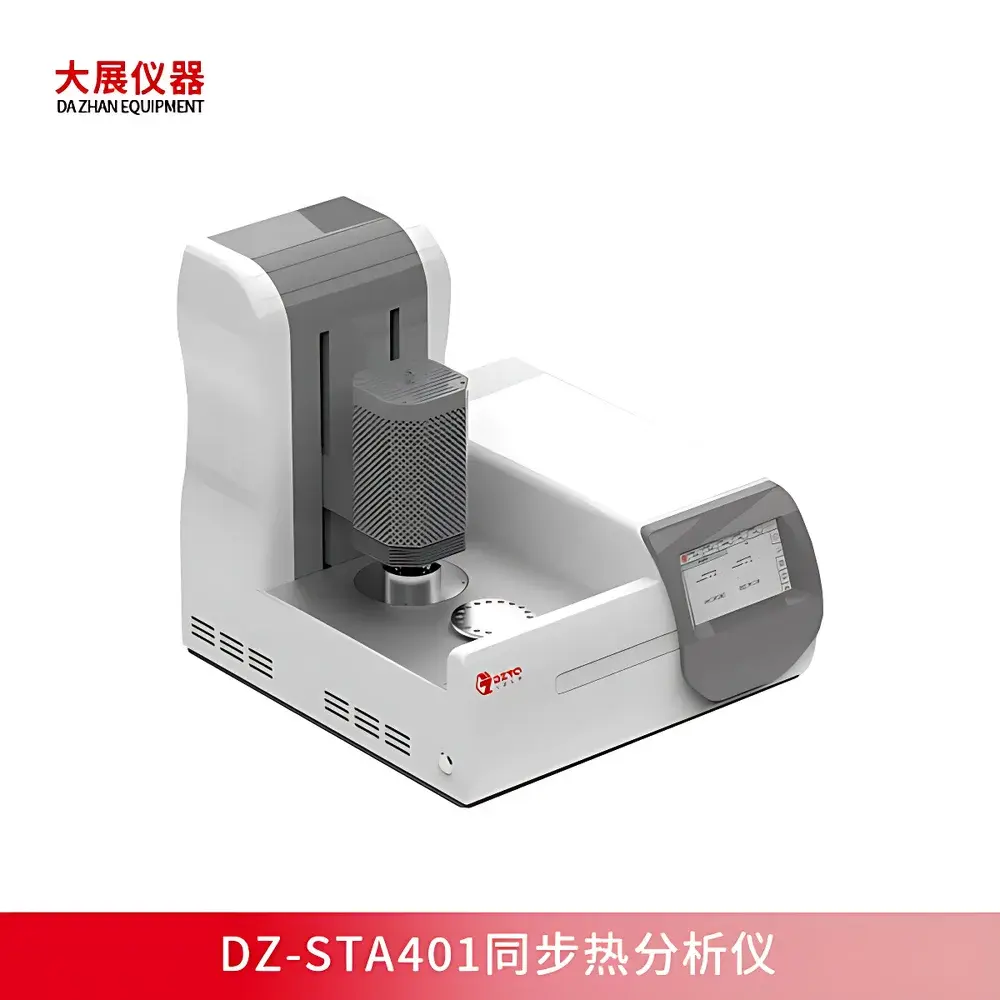
DAZHAN DZ-STA401 Automatic-Lift Simultaneous Thermal Analyzer (TG-DSC)
| Brand | DAZHAN |
|---|---|
| Origin | Jiangsu, China |
| Model | DZ-STA401 |
| Technique | TG-DSC |
| Temperature Range | Ambient to 1250 °C |
| Heating Rate | 0.1–100 °C/min |
| Temperature Stability | ±0.01 °C |
| Mass Resolution | 1 µg |
| Mass Range | 0.01 mg–3 g (expandable to 50 g) |
| Maximum Sample Capacity | 30 g |
| Atmosphere Control | Inert, oxidative, reductive |
| Gas Flow Control | Digital mass flow controller |
| Cooling Time (1000 °C → 50 °C) | ≤20 min |
| Temperature Resolution | 0.1 °C |
| DSC Sensitivity | ±1000 mW |
| Furnace Material | Dual-wound Pt-Rh alloy heating element |
| Sensor | High-purity noble metal alloy microbalance sensor |
| Thermal Insulation | Dual-layer vacuum-insulated furnace housing |
| Integration Capability | FTIR coupling interface compliant with standard gas outlet port |
Overview
The DAZHAN DZ-STA401 Automatic-Lift Simultaneous Thermal Analyzer is a precision-engineered instrument designed for concurrent thermogravimetric analysis (TGA) and differential scanning calorimetry (DSC) measurements under controlled atmospheric conditions. Based on the principle of simultaneous mass and heat flow detection, the system employs a high-stability microbalance and calibrated thermocouple array to capture real-time changes in sample mass and thermal energy absorption/release during programmed temperature ramps. Its core architecture integrates a dual-wound platinum-rhodium (Pt-Rh) furnace capable of sustained operation up to 1250 °C, coupled with an actively cooled, vibration-isolated balance platform. The automatic vertical lift mechanism enables rapid thermal decoupling between furnace and sensor—reducing thermal lag and enabling faster cooling cycles (≤20 min from 1000 °C to 50 °C)—while minimizing mechanical stress on the microbalance during loading/unloading. This design supports rigorous compliance with ISO 11358, ASTM E1131, and USP for thermal stability and decomposition kinetics studies.
Key Features
- Automated furnace lift mechanism for safe, repeatable sample insertion and accelerated thermal equilibration
- Dual-layer vacuum-insulated furnace housing ensuring superior temperature linearity and reduced radial thermal gradients
- High-fidelity microbalance with 1 µg resolution and 3 g nominal capacity (extendable to 50 g), fabricated from corrosion-resistant noble metal alloys
- Digital mass flow controller enabling precise, programmable gas delivery for inert (N₂, Ar), oxidative (air, O₂), or reductive (H₂/N₂ mix) atmospheres—static or dynamic
- Intelligent PID temperature control with ±0.01 °C stability and 0.1–100 °C/min adjustable ramp rates
- Integrated FTIR coupling port with heated transfer line compatibility for evolved gas analysis (EGA)
- Electrically isolated power supply and dedicated air-cooled circulation module to eliminate electromagnetic and thermal interference on the weighing system
Sample Compatibility & Compliance
The DZ-STA401 accommodates solid, powder, and thin-film specimens up to 30 g, supporting crucibles of alumina, platinum, or graphite depending on thermal and chemical compatibility requirements. It meets essential functional criteria for GLP/GMP environments: audit-trail-enabled software logging, user-access-level permissions, and electronic signature support aligned with FDA 21 CFR Part 11 principles. Data output conforms to ASTM E1957-compliant TGA/DSC reporting templates, including derivative thermogravimetry (DTG), peak onset/midpoint/offset temperatures, enthalpy integration, and kinetic parameter extraction (e.g., Arrhenius, Ozawa-Flynn-Wall). All thermal calibrations are traceable to NIST-certified reference materials (e.g., Ni, In, Zn, Al₂O₃).
Software & Data Management
The proprietary STAControl™ software provides full instrument control, real-time dual-channel visualization (mass vs. time/temperature and heat flow vs. temperature), and post-acquisition analysis modules for baseline correction, peak deconvolution, multi-step kinetic modeling (ASTM E698, Friedman, Kissinger-Akahira-Sunose), and comparative overlay of up to 16 curves. Raw data are stored in vendor-neutral ASCII (.txt) and universal .tdms formats, compatible with MATLAB, OriginLab, and Python-based scientific computing pipelines. Automated report generation includes metadata stamping (operator ID, calibration date, atmosphere log), compliance-ready PDF export, and optional LIMS integration via OPC UA protocol.
Applications
- Thermal stability assessment of polymers, pharmaceuticals, and battery cathode materials under oxidative aging conditions
- Decomposition kinetics modeling for catalysts, metal-organic frameworks (MOFs), and energetic materials
- Quantification of filler content, moisture loss, and organic/inorganic residue in composites and ceramics
- Phase transition analysis—including glass transition (Tg), cold crystallization (Tcc), melting (Tm), and solid-state polymorphic transitions
- Corrosion behavior evaluation of alloys in simulated service environments (e.g., sulfidation, oxidation kinetics)
- Reaction enthalpy determination for solid-state synthesis and catalytic redox processes
- Evolved gas analysis (EGA) when interfaced with FTIR or MS systems for mechanistic reaction pathway elucidation
FAQ
What types of atmospheres can be used with the DZ-STA401?
Inert (N₂, Ar), oxidative (air, O₂), and reductive (5% H₂/95% N₂) gases are supported in both static and dynamic flow modes, with flow rates digitally regulated from 0–200 mL/min.
Is the instrument suitable for GMP-regulated pharmaceutical testing?
Yes—software features include audit trail, user authentication, electronic signatures, and 21 CFR Part 11–compliant data integrity controls.
Can the DZ-STA401 perform kinetic analysis of decomposition reactions?
Yes—integrated models include ASTM E698, Friedman, Kissinger, and Ozawa-Flynn-Wall methods, with activation energy and pre-exponential factor derivation directly from multiple heating-rate experiments.
How does the automatic lift function improve measurement reproducibility?
By eliminating manual furnace handling, it ensures consistent sensor-to-sample geometry, minimizes thermal shock to the microbalance, and reduces operator-induced variability in sample positioning and thermal contact.
What is the maximum recommended sample mass for high-accuracy DSC measurements?
For optimal signal-to-noise ratio and thermal homogeneity, samples ≤10 mg are recommended for quantitative DSC; larger masses (up to 30 g) are permissible for TGA-dominant applications where mass change sensitivity remains critical.
Related Products



